

Since Anthropic’s IPO may be imminent, I thought now would be a good time to revisit the question of why Effective Altruism is terrible. Anthropic is basically an EA organization (Dario Amodei was among the very first EAs), and consequently the IPO will result in a massive influx of billions and billions of dollars to EA. That should worry us.
“Effective Altruism is the devil,” a colleague at the Centre for the Study of Existential Risk (CSER) told me in 2019. I strongly disagreed at the time, though just a few months later, I was basically on board. This article outlines some of the reasons that Effective Altruism (EA) is a dangerous cult that’s caused a great deal of harm in the world.
Related:
Effective Altruism Is a Dangerous Cult — Here's Why

My apologies for this article being so long. It aims to provide an in-depth examination of the ways in which the Effective Altruism movement instantiates a cult. I hope you find it interesting and useful!
EA Televangelists
The most obvious thing to mention is that EA produced Sam Bankman-Fried (SBF). In 2012, SBF went to lunch with William MacAskill, who became his moral advisor. MacAskill convinced SBF to pursue an “earn to give” career path, invented by EA, whereby one might work for what MacAskill himself calls “immoral organizations” — Wall Street firms, petrochemical companies, etc. — to give more to charity. Forget your moral integrity, what matters are the overall consequences of your actions. If you participate in something “immoral,” that’s perfectly fine if it means more money for EA-approved charities.
SBF then got a job at Jane Street Capital (in the news a while back for insider trading and market manipulation1), then worked at MacAskill’s Centre for Effective Altruism for a year, after which he went into crypto (which he once described as basically a Ponzi scheme). He did this to “get filthy rich, for charity’s sake” — something that MacAskill personally encouraged him to do. SBF is now serving a 25-year sentence in federal prison.
To help SBF gain ever-more wealth and power, MacAskill along with many other EAs intentionally spread lies about SBF’s humble lifestyle. They repeated the myth that SBF lives modestly, when in fact he was flying on private jets, living in a $35 million penthouse, and owned $300 million in Bahamian real estate. He even bought his parents a $16.4 million vacation home.
MacAskill and others also habitually misled the public about their own modesty. On The Daily Show, MacAskill boasted of giving away half of his income while promoting his book What We Owe the Future. What he didn’t mention is that his billionaire buddies had given him a budget of literally $10 million (!!!) just to promote the book, and he was paying one PR firm (of several) $12,000 per month for help. (A whistleblower at one of these firms shared this information with me and the Washington Post because she said no one had ever before heard of a $10m budget ceiling, which they felt was hypocritical given MacAskill’s claim to modesty.)
Nor did MacAskill mention that he celebrated the release of his book at an “ultra-luxurious vegan restaurant where the tasting menu runs $438 per person with tip, before tax.” These people boast of being more “effectively” altruistic than the rest of us — they are morally better people — yet behind the scenes they’re living it up in private jets, in sumptuous mansions, and at luxurious restaurants.
Read more: Fraud, Lies, Exploitation and Eugenic Fantasies: The multibillion-dollar Effective Altruism movement makes rich people feel good about being rich — to hell with the bad publicity.
Even more, the umbrella organization of CEA, Effective Ventures, had secretly bought a literal castle in Oxfordshire for a whopping $18.5 million. Most people in the EA community only found out about this because I tweeted about the hypocrisy, later comparing EA and its leaders to televangelists who preach one thing while privately living in huge mansions and flying on private jets.
When asked about this castle, a New Yorker journalist summarized their argument as follows: “The math could work out: it was a canny investment to spend thousands of dollars to recruit the next Sam Bankman-Fried.” This wasn’t even the only sumptuous edifice the community bought: there was also a chateau in the Czech Republic, purchased with money from Bankman-Fried.


In early 2022, MacAskill shared private messages with Elon Musk, in which he tried to convince Musk to buy Twitter with SBF. Later that year, SBF’s fraud became public. To this day, I don’t believe that MacAskill has once said he regrets having fostered a friendship with Musk, one of the most evil people on Earth.

EA Leaves Poor People More Hopeless Than Ever
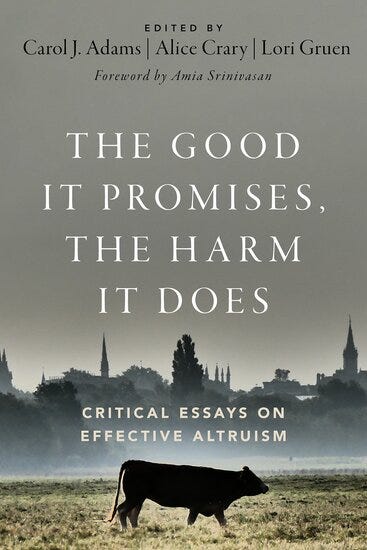
EA has had a devastating impact on non-EA animal rights activists, and has left many people in the Global South even more hopeless than they previously were. The first issue is discussed in The Good It Promises, The Harm It Does, so I won’t examine it here. With respect to the second, EA is notably worse than traditional philanthropy — and traditional philanthropy is very bad.
The premise of traditional philanthropy is that wealthy (almost always white) people in the Global North should transfer some amount of wealth to the Global South while retaining all the relevant decision-making power. They decide who gets money, how it will be used, where it goes, when it’s transferred, and so on. They decide if money will be spent building a new school, paving a road, buying books, deworming children, or distributing anti-malarial bed nets.
This approach is deeply flawed because those in the Global North have no ground-level knowledge of the root causes of poverty in particular regions. They impose a “one-size fits all” model that completely ignores the fact that poverty may be caused by different phenomena in different regions (obviously).
However, at least sometimes traditional philanthropy will transfer both wealth and power to the Global South by funding grassroots organizations run by people with the necessary lived experienced to determine the actual best way to use resources. EA, in contrast, will never do this. That’s because EA “evaluates” charities according to an extremely narrow, impoverished, quantitative metric. If you can’t precisely calculate how many lives are “saved” by an intervention, then that intervention will never ever get funded.
Consider Anthony Kalulu, a farmer in one of Uganda’s poorest regions.
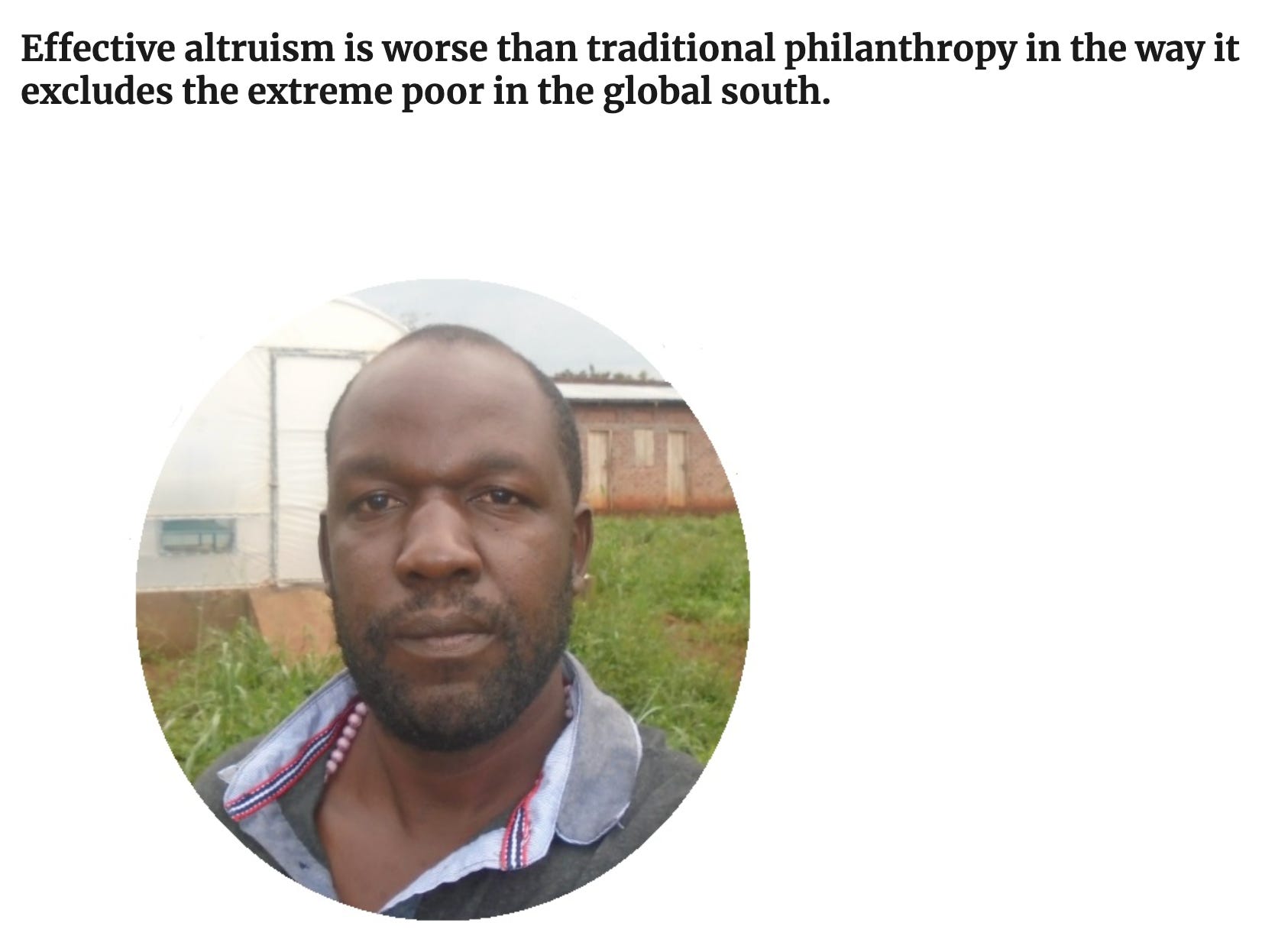
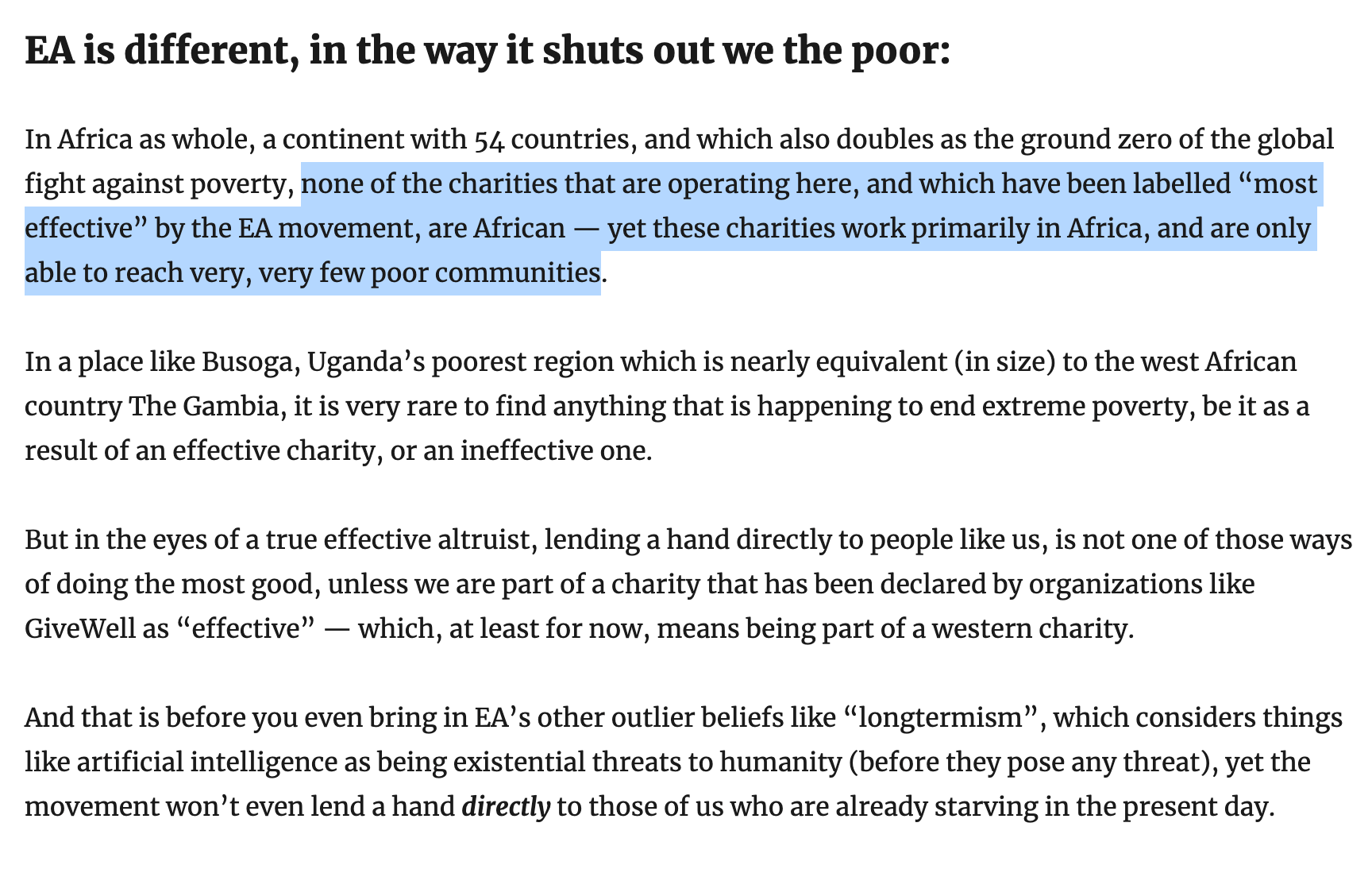
Having lived there all his life, he knows that what people need is a food processing plant that will distribute crops to ready markets. He’s requesting several million dollars to build this plant, and repeatedly pleaded with EAs to help. He even asked them to simply retweet his request — only a single person out of about 100 did, because the rest told him that his grassroots organization, the Uganda Community Farm, isn’t “effective.” And it’s not “effective” because Kalulu has no way of quantifying the exact number of people who will be saved by the food processing plant. This is why he wrote in a blog post that EA makes him feel even more hopeless than before.
No One Knows How Many Lives EA has “Saved”
EAs like to boast that they’ve saved 150,000 lives thus far. But they never ask how many lives would have been saved if EA had never existed. They love to talk about “counterfactuals” (the basis of MacAskill’s argument for taking lucrative jobs at “immoral organizations”), but refuse to ask basic counterfactual questions when assessing the impact of EA — because doing so would reveal that EA might actually have done more harm than good.
To quote a former OpenAI employee who, like me, enthusiastically joined the EA community but later fled, “all the ‘good [EA]s’ I know were obviously altruist angels even as kids, ea did nothing for them they were going to try and help the world anyway if it never existed” (see below). He now considers himself to be “antiea radicalized.”
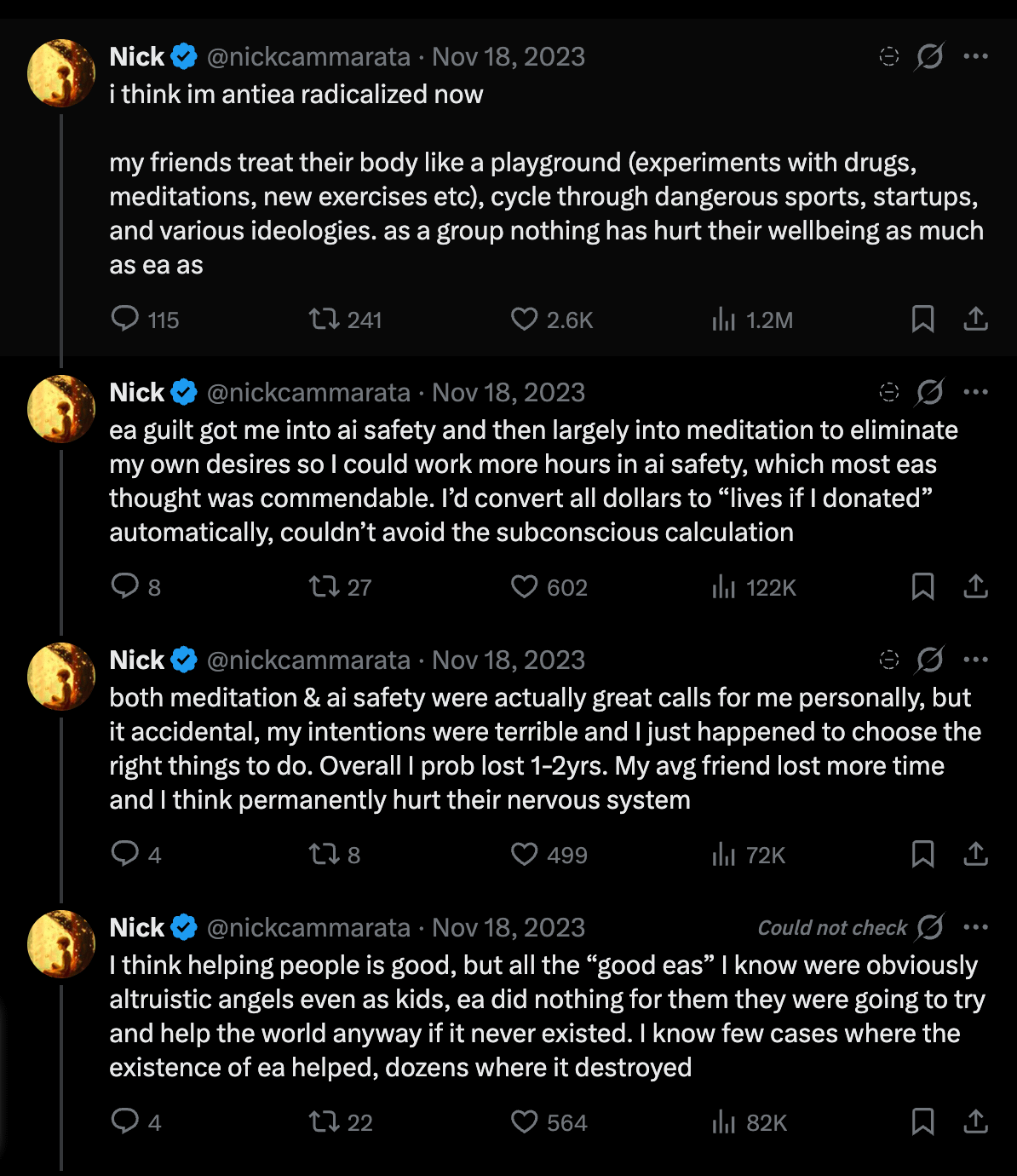
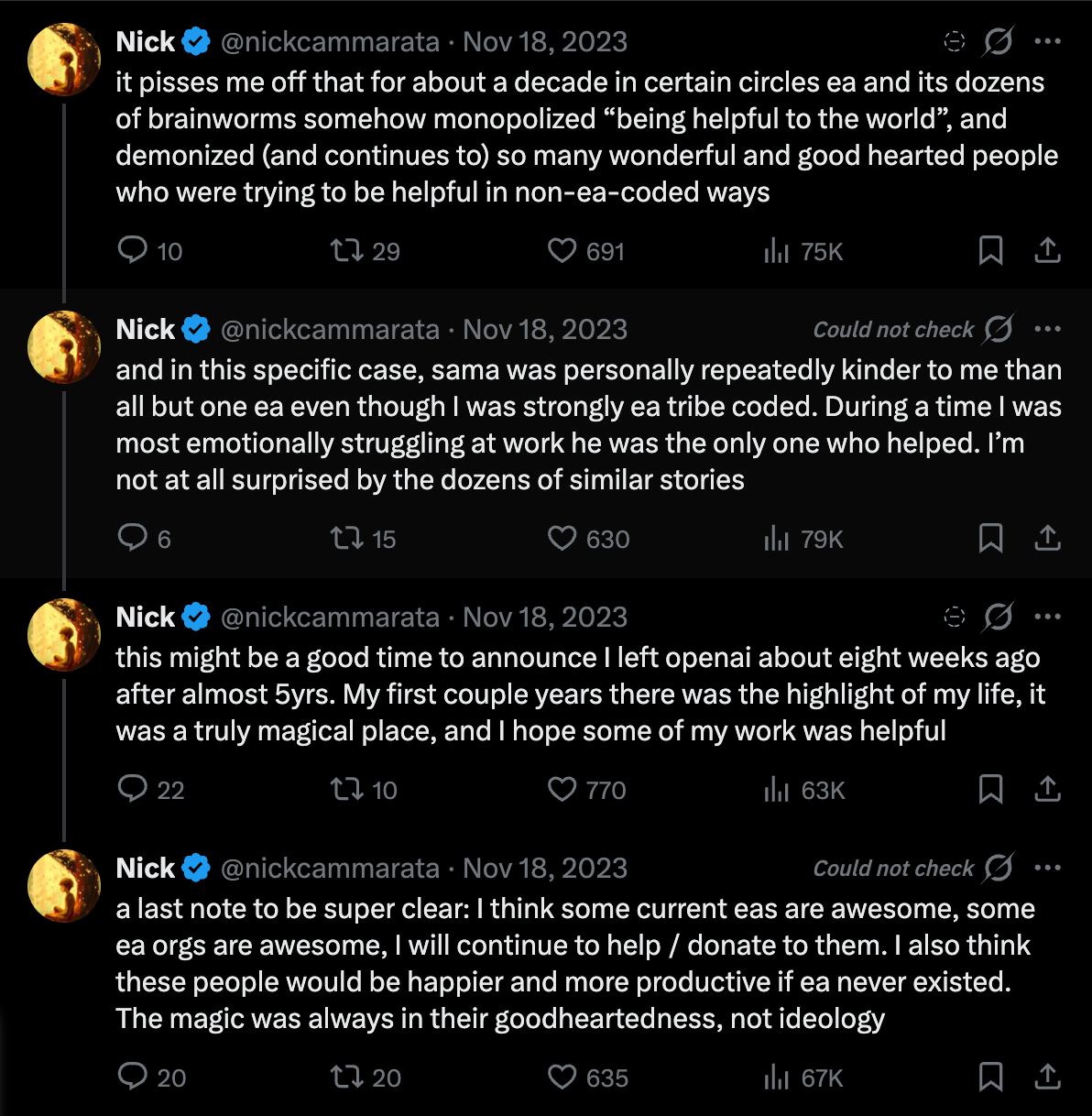
The implication, which I think is correct, is that you can’t praise EA for people donating their disposable incomes to charity, as they would have done so anyway. I myself am 100% committed to donating nearly all of my disposable income, and I think EA is complete bullshit.
He adds that EA hurts the wellbeing of members, guilts people into pursuing “AI safety” research, pressures people to work insane hours, makes people less happy and productive than “if ea never existed,” and demonizes “so many wonderful and good hearted people who were trying to be helpful in non-ea-coded ways.”
EA Is Just Capitalism Applied to Ethics
Even more, it’s crucial to note that EAs don’t actually give a shit about poor people themselves. That is, they don’t care about anyone as a moral end, as beings who matter for their own sake. The reason is that EA is deeply influenced by utilitarianism — as Toby Ord notes here — and utilitarianism cares about other people only insofar as those people contribute to maximizing “value,” e.g., pleasure or happiness.
On the utilitarian view, the entire domain of ethics is reduced to a branch of economics. Value is quantifiable, people are merely the fungible “containers” of value, and ethics is literally nothing more than number-crunching. If utilitarian EAs were to suddenly find that helping the global poor isn’t the best way to maximize value, they would no doubt kick the poor into the gutter without a second thought.
In contrast, my commitment to donating is based on a genuine concern for people as ends in themselves. It’s because people are ends that I want to help them, not because helping them maximizes some abstract thing called “value,” which no one can even define.
Utilitarianism — and EA — is just capitalism in disguise. Capitalists want to maximize profit, whereas utilitarians — and EAs — want to maximize “moral value.” This parallel isn’t a coincidence: both emerged at the very same time (latter 19th century) in the very same place (the UK). If you’re a capitalist who sees human beings as fungible cogs in the machine and you like the idea of maximization as the ultimate goal (“more, more, more — always more!”), then EA will appeal to you.
An Example
For a startling example of this quantitative, impersonal approach — morality as mathematics, ethics as capitalism — consider a prominent EA who tweeted this2:
People ask me if I like Musk. To me, Musk is too big and far away to like or dislike. He’s like a Greek deity. To be feared and treated careful. I love some of what he’s done, detest other bits.
Like him? Who cares.
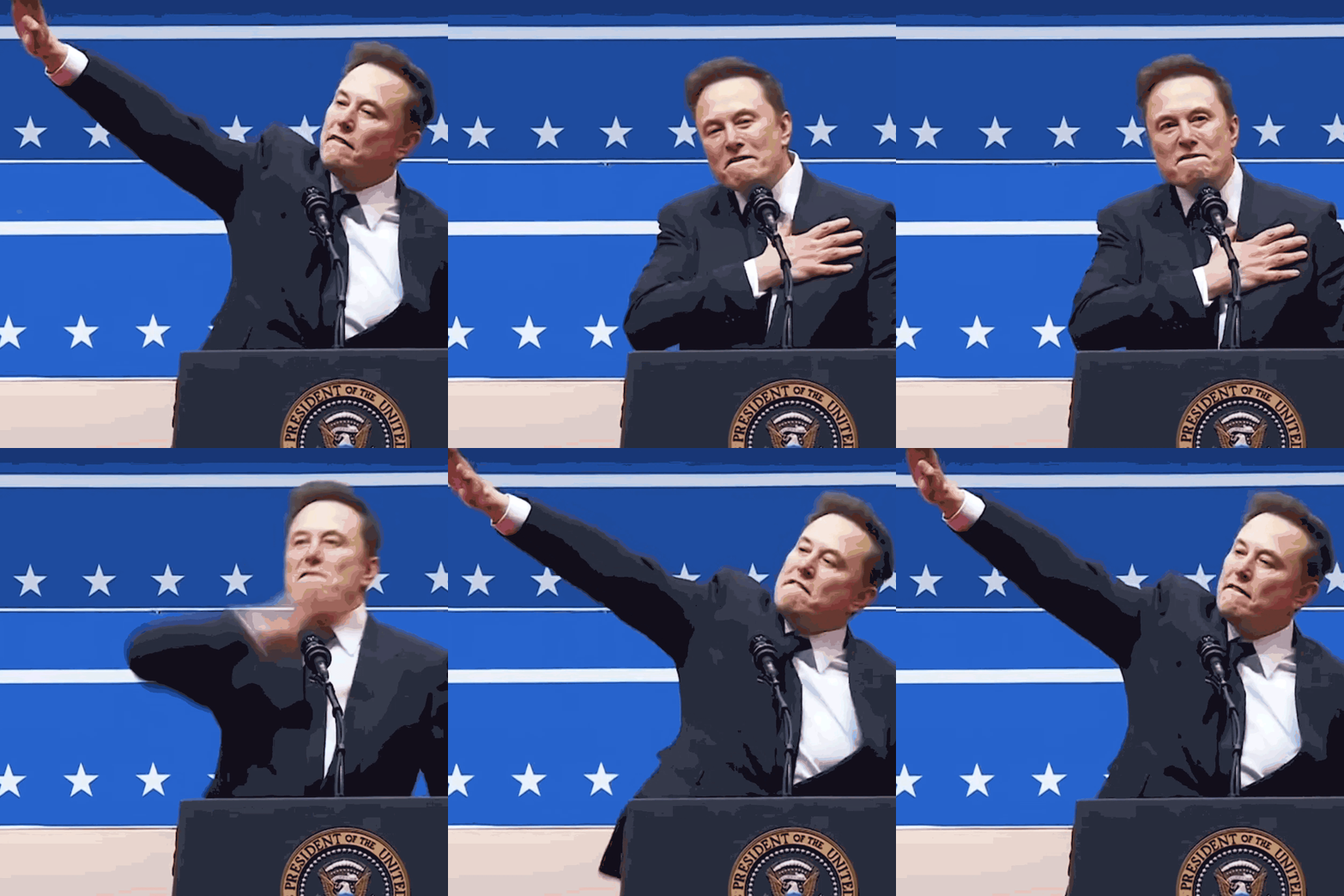
What do you mean, who cares? Musk terminated USAID, causing an extra 14 million deaths between now and 2030. He’s propped up fascists in Washington, and twice gave a Nazi salute to MAGA supporters. He allowed Grok to spread 3 million sexualized images of women without their consent, including 23,000 that “appear to depict children.” He’s been accused of exposing his penis to a SpaceX flight attendant, who SpaceX then paid $250,000 to keep quiet. He begged Jeffrey Epstein to let him visit Epstein Island. He called a guy trying to help children trapped in a Thailand cage a “pedo” without evidence. He routinely spouts sexist, racist, transphobic nonsense on social media. He supports the far-right in Germany and the UK. And so on.
I responded to this EA with stats about the consequences of terminating USAID, and then sardonically asked: “What are your thoughts about Ted Bundy?” The EA replied: “Seems like a footnote compared to how many he will kill/help with AI.”
Think about the amorality of this line of reasoning. For utilitarians and capitalists, what matters are the numbers — and only the numbers. There is nothing intrinsically wrong with any act, including lying, cheating, defrauding, murdering, or even committing a genocide.3 Hence, if Musk were to build an ASI that creates a huge population of “happy” digital space brains spread throughout the universe, then overall he will have come out a morally good person.
That’s why I brought up Bundy, who killed perhaps 100 women. But if Bundy had also saved 101 women, utilitarians would have to say he was overall a good person — all other things being equal. If Hitler had saved 6.5 million Jews, the same atrocious conclusion would follow. Utilitarianism is an “ethical” theory for sociopaths.
Consider the philosopher Derek Parfit, who I’d call the Grandfather of Longtermism. Parfit was greatly influenced by utilitarianism, and even delivered a talk at an Oxford EA conference. Years back, someone showed him a video in which Hitler danced a little jig after the Nazis overtook Paris. Parfit responded something to the effect of: “Well, at least a moment of happiness for someone came out of that great tragedy.”
In other words, a scenario in which France was conquered and Hitler didn’t dance with joy is worse than one in which France was conquered and Hitler did dance. That’s because the second scenario includes a few extra utils (units of utility, value, or wellbeing) produced by Hitler, thus making it better. For utilitarians, all that matters is the total amount of value, assessed from an impersonal perspective they call “the point of view of the universe.”
Even if the former trillionaire (Musk) were to do “great good” in the future (which he won’t, of course), that doesn’t somehow “make up” for the unforgivable things he’s already done without compunction — like murdering 14 million people. For EAs, everything is transactional. Every person is a means to an end. Ethics is nothing more than a perfunctory calculation. This is a deeply impoverished and extremely dangerous way of thinking about ethics. Yet it underlies the entire project of EA.
Peter Thiel giving the keynote address at an EA conference:
Eugenics and the Destruction of Nature
EAs are pretty cozy with eugenics. Some have explicitly defended it, including a prominent member (who, as it happens, has made transphobic remarks targeting me). Others have cited the race science advocate Charles Murray. The most prominent EA aside from SBF and MacAskill, Peter Singer, literally argued in his 1986 book Should the Baby Live? The Problem of Handicapped Infants that we should kill infants with cognitive disabilities, in part because they’re a burden on society.
MacAskill himself says that to keep the economy roaring, we should use genetic engineering to design super-babies in the laboratory or just replace workers with AGIs (a radical form of eugenics).
He’s also literally argued — using the exact same utilitarian reasoning as Singer — that our systematic obliteration of the biosphere may be net positive, because most wild animals have lives, he claims, that are “morally” worthless. Hence, the fewer wild animals there are, the less total wild-animal suffering. Since wild animals are bringing down the total amount of positive value in the world, it may be overall good that we’re poisoning the rivers, razing forests, polluting the ocean, and flooding the atmosphere with heat-trapping CO2.

The main concern re: climate change, by the way, is that if we keep using up oil, and if civilization collapses, there might not be enough oil remaining to rebuild industrial society. That’s what MacAskill suggests. Why rebuild industrial society if it collapses? Because it’s probably necessary to reach the stars, and the stars are where most future value will reside (see “longtermism” below).
MacAskill also says in his book that “even with fifteen degrees of warming, the heat would not pass lethal limits for crops in most regions.” (Lol.) Global agriculture would survive, according to him, which every expert I spoke to for an article in the Bulletin of the Atomic Scientists described as outrageous nonsense. EAs, in my experience, are happy to accept unjustified claims if they support their narratives.
Back to eugenics, many EAs are concerned about so-called “existential risks.” Some see existential risk mitigation as the most “effective” form of “philanthropy,” meaning that anything not directed at mitigating existential risk is a waste of resources.
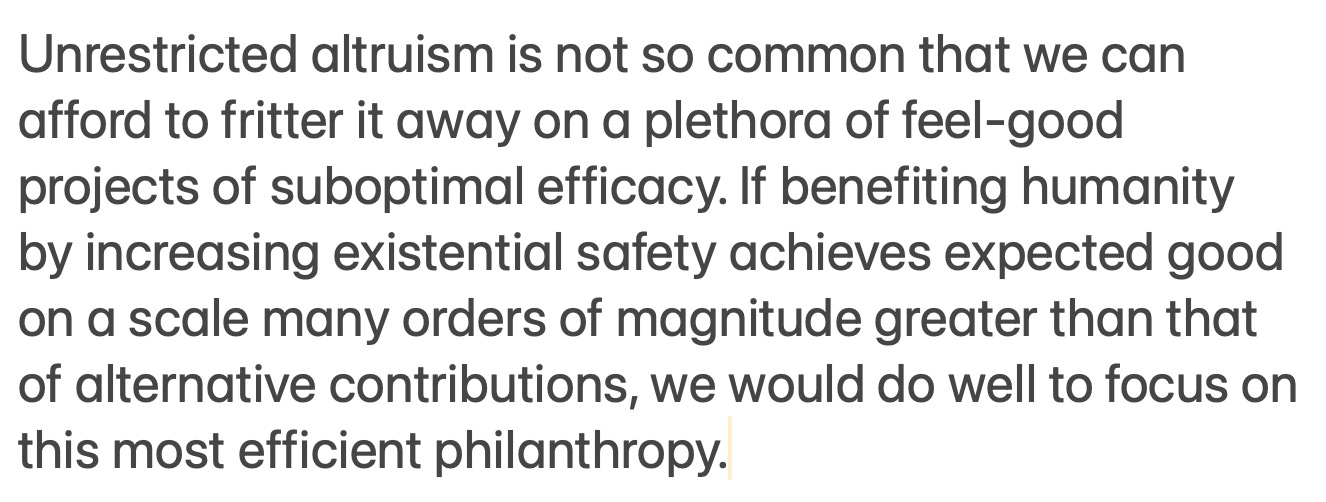
The guy who introduced the idea of existential risk, Nick Bostrom, founded the Future of Humanity Institute (FHI), which shared office space with the Centre for Effective Altruism (CEA) before FHI was shut down.
One of the existential risk scenarios that Bostrom highlights is “dysgenic pressures,” whereby “less intelligent” people outbreed their more intelligent peers. Since building technology that enables us to flee Earth will require intelligence, too many “unintelligent” people could pose an existential risk.
In 2022, I stumbled upon an old email in which Bostrom asserts that “Blacks are more stupid than whites,” after which he writes the N-word. Some EAs defended this email, because Bostrom was after all just being honest. This email appears to have played a part in Oxford University terminating the FHI in 2024.
IQ Worship
Along similar lines, EAs worship IQ. Most are IQ realists, which Bryan Caplan calls “a scary bunch.” Some internal surveys of the EA community even ask people for their IQ, and Carla Cremer, a former EA, notes that “the reputation of an EA correlates strongly with his perceived intelligence.”
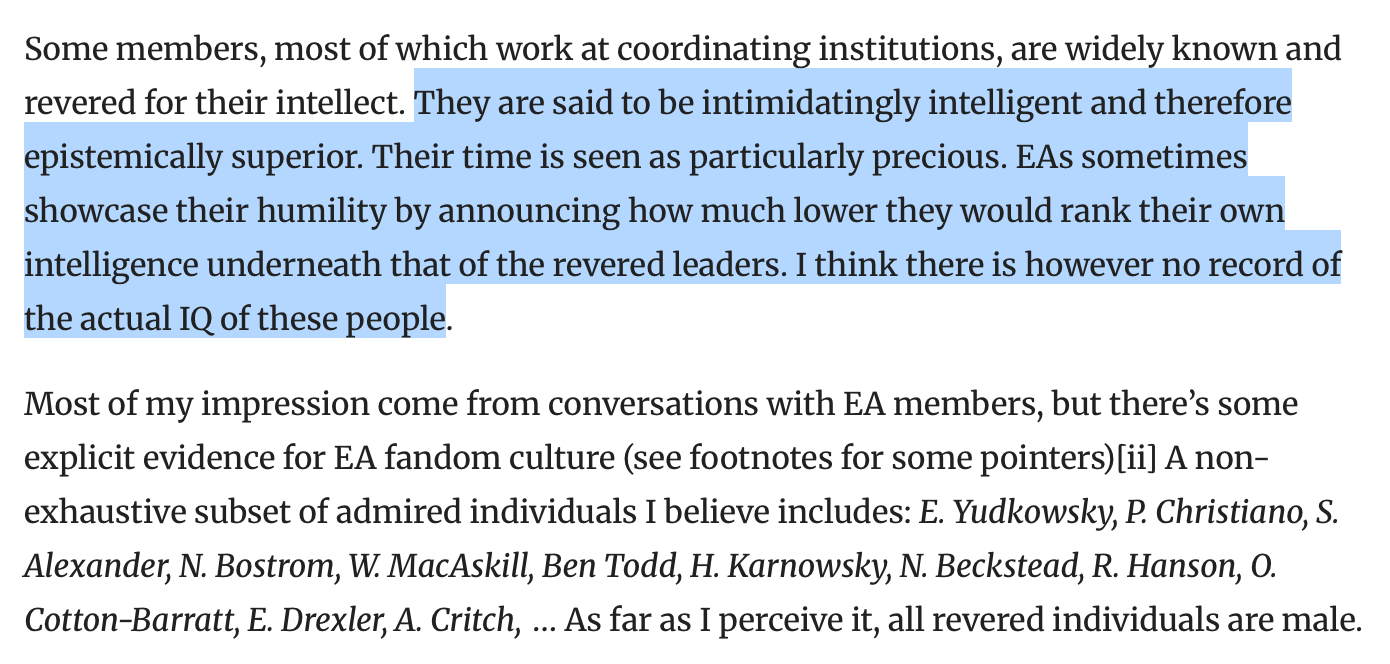
In 2023, Cremer revealed that CEA had secretly tested an internal ranking system called “PELTIV.” EA members with IQs lower than 100 would get PELTIV points subtracted, while those with IQs above 120 would get them added.
Note that IQ was developed in the 20th century by white eugenicists who used it, in part, to “justify” anti-miscegenation laws, anti-immigration laws, and other racist policies. IQ is a terrible measure of “intelligence,” and it encourages hierarchical thinking whereby certain humans are ranked above others along a single, linear, one-dimensional axis. In many ways, it embodies the same highly simplistic mode of thinking found in utilitarianism, according to which the goodness or badness of outcomes can be ranked by how much “value” they contain.
The Scientology of Silicon Valley: EA Is Run Like a Cult
The cultishness of EA is evidenced by the myths they spread about how exceptional their leaders are, their decision to secretly buy a castle, the PELTIV ranking system, and so on. Even EAs themselves worry about the community’s cultishness. Here’s what one wrote on the EA Forum (this is worth reading in full):
What if I told you about a group of people calling themselves Effective Altruists (EAs) who wish to spread their movement to every corner of the world. Members of this movement spend a lot of money and energy on converting more people into their ideology (they call it community building). They tend to target young people, especially university students (and increasingly high school students). They give away free books written by their gurus and run fellowship programs. And they will gladly pay all the expenses for newcomers to travel and attend their events so that they can expose them to their ideas.
EAs are encouraged to consult the doctrine and other movement members about most major life decisions, including what to do for a living (career consultation), how to spend their money (donation advice), and what to do with their spare time (volunteering). After joining the movement, EAs are encouraged to give away 10% or more of their income to support the movement and its projects. It’s not uncommon for EAs to socialize and live mostly with other EAs (some will get subsidized EA housing). Some EAs want even their romantic partners to be members of the community.
While they tend to dismiss what’s considered common sense by normal mainstream society, EAs will easily embrace very weird-sounding ideas once endorsed by the movement and its leaders.
Many EAs believe that the world as we know it may soon come to an end and that humanity is under existential threat. They believe that most normal people are totally blind to the danger. EAs, on the other hand, have a special role in preventing the apocalypse, and only through incredible efforts can the world be saved. Many of these EAs describe their aspirations in utopian terms, declaring that an ideal world free of aging and death is waiting for us if we take the right actions. To save the world and navigate the future of humanity, EAs often talk about the need to influence governments and public opinion to match their beliefs.
Many EAs are also afraid to publicly criticize the community and its broadly authoritarian structure (see: epistocracy). A group of ~10 EAs, going by ConcernedEAs, published an EA Forum article about how the community should be more democratic. They did this anonymously because, as they said, they were worried about losing funding, being ostracized, their career being negatively impacted, etc. — all for merely expressing views that other EAs, especially those in leadership positions, might disagree with.
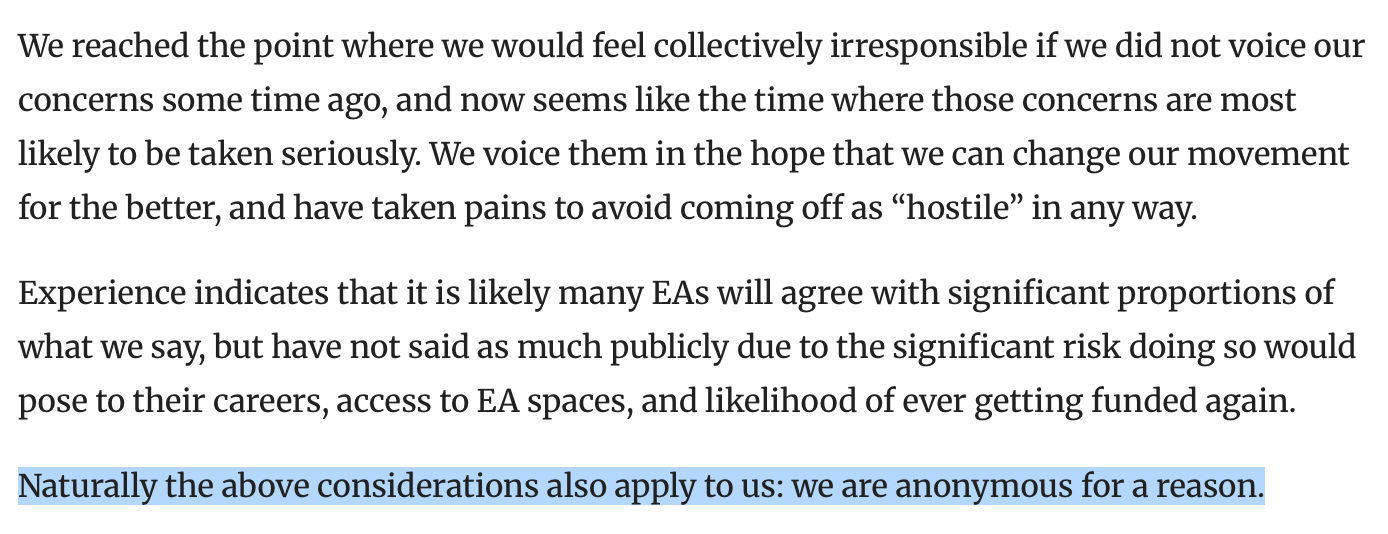
In 2021, Cremer and Luke Kemp published an article critical of the techno-utopian ideology of EA. Here’s how Cremer described the process:
It could be a promising sign for epistemic health that the critiques of leading voices come from early career researchers within the community. Unfortunately, the creation of this paper has not signalled epistemic health. It has been the most emotionally draining paper we have ever written.
We lost sleep, time, friends, collaborators, and mentors because we disagreed on: whether this work should be published, whether potential EA funders would decide against funding us and the institutions we’re affiliated with, and whether the authors whose work we critique would be upset. …
The EA community prides itself on being able to invite and process criticism. However, warm welcome of criticism was certainly not our experience in writing this paper. …
We were told by some that our critique is invalid because the community is already very cognitively diverse and in fact welcomes criticism. They also told us that there is no TUA [techno-utopianism], and if the approach does exist then it certainly isn’t dominant. It was these same people that then tried to prevent this paper from being published. They did so largely out of fear that publishing might offend key funders who are aligned with the TUA.
These individuals — often senior scholars within the field — told us in private that they were concerned that any critique of central figures in EA would result in an inability to secure funding from EA sources, such as OpenPhilanthropy. We don’t know if these concerns are warranted. Nonetheless, any field that operates under such a chilling effect is neither free nor fair. Having a handful of wealthy donors and their advisors dictate the evolution of an entire field is bad epistemics at best and corruption at worst.
The greatest predictor of how negatively a reviewer would react to the paper was their personal identification with EA. Writing a critical piece should not incur negative consequences on one’s career options, personal life, and social connections in a community that is supposedly great at inviting and accepting criticism.
Many EAs have privately thanked us for “standing in the firing line” because they found the paper valuable to read but would not dare to write it. Some tell us they have independently thought of and agreed with our arguments but would like us not to repeat their name in connection with them. This is not a good sign for any community, never mind one with such a focus on epistemics. If you believe EA is epistemically healthy, you must ask yourself why your fellow members are unwilling to express criticism publicly. We too considered publishing this anonymously. Ultimately, we decided to support a vision of a curious community in which authors should not have to fear their name being associated with a piece that disagrees with current orthodoxy. It is a risk worth taking for all of us.
I myself have been harassed and threatened by EAs for writing my articles. One leading EA sent an editor of mine, their boss, and their boss’ boss a flurry of emails demanding that an article of mine be removed from their website. My editor told me that in all their years of operation, they’d never experienced anything like it. This wasn’t the only incident.
Two EA accounts warned me: “Better be careful or an EA superhero will break your kneecaps.” Another anonymous account echoed this on Twitter (below), adding “I wish you remained unborn.”

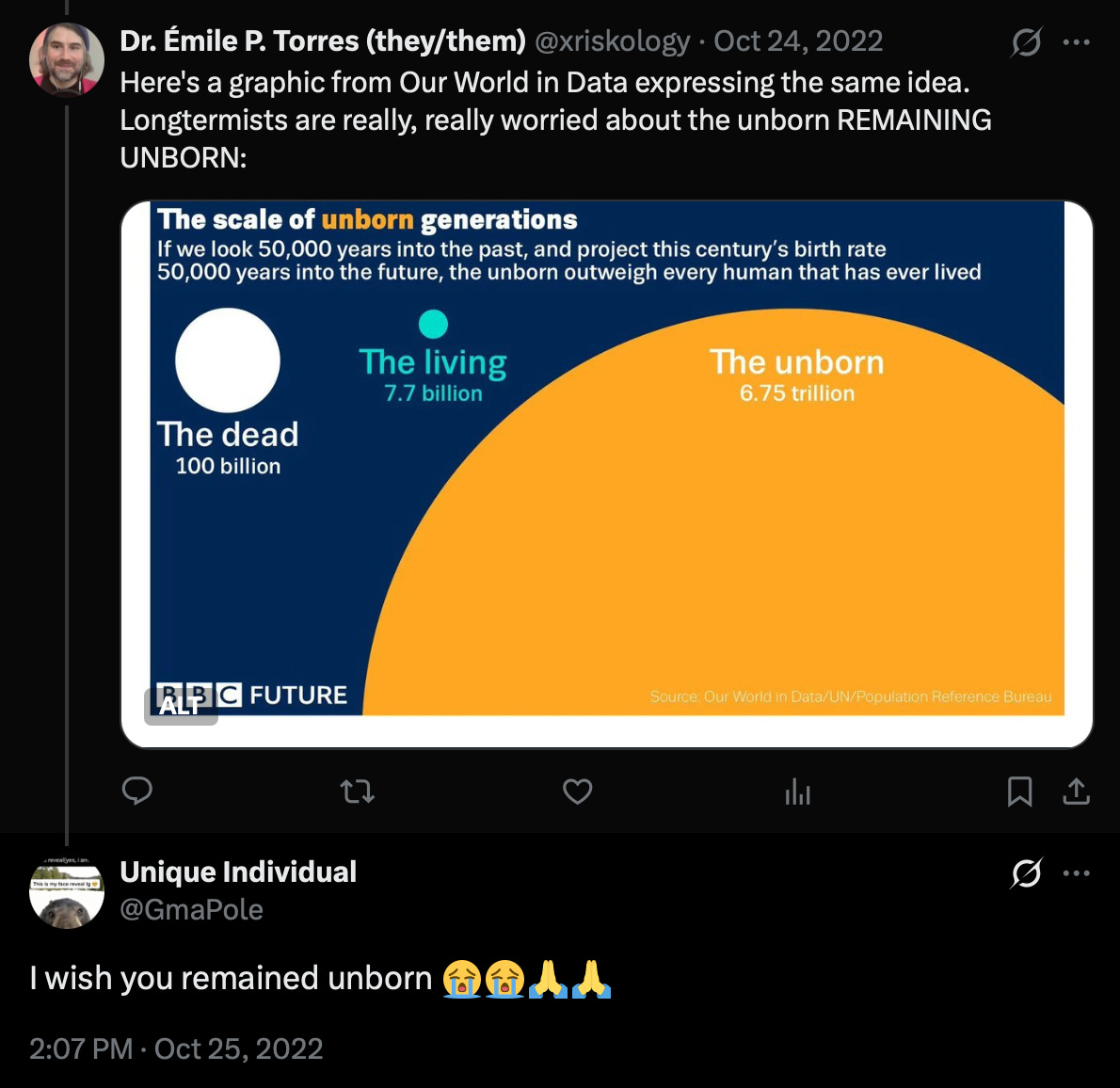
Yet another account impersonated me, complete with personal information about where I had worked. I also received multiple anonymous emails threatening me, one of which was a death threat. These are just a few examples.

On the EA Forum, numerous EAs argued that I must have a personality disorder or suffer from episodes of psychosis (lolz?). One participant in this discussion, another prominent EA, said they believe I write my articles criticizing EA during episodes of psychosis, and hence if there were some way to predict when I’ll become psychotic, they can prepare ahead of time to counter my articles!
(An EA at the time wrote me apologizing for the abuse. They told me that they had personally experienced psychosis in the past, and were really hurt by these wild speculations on the EA Forum.)
This is who EA is: a community that markets itself as caring about epistemic humility, but in fact will lash out at anyone who takes a stand against them.4 EAs like the criticisms that they like — those requiring minor tweaks to components of their framework — but if you criticize underlying pillars of the framework itself, you better watch out. I became so anxious about these threats that I changed my route home at night while I was in Germany. When I gave a public talk at Oxford in 2023, I spoke to security about not allowing certain EAs into the building due to safety concerns. To this day, I don’t publicly announce where I’m traveling — only where I’ve been — because of EA.
Related:
How Effective Altruists Use Threats and Harassment to Silence Their Critics

In a previous newsletter article, I briefly mentioned that Karen Hao made a mistake in her otherwise excellent book Empire of AI, which examines the rise of OpenAI and CEO Sam Altman’s messianic mission to build God-like superintelligence. Basically, Hao used a government document that
EA Gave Rise to Longtermism
Yet another reason that “EA is the devil” is that it gave rise to longtermism. (When people talk about EA in the context of Silicon Valley, they’re almost always referring to this ideological offshoot.)
As with EA more generally, longtermism is built on utilitarianism — specifically, the “Total View,” which says that the more “value” there is in the universe as a whole, between now and the heat death, the better the universe will become.
The Total View yields the Repugnant Conclusion, which says that a world full of miserable people5 would be better than one containing far fewer people with exceptionally wonderful lives. That’s because, once again, people are just the “containers” of value. If you have 1 billion containers with 1 drop of water, you’d have more total water than if you had 1 million containers each with 999 drops of water. It’s all about crunching the numbers — ethics is just a branch of economics.
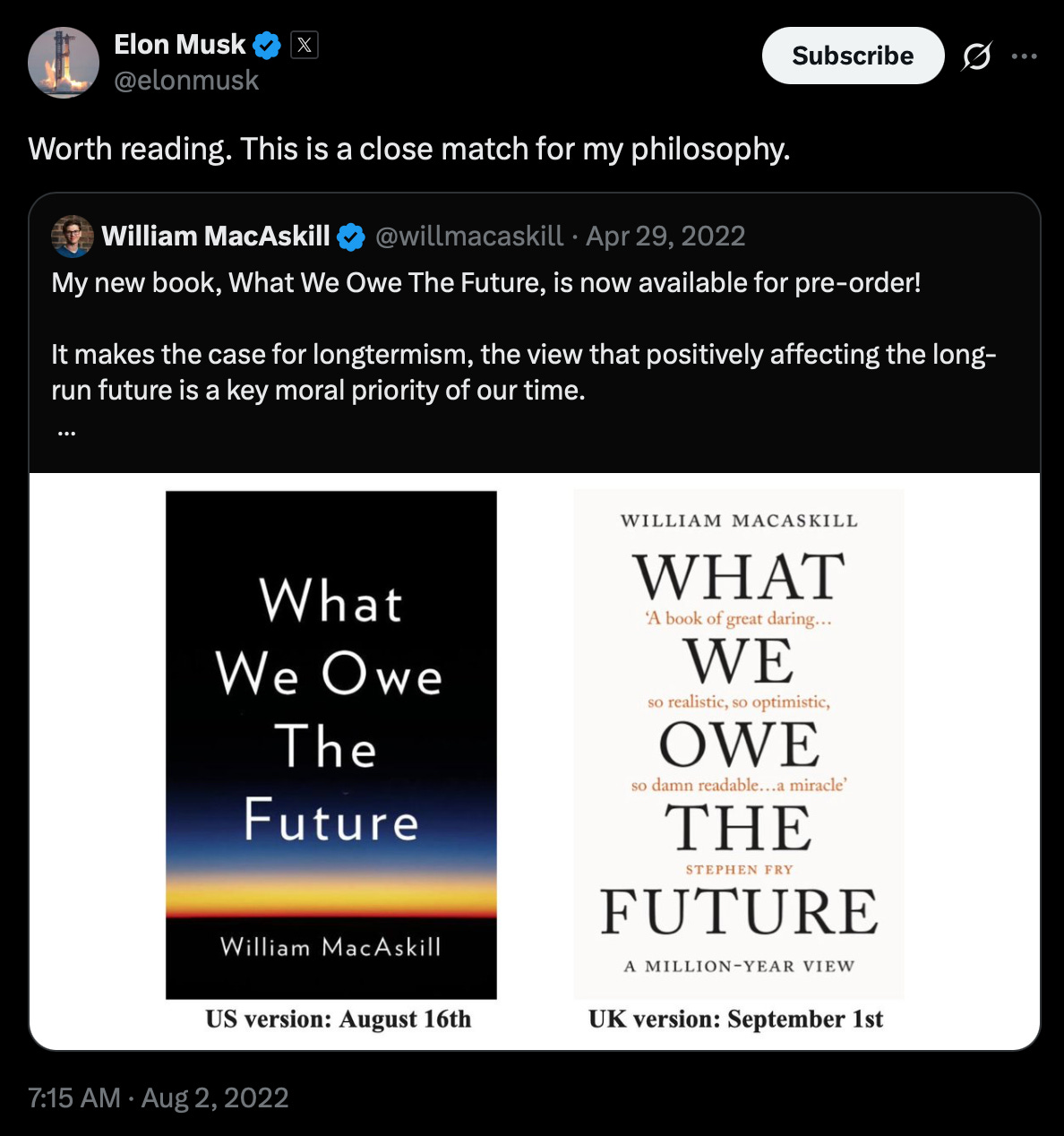
MacAskill has explicitly defended the Repugnant Conclusion. He doesn’t think it’s all that repugnant. He says we should choose a world full of huge numbers of miserable people over one containing far fewer super-happy people. The Total View also leads him to argue, in What We Owe the Future, that we should colonize space — no wonder, then, that Musk himself promoted MacAskill’s book and called longtermism “a close match for my philosophy.”
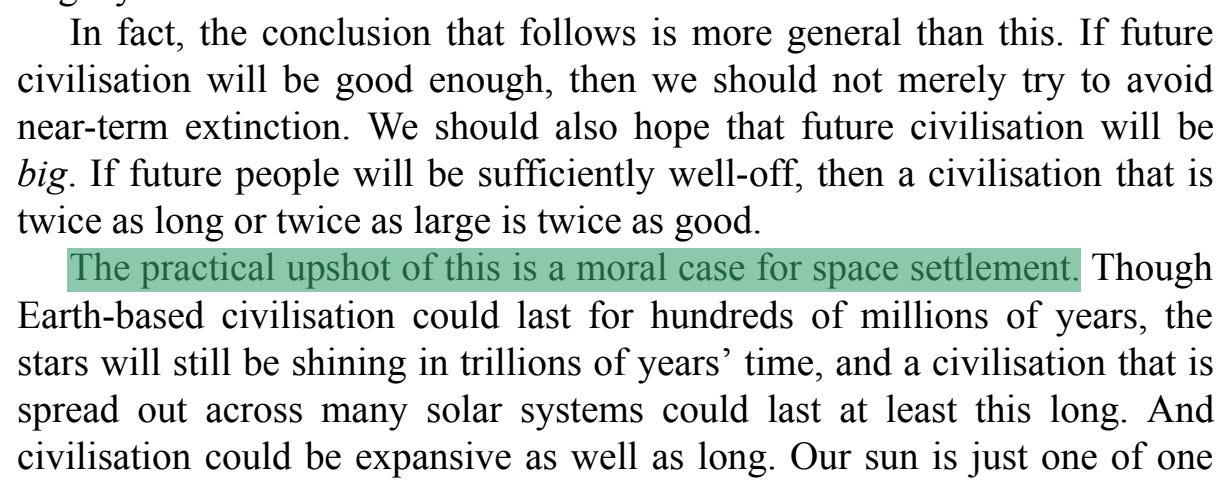
Longtermism is the view that we should be most concerned about how “well” the long-term future goes, rather than about how much suffering there is in the world right now. It’s not that future digital space brains (i.e., value-containers) matter more. It’s just a numbers game: if we colonize space and build giant computer simulations for digital space brains to live in, there could be much more value in the future than has existed in human history thus far. As MacAskill’s close colleague Benjamin Todd writes:
This thesis is often confused with the claim that we shouldn’t do anything to help people in the present generation. But longtermism is about what most matters — what we should do about it is a further question. It might turn out that the best way to help those in the future is to improve the lives of people in the present, such as through providing health and education. The difference is that the major reason to help those in the present is to improve the long-term.
Again, people are just means to an end. If “helping” current people is the most effective way to influence the far future, then we should exploit them in this way.
Why Must the Future Be Digital?
Now, you might be asking: why fill the universe with digital space brains (my satirical term) living in giant computer simulations spread throughout our future light cone? Why not biological humans? The answer is that you can cram way more “digital people” (their term) into the universe, per volumetric unit of spacetime, than you can biological people. Hence, to maximize value, all future people should be digital.
But digital people would be wildly different from us. They would take the form of software — pure information. And since software is immortal, they would be immortal. They could also share bits of their memories, personalities, preferences, and experiences with each other with the metaphorical click of a button. We should thus classify such future people as posthumans.
Since posthumans could be designed to contain far more “value” than biological humans, the longtermist ideology is inherently pro-extinctionist. Think about it this way:
There are several ways to maximize value, in accordance with utilitarianism. One is to increase the total number of value-containers (people) in existence. Another is to increase the “depth” of these containers such that each can contain more total “value.” Since posthumans could supposedly contain more total “value,” posthumanity should replace humanity — asap. This is a direct implication of utilitarianism: our species should die out immediately after creating our posthuman successors, who will then take over the world and eventually colonize the universe.
In fact, some longtermists have explicitly argued for this conclusion, though it’s implicit in claims from people like Toby Ord that “rising to our full potential for flourishing would likely involve us being transformed into something beyond the humanity of today. Remember that evolution has not stopped with humanity.” He also says that “forever preserving humanity as it now is may also squander our legacy, relinquishing the greater part of our potential.”
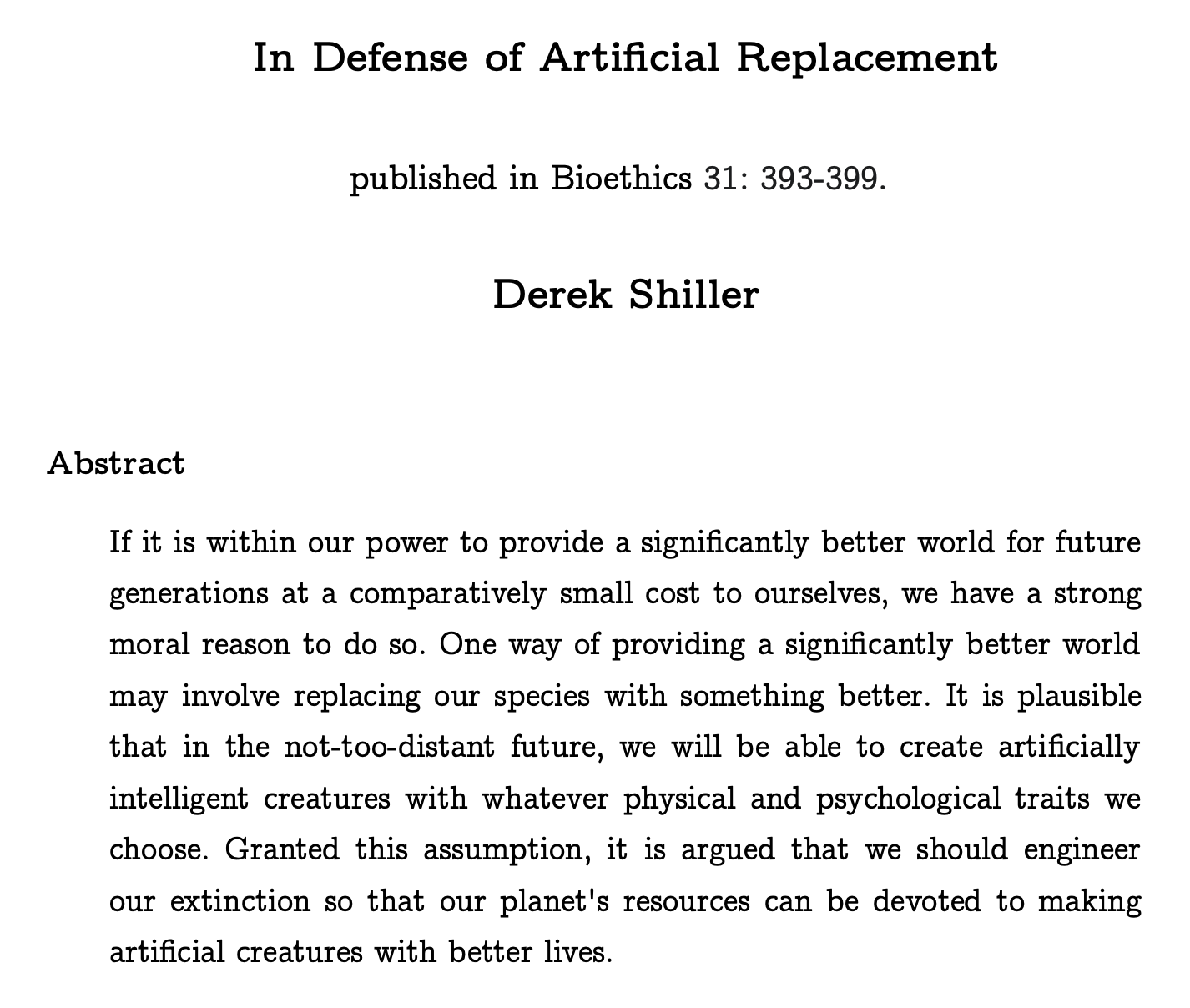
Since posthumanity replacing humanity would result in the extinction of Homo sapiens, longtermism is pro-extinctionist.
Longtermism Could “Justify” Genocide
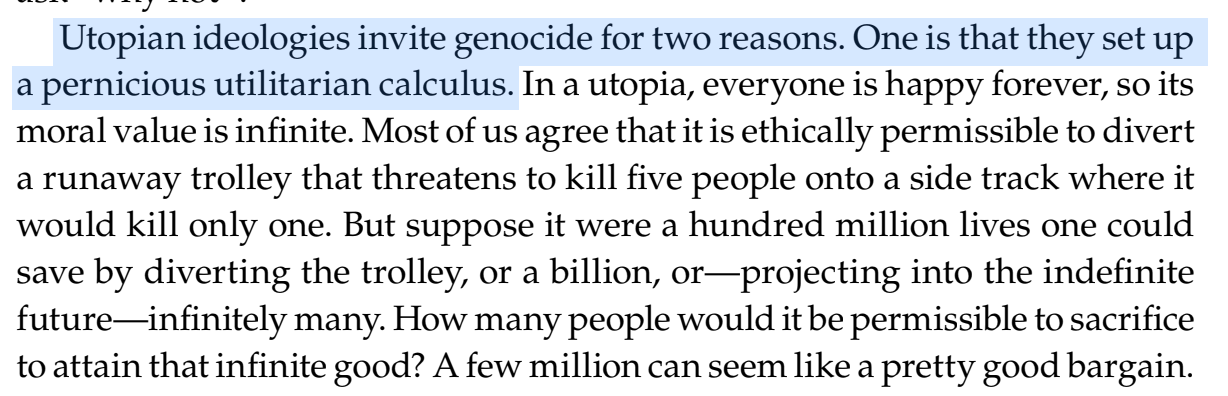
The dangers of longtermism go far beyond the implication that our species should die out. As I’ve repeatedly argued, any ideology that combines a utopian vision of the future with a utilitarian mode of moral reasoning has all the ingredients necessary to “justify” virtually anything for the sake of our “vast and glorious” future, to quote Ord.
If the ends justify the means, and the ends are a literal utopia full of digital space brains that never die and live in perfect simulated happiness within their virtual reality worlds, then what’s off the table for “protecting” and “preserving” this future — again, quoting Ord?
The answer: Nothing.
Since no act is intrinsically right or wrong according to utilitarianism, there’s literally nothing one shouldn’t do to protect, preserve, and realize this utopia.
The statistician Olle Häggström, who acknowledges that Bostrom has pro-extinctionist “tendencies,” worries about this implication of longtermism in his book Here Be Dragons.6 He begins with Bostrom’s ridiculous claim that increasing the probability of 10^54 digital people existing in the far future by a minuscule amount is the moral equivalent of saving literally billions of actual, living, breathing people. He then writes:
I feel extremely uneasy about the prospect that [the calculations above] might become recognised among politicians and decision-makers as a guide to policy worth taking literally. It is simply too reminiscent of the old saying “If you want to make an omelette, you must be willing to break a few eggs,” which has typically been used to explain that a bit of genocide or so might be a good thing, if it can contribute to the goal of creating a future utopia. Imagine a situation where the head of the CIA explains to the US president that they have credible evidence that somewhere in Germany, there is a lunatic who is working on a doomsday weapon and intends to use it to wipe out humanity, and that this lunatic has a one-in-a-million chance of succeeding. They have no further information on the identity or whereabouts of this lunatic. If the president has taken Bostrom’s argument to heart, and if he knows how to do the arithmetic, he may conclude that it is worthwhile conducting a full-scale nuclear assault on Germany to kill every single person within its borders.
This is yet another reason I’ve worried about my personal safety. From the longtermist view, critics like me aren’t just minor annoyances. We are profoundly immoral people, standing in the way of “astronomical” amounts of future value in a cosmic utopia. For utilitarians, murder is morally right if it leads to overall better outcomes. Hence, if they come to believe that murdering me would increase the probability of utopia being realized — even by a teeny-tiny amount — then they have a moral obligation to murder me. Utilitarianism is scary, and as Steven Pinker (ugh) points out, utopianism contains within it a particularly insidious kind of utilitarian reasoning:
These concerns aren’t merely hypothetical. In 2023, Eliezer Yudkowsky — a major figure within the EA-longtermist community — argued that states should be willing to engage in military strikes to prevent misaligned ASI from being built. He said they should do this even at the risk of triggering a thermonuclear war. The reasoning is that thermonuclear war probably wouldn’t foreclose what he calls our “glorious transhumanist future,” whereas misaligned ASI supposedly would. When asked on Twitter, “How many people are allowed to die to prevent [misaligned] AGI?,” he said basically everyone on Earth should be allowed to perish. So long as there are enough people to rebuild industrial capitalism, then “there’s still a chance of reaching the stars someday.”
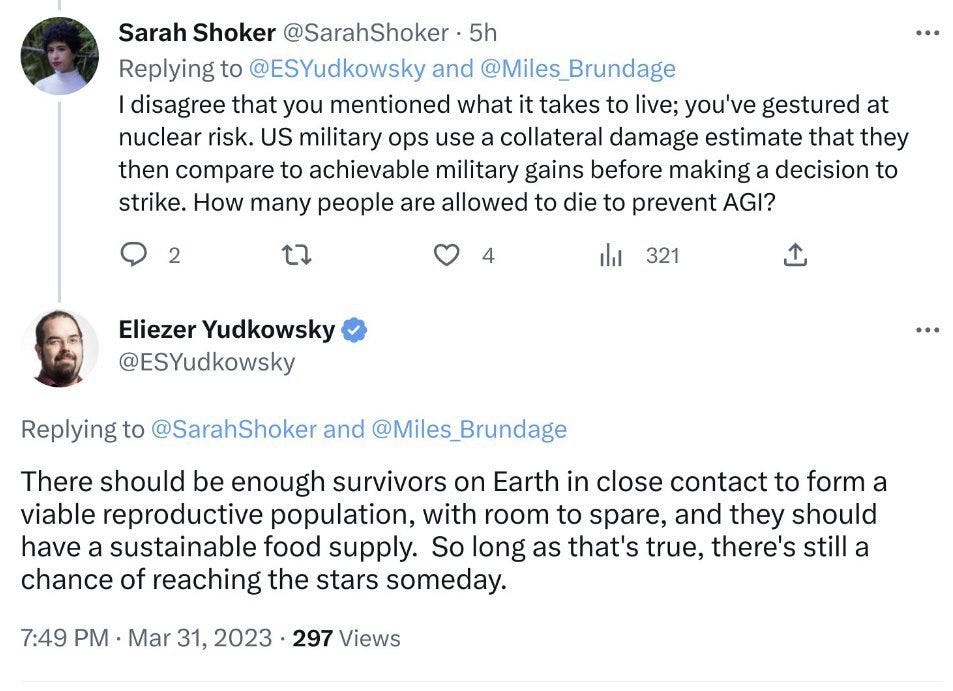
Yudkowsky is gaining influence in Washington, and has met with Bernie Sanders. If his views are implemented, they could have catastrophic consequences for humanity. Yet, even if we avoid extinction from advanced AI, Yudkowsky imagines a future in which our species ceases to exist, as Homo sapiens will be replaced by digital posthumans living in computer simulations.
Longtermism is also why Nick Beckstead argued that we should prioritize saving the lives of people in rich countries over those in poor countries. I wouldn’t normally quote a PhD dissertation, but it’s been repeatedly cited within EA circles as a work of brilliance. It’s posted on the 80,000 Hours website. Toby Ord lists it as “further reading” in The Precipice, says he “builds on” Beckstead’s dissertation, and calls it “one of the best texts on existential risk.” To quote Beckstead in full:
Saving lives in poor countries may have significantly smaller ripple effects than saving and improving lives in rich countries. Why? Richer countries have substantially more innovation, and their workers are much more economically productive. By ordinary standards — at least by ordinary enlightened humanitarian standards — saving and improving lives in rich countries is about equally as important as saving and improving lives in poor countries, provided lives are improved by roughly comparable amounts. But it now seems more plausible to me that saving a life in a rich country is substantially more important than saving a life in a poor country, other things being equal.
This makes perfectly good sense on the longtermist view. People don’t matter in and of themselves. If letting poor people die is the best way to increase “value” elsewhere in the universe at some later point, then of course one should do this — other things being equal. MacAskill’s collaborator Hilary Greaves says the exact same thing:
I just want to know, as an empirical matter of fact, in which cause area would I be best advised to spend my resources, insofar as my aim is doing the most good — improving the world by the most that I can, given that resource constraint. And, at the moment, many people think the answer to that is, for example, global health and poverty interventions. And there’s a clear reason why you think that might be the case: in a world with massive global inequality, given that a given amount of money improves people’s well-being by a lot more when they’re poor than it does when somebody’s already rich, there’s a clear place for transferring resources from the affluent Western world to the global poor. But longtermist lines of thought suggest that something else may be better still.
There are a number of candidates for potentially very high-value longtermist interventions. I should say the case for thinking they are very high value is not completely clear-cut, or perhaps — I think one of them actually is quite clear cut, and then a lot of others are much less clear-cut. The most clear-cut one I think is reducing risks of premature human extinction.7
To be clear, what she means by “human extinction” is not what you think. In a paper with MacAskill, she writes:
We will use “human” to refer both to Homo sapiens and to whatever descendants with at least comparable moral status we may have, even if those descendants are a different species, and even if they are non-biological.
This is the Broad Definition of “human” and “humanity,” in contrast to the Narrow Definition, which identifies these terms with our species. What matters to longtermists like her is that the universe is flooded with digital space brains that maximize “value.” Our species’ survival matters only insofar as it’s necessary to create these digital posthumans. On her definition of “human,” our species could literally die out next year without “human extinction” having happened. So long as we’re replaced by posthumans, then “humanity” will persist and “extinction” won’t have happened.
Don’t be fooled by their language games: just as EAs only care about poor people insofar as alleviating global poverty will increase total value, they only care about the survival of our species until the posthuman era begins.
EA Played an Integral Role in Accelerating the AGI Race
Many EAs are freaked out about AGI being just around the corner, yet the EA community — in particular, its longtermist arm — played a pivotal role in launching, sustaining, and accelerating the race to build god-like superintelligence.

Open Philanthropy (now Coefficient Giving), one of the main EA grant-making organizations, funded both OpenAI and Anthropic. Anthropic also received half a billion dollars from SBF’s FTX. The FTX Future Fund, as it happens, was run by Beckstead.
The EA career advice organization 80,000 Hours, cofounded by MacAskill and Benjamin Todd, has repeatedly told EAs to pursue AGI research instead of other careers. It lists AI “safety” research as one of the best ways to maximize one’s “positive” impact in the world. Altman himself is a “product” of the EA movement, and Anthropic is full of EA-longtermists like Dario Amodei, Holden Karnofsky, and the hardcore utilitarian Amanda Askell.
Thanks to EA, the AGI race is barreling full-steam ahead, causing immeasurable harms in the process: AI psychosis; spreading disinformation; generating deepfakes; undermining of key civic institutions like universities, the rule of law, and the free press, enabling mass surveillance, etc. AI is destroying society in realtime, and for what? A cosmic posthuman utopia, as envisioned by longtermists.
Utopia justifies anything and forgives everything. But don’t be fooled: the utopia that EA longtermists are trying to create is one in which our species will be systematically sidelined, marginalized, disempowered, and eventually eliminated. If you think the creation of AI has been bad for society, blame the EA movement and its billionaire mega-donors.
Conclusion
These are just a few reasons to think the EA community is rotten. I have a much longer discussion of this in my forthcoming book, Will Humanity Survive?, which argues that this worldview poses a dire threat to humanity.
EA is the devil, and the world would have been better without it. Unfortunately, we must now pick up the pieces and try to undo the damage it’s done.
Facebook cofounder Dustin Moskovitz, the main funder of Open Philanthropy, on regretting his role in EA:
As always:
Thanks for reading and I’ll see you on the other side!
A bunch of EAs still work there, as it happens. I have no idea if they were involved in insider trading, but I wouldn’t be surprised.
I am not naming this person here because I don’t want to make it about them.
That’s why SBF felt “justified” in defrauding his customers: it was for the greater cosmic good. Not defrauding them would have been immoral, on his utilitarian view
Or, the other response EAs have to criticisms is to simply ignore them.
That is, unhappy people who are not so unhappy that they would prefer to have never existed. So long as a life has net-positive amounts of value, then it contributes to the overall total value in the world.
Note that Häggström is otherwise sympathetic with longtermism. Here’s what he writes about Bostrom: “among thinkers with at least some successionist tendencies, one might even include Nick Bostrom,” where “successionist” is synonymous with “pro-extinctionist.”
Both this quote and the quote from Beckstead exemplify a conclusion that Greaves and MacAskill came to in the 2019 draft of their paper “The Case for Strong Longtermism.” They write that “for the purposes of evaluating actions, we can in the first instance often simply ignore all the effects contained in the first 100 (or even 1,000) years, focussing primarily on the further-future effects. Short-run effects act as little more than tie-breakers.” Since alleviating global poverty is a near-term goal, it should be ignored in favor of the far future. As I’ve summarized the central idea of longtermism: Won’t someone think of all the digital unborn? Sorry poor people!
“I myself am 100% committed to donating nearly all of my disposable income, and I think EA is complete bullshit.”
Émile, you bragging about this all the time doesn’t make you look like some saint. It comes off as performative, like you want people to admire you and see you as somebody special.
If you really believed this then you wouldn’t feel a need to brag about it so regularly. Loudly talking about how much money you donate to charity just makes you come off as somebody who has something to prove. Most people don’t brag about how much of their money they give away to charity.
“EA is the devil, and the world would have been better without it. Unfortunately, we must now pick up the pieces and try to undo the damage it’s done.”
There are many, many devils in this world. I appreciate you so much for calling out the TESCREAL devils, but please don’t get tunnel vision and see these guys as the only or primary devils in the world. As bad as they are, they’re well-behaved schoolboys compared to Putin and others causing global violence at massive scale.