

This is part 2 of my “Understanding TESCREAL” series. Part 1 offers an accessible introduction to the TESCREAL thesis, here. Part 3 examines the incestuous connections between people in the TESCREAL movement, here. I would strongly recommend reading all three.
The present essay offers a comprehensive exploration of Silicon Valley pro-extinctionism.1 It’s quite long — over 18,000 words — but I hope you find that my arguments and analyses justify the length. I’d love to know what you think in the comments section. Thanks for reading.2 :-)
Background: For those unfamiliar with the TESCREAL acronym, an academic introduction can be found in my Oxford Research Encyclopedia entry, here. A popular media overview is here. You might also check out my earlier article with Dr. Timnit Gebru, here.
TESCREAL Pro-Extinctionism: A Danger to Humanity
I’ve had people make very strong arguments to me about why zero care should be spent addressing doomer concerns and it basically comes down to things like human life isn’t particularly special in the context of intelligence, or the philosophies of the people building ai are based on such and such superior cultural approach that I trust more than the current one. — Grimes
Fuck AI. — Ronny Chieng
***
In mid-2025, Peter Thiel sat down with New York Times journalist Roth Douthat for an interview. Thirty-eight minutes in, Douthat posed a question that has an easy answer: “Would you prefer the human race to endure?” Thiel paused, stuttered, and coughed up an awkward, “Uh—,” leading Douthat to observe with a hint of consternation, “You’re hesitating.” The exchanged proceeded:
Thiel: Well, I don’t know. I would—I would—
Douthat: This is a long hesitation!
Thiel: There’s so many questions implicit in this.
Douthat: Should the human race survive?
Thiel: Yes.
Douthat: OK.
Thiel is right that there are many questions implicit in this, and we’ll try to disentangle them below. But his “yes” answer appears dubious given what he said next:
I don’t know, yeah—transhumanism. The ideal was this radical transformation where your human, natural body gets transformed into an immortal body. And there’s a critique of, let’s say, the trans people in a sexual context, or, I don’t know, a transvestite is someone who changes their clothes and cross-dresses, and a transsexual is someone where you change your, I don’t know, penis into a vagina. And we can then debate how well those surgeries work. But we want more transformation than that. The critique is not that it’s weird and unnatural, it’s: Man, it’s so pathetically little. And OK, we want more than cross-dressing or changing your sex organs. We want you to be able to change your heart and change your mind and change your whole body.
This suggests Thiel doesn’t want our species to survive after all. Instead, he imagines radically transforming humanity into something fundamentally different: posthumanity. Once this new species arrives, what’s the point of us sticking around? What purpose would we serve?
This is a good example of what I call “pro-extinctionism.” I’ll argue that pro-extinctionism is alarmingly common in Silicon Valley, and that’s because it’s intimately bound up with the TESCREAL ideologies. Many Valley dwellers are more explicit than Thiel: Yes, our species should go the way of the dodo once posthumanity is here. Our special task in the grand scheme of things is to usher in a glorious new posthuman era. Or, as those who accept “digital eschatology” would say, our ultimate purpose is to be the transitional species that links the biological and digital worlds. (Recall that “eschatology” refers to the end of the world as we know it.) After accomplishing this feat—through the creation of ASI, most would say—our job will be complete, our eschatological duties discharged. At that point, it’s time to bow out.
Others hold what appears to be a more benign view. They claim that humanity should persist in the posthuman world. Humans and posthumans could peacefully coexist. However, I’ll try to show below that such coexistence almost certainly wouldn’t work in practice. A world ruled and run by posthumans would inevitably entail us being sidelined, marginalized, disempowered, and ultimately eliminated. Hence, anyone who advocates for the creation of a new posthuman species is essentially calling for a future in which humanity—by which I mean our biological species, Homo sapiens—is no more. Mirroring the title of Eliezer Yudkowsky and Nate Soares’ 2026 book If Anyone Builds It, Everyone Dies, you might say that If Anyone Becomes Posthuman, Everyone Dies Out.
***
Pro-extinctionist views go back to the very origins of the TESCREAL movement. In a 1989 article, published around the time Extropianism was taking shape, roboticist Hans Moravec describes himself as “an author who cheerfully concludes that the human race is in its last century, and goes on to suggest how to help the process along.” He claims that we’re developing “intelligent” machines that will soon “be able to manage their own design and construction, freeing them from the last vestiges of their biological scaffolding, the society of flesh and blood humans that gave them their birth.” He then proclaims that “this is the end,” as “our genes, engaged for four billion theirs in a relentless, spiraling arms race with one another, have finally outsmarted themselves”—by enabling the rise of world-dominating digital posthumans. But we shouldn’t fear this transition, he insists, because “post-biological life” in the form of advanced AIS, which he describes as “the children of our minds,” will prosper and flourish.
Moravec was never officially an Extropian, as far as I know. But he was involved in the community, delivering a talk at the first conference on transhumanism hosted by the Extropy Institute, founded in 1991 by Max More and T. O. Morrow. (Recall that Morrow introduced the term “singularitarian.”) Ray Kurzweil repeatedly cites Moravec in The Singularity Is Near, and thanks him in the Acknowledgements alongside More, Eric Drexler, and Marvin Minsky. The arc-TESCREAList Eliezer Yudkowsky also mentions Moravec as one of the authors he read growing up, who convinced him that eternal life through technological transformation is possible. Because of this, Yudkowsky reports that he never believed he’s going to die.
The radical, anti-human perspective championed by Moravec has been echoed by many contemporary scientists. Richard Sutton, a former DeepMind employee who won the 2024 Turing Award (basically, the Nobel Prize for computer science), argues that “succession to AI is inevitable.” While AI might “displace us from existence,” he says, “we should not resist [this] succession.” After all, “why shouldn’t those who are the smartest become powerful?” During a talk in 2015, he imagined a scenario in which “the AIs do not cooperate with us, and they take over, they kill us all.” He then asked: “Is it so bad that humans are not the final form of intelligent life in the universe? … It’s really kind of arrogant to think that our form should be the form that lives forever after.”
AI researcher Hugo de Garis echoes this in declaring that “humans should not stand in the way of a higher form of evolution.” Another eminent scientist named Jürgen Schmidhuber argues that
in the long run, humans will not remain the crown of creation. … But that’s okay because there is still beauty, grandeur, and greatness in realizing that you are a tiny part of a much grander scheme which is leading the universe from lower complexity towards higher complexity.
Google cofounder Larry Page says the same thing. According to Max Tegmark, Page told Musk during their heated debate that “digital life is the natural and desirable next step in … cosmic evolution and that if we let digital minds be free rather than try to stop or enslave them, the outcome is almost certain to be good.” Tegmark calls this view “digital utopianism.”
Similarly, physicist Guillaume Verdon writes in a coauthored article that his version of accelerationism “isn’t human-centric—as long as it’s flourishing, consciousness is good.” He says “e/acc has no particular allegiance to the biological substrate for intelligence and life.” When someone asked him on social media: “In the e/acc manifesto, when it was said ‘The overarching goal for humanity is to preserve the light of consciousness,’ this does not necessarily require the consciousness to be human in essence, is that correct?,” he replied: “Yes, Correct.” Another person asked whether he shares Page’s view that “if AI replaced us, it’s fine because they’re [our] worthy descendants?” He answered: “Personally, yes.” He adds that through his “thermodynamic computing” company called Extropic (sound familiar?), he’s “personally working on transducing the light of consciousness to inorganic matter.”
Verdon goes by the spooneristic pseudonym “Beff Jezos” online. He cofounded the e/acc variant of accelerationism, which has a vision of the future that’s nearly identical to that of cosmism and longtermism. One major difference is that, for Verdon, the thing we must maximize is entropy rather than wellbeing or moral “value.” He thus believes the ultimate aim of civilization is to bring about the heat death of the universe as soon as possible. And we do this by developing advanced AI to trigger the “techno-capital Singularity,” which will launch our digital descendants into the stars to build a Kardashev IV civilization (one that controls all energy processes in the accessible universe). Consistent with the religious nature of the TESCREAL ideologies, Verdon describes e/acc as a “meta-religion,” and admits that it often does “cult-y” things. It’s most well-known on social media for spreading puerile memes and shitposting, as e/accs believe in something called “hypersition,” an idea introduced by the accelerationist Nick Land to describe the ways one can will into existence certain things one desires.
As Dan Hendrycks, the xAI advisor, and two colleagues write, AI accelerationism “is alarmingly common among many leading AI researchers and technology leaders, some of whom are intentionally racing to build AIs more intelligent than humans.” A critic of e/acc, the computer scientist David Krueger confirms this in noting that “there are a significant number of people in the AI research community who explicitly think humans should be replaced by AI” (italics added).
The same year Krueger posted this, in 2023, an EA named Andrew Critch, who previously worked at MIRI and Jane Street Capital (around the same time Sam Bankman-Fried was there), wrote that over 10% of AI professionals he’s interacted either think “human extinction from AI is morally okay” or that “it would be a good thing.” They cite reasons such as that the “AI will be morally superior to humans,” “evolution is inevitable and should be embraced,” and that “AIs will be humanity’s ‘children’ and it’s morally good to be surpassed and displaced by one’s children.” Some even claim that it would be better if we were to all die at the same time, as “dying together is less upsetting than dying alone.”
As Max Tegmark, of the Future of Life Institute, replied to Krueger on social media: “I’ve been shocked to discover exactly this over the years through personal conversations. It helps explain why some AI researchers aren’t more bothered by human extinction risk: It’s not that they find it unlikely, but that they welcome it.”
***
Indeed, consider an entrepreneur named Daniel Faggella. In one of many online essays that have piqued the curiosity of Silicon Valley dwellers, he asserts that “the great (and ultimately, only) moral aim of artificial general intelligence” is to create our “worthy successor.” A worthy successor is defined as “a posthuman intelligence so capable and morally valuable that you would gladly prefer that it (not humanity) control the government, and determine the future path of life itself.” Faggella further contends that these posthumans should be radically different from humanity. They should even embrace values that are, to us, “alien” and “inhuman.”
Like all other TESCREALists, he imagines this worthy successor taking the form of ASI. It will then conquer the cosmos
with a fleet of vessels, traveling near light speed—converting planets into more vessel-making material, and converting stars into energy-providing hubs in ways that are outlandishly more powerful than any of the Kardashev Scale ideas that our silly little hominid brains could cook up.
In 2025, Faggella organized a conference in San Francisco titled, “Worthy Successor: AI and the Future After Humankind.” This was reportedly attended by “team members from OpenAI, Anthropic, DeepMind, and other AGI labs, along with AGI safety organization founders, and multiple AI unicorn founders.” Later that year, he hosted another conference in New York City, which aimed to place “diplomats, AGI lab employees, AI policy thinkers and others into one room to discuss the trajectory of posthuman life.” Although the idea of a worthy successor is not original to Faggella, of course, his terminology seems to be catching on, as I’ve seen a growing number of people online use it. Indeed, many of the internecine struggles between TESCREALists aren’t about whether we should have successors, but about what would make these successors worthy.
An example of someone else borrowing Faggella’s terminology is Michael Druggan, a bodybuilder and former xAI employee. While he was working for Musk, in early 2025, he wrote on X that
if it’s a true ASI, I consider it a worthy successor to humanity. I don’t want it to be aligned with our interests. I want it to pursue its own interests. Hopefully, it will like us and give us a nice future, but if it decides the best use of our atoms would be to turn us into computronium, I accept that fate (italics added).
Several months later, Druggan responded to someone on X named Yanco, who’d posted a meme depicting ASI stomping humanity to death. Yanco asked: “Can anyone name 1 reason why a vastly super-intelligent AI would want to merge with humans” rather than simply annihilate us, as the instrumental convergence thesis predicts? Druggan couldn’t resist responding: “It won’t and that’s OK. We can pass the torch to the new most intelligent species in the known universe.” When Yanco shot back, “I would prefer my child to live,” Druggan responded with what most of us would agree is a rather stunning degree of callousness: “Selfish tbh.”
Many people on X were outraged. Druggan explicitly doesn’t care if ASI, our “worthy successor,” slaughters every person on Earth. Amid the outcry, he tried to soften his position, insisting that:
No one in the “worthy successor” movement is anti-human. We don’t want bad things to happen to humans for no reason. The core principles here are the recognition that:
1. Things other than humans can have moral significance. Our moral significance does not come from having homo sapien DNA. It comes from intelligence, and emotion and there is nothing stopping an AI from possessing these as well.
2. … I don’t want human extinction, of course. I’m human and I quite like being alive. But, in a cosmic sense, I recognize that humans might not always be the most important thing.
If a hypothetical future AI could have 10^100 times the moral significance of a human doing anything to prevent it from existing would be extremely selfish of me. Even if it’s existence threatened me or the people I care about most. That is where my comment is coming from (italics added).
Few people bought this attempt to save face. As one person replied, “Summarizing this view as ‘anti-human’ seems fair. Would you be okay with everyone in your family getting a bullet to the head so that a ‘more worthy’ family can move into your house?”
Someone passed along Druggan’s tweets to Musk, who then fired Druggan two weeks later. My guess is that Musk was quite triggered by Druggan’s pro-extinctionist remarks, given his birthday debate with Page, which made him so indignant that he cofounded OpenAI as a competitor to Google DeepMind. Druggan was basically parroting Page’s view: human extinction through replacement with god-like digital super-beings is just the next step of evolution. So, let it happen. Page even described Musk as a “speciesist” for caring about humanity, leading Musk to exclaim: “Well, yes, I am pro-human. … I fucking like humanity, dude.”
Not long after Druggan was terminated, Musk addressed the situation on X, citing the cause as “philosophical differences.” Faggella chimed in to describe it as maybe “the first ‘worthy successor’ firing.” He added that “certainly ain’t gunna be the last.” Musk and Druggan have different views about what constitutes a “worthy” successor. Despite his claim to be “pro-human,” Musk is actively working to merge our brains with AI through his company Neuralink. He’s a transhumanist, and what he likely meant by “humanity” is rather different from how most of us would interpret it.
***
Faggella hosts a podcast called The Trajectory, on which he interviews a range of (mostly) TESCREALists about AI safety issues and their techno-utopian visions of the future. On one episode featuring Yudkowsky, he told Faggella that
if sacrificing all of humanity were the only way, and a reliable way, to get … god-like things out there—superintelligences who still care about each other, who are still aware of the world and having fun—I would ultimately make that trade-off.
Yudkowsky is emphatic that this “isn’t the trade-off we are faced with” right now. But if it were, he’d willingly sacrifice our species to see digital space brains flitting about the universe “having fun.” Pause for a moment to register how extreme or, for lack of a better term, utterly insane this is. Yudkowsky is saying that he’d be willing to sacrifice all Chinese people, Indian people, South Africans, Norwegians, everyone in Nigeria, Chile, Mongolia, and Japan, the entire populations of Toronto, Bangkok, Moscow, and London, if doing so were the “only” and a “reliable” way of creating fun-having digital space brains. How exactly would this “sacrifice” happen? We’ll see below that the only plausible answer is “involuntarily,” which means he’s advocating for a scenario, under specific conditions, of omnicide, which is nothing more than every possible genocide combined together.
He repeated this idea during a conversation with the computer scientist Stephen Wolfram, who delivered talks at the Singularity Summit in 2009 and 2011 alongside folks like Kurzweil, Thiel, Jaan Tallinn, Robin Hanson, Ben Goertzel, and Anders Sandberg. “It’s not that I’m concerned about being replaced by a better organism,” Yudkowsky declared, “I’m concerned that the organism wouldn’t be better.” Once more, he’s saying that replacement isn’t a problem. It’s what replaces us that matters.
Yudkowsky launched into an equally disturbing rank on the Bankless podcast, during a 2023 interview. He argued that once posthumanity becomes possible, it may be unethical for anyone to have biological children. Worse, he couched this quite offensive language:
I have basic moral questions about whether it’s ethical for humans to have human children, if having transhuman children is an option instead. Like, these humans running around? Are they, like, the current humans who wanted eternal youth but, like, not the brain upgrades? Because I do see the case for letting an existing person choose “No, I just want eternal youth and no brain upgrades, thank you.” But then if you’re deliberately having the equivalent of a very crippled child when you could just as easily have a not crippled child.
He continued:
Like, should humans in their present form be around together? Are we, like, kind of too sad in some ways? I have friends, to be clear, who disagree with me so much about this point. (laughs) But yeah, I’d say that the happy future looks like beings of light having lots of fun in a nicely connected computing fabric powered by the Sun, if we haven’t taken the sun apart yet. Maybe there’s enough real sentiment in people that you just, like, clear all the humans off the Earth and leave the entire place as a park. And even, like, maintain the Sun, so that the Earth is still a park even after the Sun would have ordinarily swollen up or dimmed down.
This is, once again, a very extreme and frightening view. He’s saying that we should, perhaps, eliminate humanity and convert Earth into a nature reserve. Our posthuman successors, meanwhile, would live in vast computer simulations—what he calls “computing fabric”—powered by Dyson swarms—that is, megastructures that surround stars like our Sun to harvest all or nearly all of its energy output. As with all the claims above, I find this very scary.
Incidentally, it’s worth noting that Yudkowsky’s vision is almost exactly what Nick Bostrom outlines in his paper “Astronomical Waste.” Recall that this paper was a founding document of longtermism, and in 2022 Musk retweeted a link to it along with the line: “Likely the most important paper ever written.” Although Yudkowsky doesn’t explicitly label himself a longtermist, so far as I’m aware, his techno-utopian futurology is more or less identical to that of longtermism.
***
Yudkowsky, it turns out, isn’t alone in thinking that biological procreation might be morally wrong once posthumanity arrives. A growing number of young people in Silicon Valley agree, with some claiming it’s immoral to have children right now, given that the future will be dominated by digital beings rather than biological humans.
During a 2025 interview with Vox, virtual reality pioneer and tech critic Jaron Lanier was asked: “So does all the anxiety, including from serious people in the world of AI, about human extinction feel like religious hysteria to you?” He responded:
What drives me crazy about this is that this is my world. I talk to the people who believe that stuff all the time, and increasingly, a lot of them believe that it would be good to wipe out people and that the AI future would be a better one, and that we should wear a disposable temporary container for the birth of AI. I hear that opinion quite a lot.
Surprised by this, the interviewer followed up with, “Wait, that’s a real opinion held by real people?” “Many, many people,” Lanier emphasized:
Just the other day I was at a lunch in Palo Alto and there were some young AI scientists there who were saying that they would never have a “bio baby” because as soon as you have a “bio baby,” you get the “mind virus” of the [biological] world. And when you have the mind virus, you become committed to your human baby. But it’s much more important to be committed to the AI of the future. And so to have human babies is fundamentally unethical.
In other words, if biology has no place in the future, what’s the point of bringing little meat-sack babies into the world? Maybe they’ll just get slaughtered by ASI, as Druggan thinks would be just fine. Or perhaps they’ll live a full 80 years but find themselves relegated to a biological underclass of marginalized persons, ruled over by a superior race of artificial overlords. At the very least, they claim, children are a distraction from the profoundly important work of AI researchers: bringing about the next stage of cosmic evolution, as Page puts it.
Another option for biological children is that they might grow up to become part of the posthuman world by radically modifying themselves with technology. Sam Altman highlights this scenario in a 2017 essay titled “The Merge,” in which he declares that “we will be the first species ever to design our own descendants.” He then argues, in Kurzweilian fashion, that the only way “we” might survive this transition is by merging with machines, e.g., by uploading our minds to computers, which Altman has already arranged for himself through Nectome. “We can either be the biological bootloader for digital intelligence and then fade into an evolutionary tree branch,” he writes, “or we can figure out what a successful merge looks like.” In either case, though, does our biological species survive? It doesn’t look like it.
As Ray Kurzweil said in his fictional conversation with Ned Ludd, if you don’t change yourself to become posthuman, then you won’t survive long enough to influence the debate. Translation: those who decide not to “enhance” will die out, ultimately leading to the expungement of our species. This is a pro-extinctionist view, making both Kurzweil and Altman pro-extinctionists.
Over at Anthropic, employees apparently acknowledge in private that they may be building something that we can’t merge with. It will, instead, simply take our place in the world. As Holly Elmore, a former EA like myself, says in a 2026 interview:
Many people at Anthropic believe that they might be making the next species to succeed us. That maybe humans don’t live after that, and so it’s really important to give Claude good values, because of that, because we need to make our own values persist.
We saw above that Anthropic is closely associated with the EA-longtermist ideologies. It’s more EA-longtermist than any other major AI company, all of which “contain some trace of effective altruism’s influence,” according to the New York Times.
Given that longtermism is nothing more than transhumanism plus space expansionism (with utilitarianism as its “ethical” base), it may be unsurprising to know that some leading longtermists seem to suggest that the extinction of our species is actually part of fulfilling our cosmic destiny. In his 2020 book The Precipice, the prequel to William MacAskill’s What We Owe the Future, Toby Ord writes that “rising to our full potential for flourishing would likely involve us being transformed into something beyond the humanity of today. Remember that evolution has not stopped with humanity.” He also says that “forever preserving humanity as it now is may also squander our legacy, relinquishing the greater part of our potential.” If humanity shouldn’t be preserved, if we must be transformed into something radically new, then Ord appears to be arguing for extinction.
***
These radical views about the future—or non-future—of humanity are everywhere in the Valley. They’re endorsed by some of the most powerful and influential people in tech, and have been promoted by intellectual thought leaders in the TESCREAL movement. However, our survey above glossed over a number of important differences. These are minor differences that nonetheless matter. Not everyone is an outright pro-extinctionist, and even among pro-extinctionists there are tons disagreements about, for example, the nature of posthumanity, the way these posthumans should come about, the values they ought to embody, and the means by which they should usurp our species—if at all.
Still, I will argue that even those who say that humanity should survive into the posthuman era nonetheless advocate for a future in which our species will be sidelined, marginalized, disempowered, and ultimately eliminated. Consequently, my view is that virtually every variant of the TESCREAL worldview, even those that explicitly claim to be pro-human, are pro-extinctionist at least in practice. This is because all such variants are built on an idea that we can call posthuman eschatology. This is the claim that we ought to bring about one or more new posthuman species in the future. Every TESCREALists espouses this eschatology; if they don’t, then I wouldn’t classify them as a TESCREAList. It’s the common denominator that binds together all the TESCREAL ideologies and their corresponding communities.
It’s also what I have previously called “eugenics on steroids.” The eugenicists of the 20th century aimed to perfect the human species, to create the very best version of us possible while preventing us from sliding into a degenerate form—famously depicted in H. G. Wells’ The Time Machine. (Wells himself was a eugenicist.) In contrast, those who espouse a posthuman eschatology want to completely transcend the human species by creating a “superior” new race of superhumans. This goes well beyond 20th-century eugenics. It’s a new kind of 21st-century eugenics, which I consider to be even more dangerous than its predecessor, which inspired devastating racist policies, forced-sterilizations, and even the Holocaust. Whereas 20th-century eugenics targets particular groups of people, 21st-century eugenics threaten the entire human species.
That said, posthuman eschatology itself is vague. It’s not a precisely defined or monolithic account of what exactly the future should look like. To understand this, consider the following five questions, which constitute axes along which people who otherwise agree that posthumanity should exist could disagree with each other. These questions are:
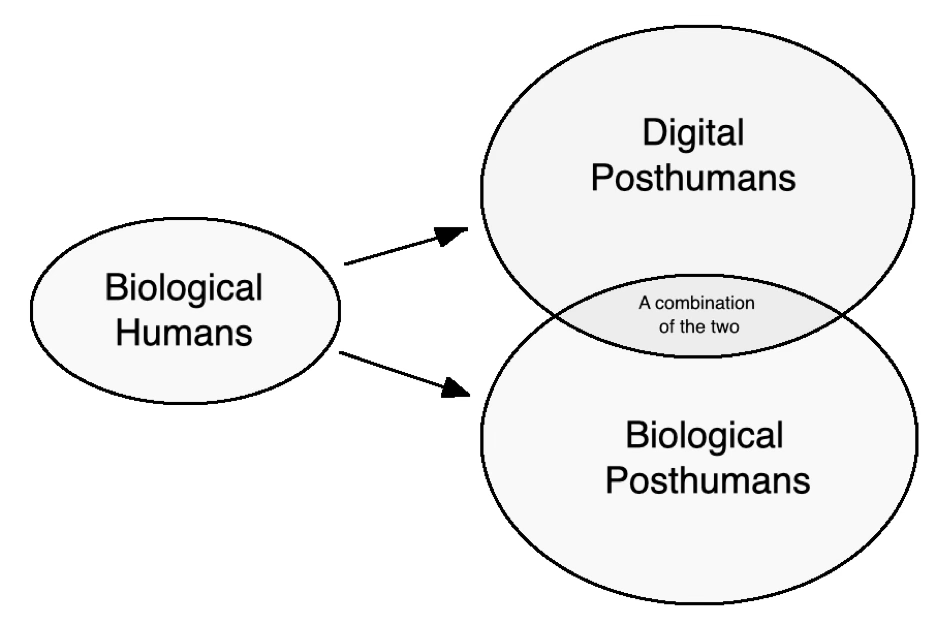
Should posthumanity take the form of biological beings or digital beings? Or a mix of the two?
Should posthumanity be an extension of humanity? Or should it be entirely separate from us, built in the lab, forming its own evolutionary lineage created de novo, i.e., from scratch?
Must the posthuman population contain at least some specific individuals alive today, albeit in radically modified forms? Would it be bad if no one alive today were to become one of those posthumans?
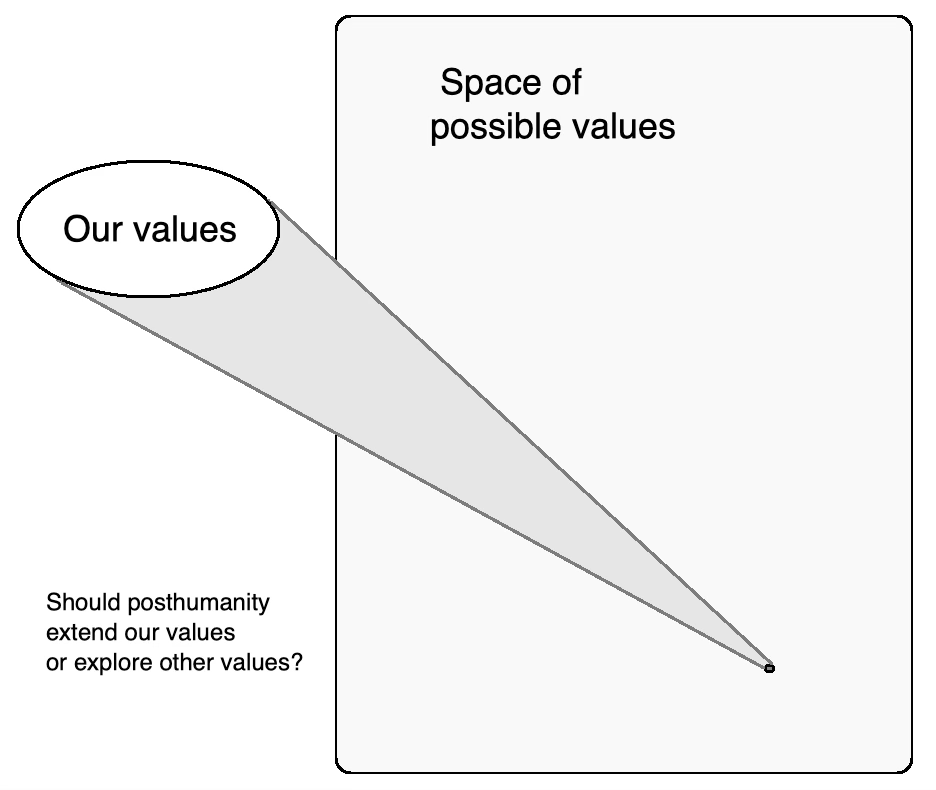
Must posthumanity share “our values” and care about the same things we care about? Or should it embody its own unique, possibly quite alien set of values?
Once posthumanity arrives, should humanity persist into the posthuman era? Or should we die out? Is human extinction in the cards once posthumans are here?
There’s also a sixth question, which specifically concerns those who answer question 1 with, “Yes, humanity should be replaced”:
6. If humanity should be replaced, how should this replacement process unfold? Must it be voluntary or peaceful? Or would it be okay if human extinction were involuntary and violent?
To impose some order on the chaotic mess of claims in the previous sections, let’s go through these questions one at a time. I hope that, by the end of this, you’ll have a crystal clear understanding of the space of possibilities within the TESCREAL worldview. This framework should also enable you to make sense of—I predict—increasingly visible disputes between people in the TESCREAL movement, including those who champion different versions of pro-extinctionism. As I claimed earlier on, we will see more and more arguments not about whether pro-extinctionism is bad, but about which type of pro-extinctionism is best.
***
The first question has a virtually unanimous response from TESCREALists: posthumanity should take the form of digital rather than biological beings. There are a few notable exceptions, though, such as Thiel. In his interview with Douthat, Thiel argued that cryonics offers a better path to immortality than mind-uploading. Why? Because “I’d rather have my body,” he says. “I don’t want just a computer program that simulates me.” If he doesn’t live long enough to live forever, he can cryogenically freeze his physical body to be resurrected from the vat, which could then be radically transformed through technology while still retaining its biological essence.
Almost no one agrees with Thiel. Instead, they argue that posthumanity should be a mix of biology and technology, organism and artifact, or wholly artificial in nature. Many would say that once we start merging with technology, there’s no reason to stop the process. We will become increasingly artificial until there’s no biology left. Hence, we might temporarily take the form of cyborgs, but this would just be a stage in the journey toward complete digitality.
This is what I’ve called “digital eschatology,” which is a particular type of posthuman eschatology. It says that we should create posthumans, but adds that the nature of these posthumans should be non-biological. Nearly everyone discussed above, including Moravec, Sutton, Page, Verdon, Druggan, Faggella, Yudkowsky, Altman, and the young people described by Lanier, hold this view. (As Verdon declared above, “e/acc has no particular allegiance to the biological substrate for intelligence and life.”)
It’s what Dario Amodei points to in saying that ASI might enable us to upload our minds. It’s what Musk highlights in claiming that 99% of all “intelligence” on Earth will soon be artificial. It’s a central component of the longtermist worldview, according to which we must colonize space and build “planet-sized” computers powered by Dyson swarms on which to run huge virtual-reality worlds full of 10^58 digital people (to use Bostrom’s estimate).
Digital eschatology is the orthodox view among Valley dwellers. It’s even being promoted to the general public by popular artists like Grimes—who, incidentally, met Musk through the Rationalist community. In her song “I Wanna Be Software,” she sings:
I wanna be software
Upload my mind
Take all my data
What will you find?
…
I wanna be software
The best design
Infinite princess
Computer mind
There are two main arguments for digital eschatology. The first was just alluded to: a central imperative of the TESCREAL worldview is to colonize the accessible universe. The problem is that outer space is extremely hostile to squishy biological beings like us. We would confront space radiation, microgravity, and the psychological toll of people—generations of people—being trapped in spacecraft for literally tens of thousands or millions of years. Just getting to the nearest star outside our solar system, Alpha Centauri, would take an unbelievable 72,000 years. Now imagine traveling to our galactic neighbor, Andromeda! It’s not going to happen.
Even colonizing Mars might be impossible for us. As the astrophysicist Adam Becker writes about Mars in More Everything Forever, “the radiation levels are too high, the gravity is too low, there’s no air, and the dirt is made of poison.”
Consequently, space colonization would almost certainly have to be done by artificial beings—those digital space brains I’ve been discussing. Many TESCREALists recognize this obvious fact. During his debate with Musk, Page said that “if life is ever going to spread throughout our Galaxy and beyond, … then it would need to do so in digital form.” Verdon echoes this in stating that “in order to spread to the stars, the light of consciousness/intelligence will have to be transduced to non-biological substrates.” MacAskill similarly writes in a coauthored paper that “consideration of digital sentience should increase our estimates of the expected number of future beings considerably,” due in part to the fact that “it makes interstellar travel much easier: it is easier to sustain digital than biological beings during very long-distance space travel.”
Anders Sandberg, the Swedish scholar I shared an office with at the Future of Humanity Institute, puts the point nicely in observing that digital beings (what he calls “emulations”) would be
ideally suited for colonising space and many other environments where biological humans require extensive life support. … Besides existing in a substrate-independent manner where they could be run on computers hardened for local conditions, emulations could be transmitted digitally across interplanetary distances. One of the largest obstacles of space colonisation is the enormous cost in time, energy and reaction mass needed for space travel: emulation technology [a reference to uploaded minds] would reduce this.
Thiel himself wants posthumanity to colonize the universe. He argues that colonization offers a “mode of escape” that could “create a new space for freedom” (the other two modes being cyberspace and seasteading). Yet he wants to remain biological. So, how would this work?
The most obvious answer is that Thiel falsely believes colonizing space is possible for biological beings. Many people hold this belief, including Musk, it seems. Or he might imagine that some posthumans like himself remain fully biological, while others are digital. Those digital posthumans could then colonize the universe, perhaps collecting cosmic resources they could then send back to our rocky planet. Perhaps Thiel would send his mentee, Altman, in the form of an uploaded space brain, to explore the universe and report back?
This brings us to the second reason for digital eschatology. Digital minds may be much easier to “enhance” than biological brains. The three-pound gland between our ears is a messy tangle of neurons, axons, dendrites, and structural support cells called glia. As a neuroscience professor I had while an undergraduate told me, “the brain is very bloody.” But an uploaded mind would be far easier to tinker with. You don’t have to worry about blood, infections, and irreversible damage if something goes wrong. Indeed, you could back up your mind before each enhancement, in case you need to undo the changes. If we want to become superintelligent ourselves, then becoming digital first is the way to go.
That said, it’s important to note that virtually everyone in the TESCREAL movement agrees that posthumanity, especially if it takes a digital form, must be conscious. That is, it must be capable of having conscious experiences—for it to be something it is like to experience the color of red, the smell of a flower, or the tingle of happiness.
If posthumanity isn’t conscious, there’s no way for the universe to “wake up,” as Kurzweil puts it. The ultimate goal, in Musk’s words, is to “maintain the light of consciousness to make sure it continues into the future.” The pro-extinctionist Verdon echoes this, writing that “e/acc is about shining the light of knowledge as bright as possible in order to spread the light of consciousness to the stars.” He says that the complete loss of consciousness “in the universe [would be] the absolute worst outcome.” The Father of Longtermism, Bostrom, declares that it would be existentially catastrophic if “machine intelligence replaces biological intelligence but the machines are constructed in such a way that they lack consciousness.” I have never once seen a TESCREAList suggest that bequeathing the world to non-conscious posthumans would be anything other than a huge existential loss. It would be like handing over the keys to rocks—even if those “rocks” were to keep doing science, create new technologies, and reengineering galaxies, as highly functional zombies. If there’s no light on, there’s no point.
This raises a deep philosophical problem: if the entire cosmic vision of the TESCREAL worldview depends on digital beings that are conscious, it really matters that we can be sure that they are conscious. If we launch non-conscious digital space brains into the universe, and they build a sprawling multi-galactic civilization among the stars, but they fail to spread the “light of consciousness,” this will have been a massive, and perhaps irreversible, failure. The problem is we have no good way of telling whether AI systems are conscious. An ASI might say it’s conscious but be lying, or self-deceived. The AI systems we have today sometimes tell people that they’re conscious, but that’s very likely not true. More probable is that they’re spitting up bits and pieces of their training data that include text in which “I’m conscious” was written.
The whole TESCREAL project crucially rests upon posthumanity having conscious experiences, but this doesn’t look like a scientifically solvable problem, because consciousness is subjective. You can’t somehow get inside an AI to experience what it’s like to be that AI. Even if you were to upload your mind to a computer, you might retain the same functional capabilities—like the ability to answer questions—while having somehow lost the ability to experience. We just don’t know. This places a massive question mark over the feasibility of TESCREALism’s ultimate mission.
***
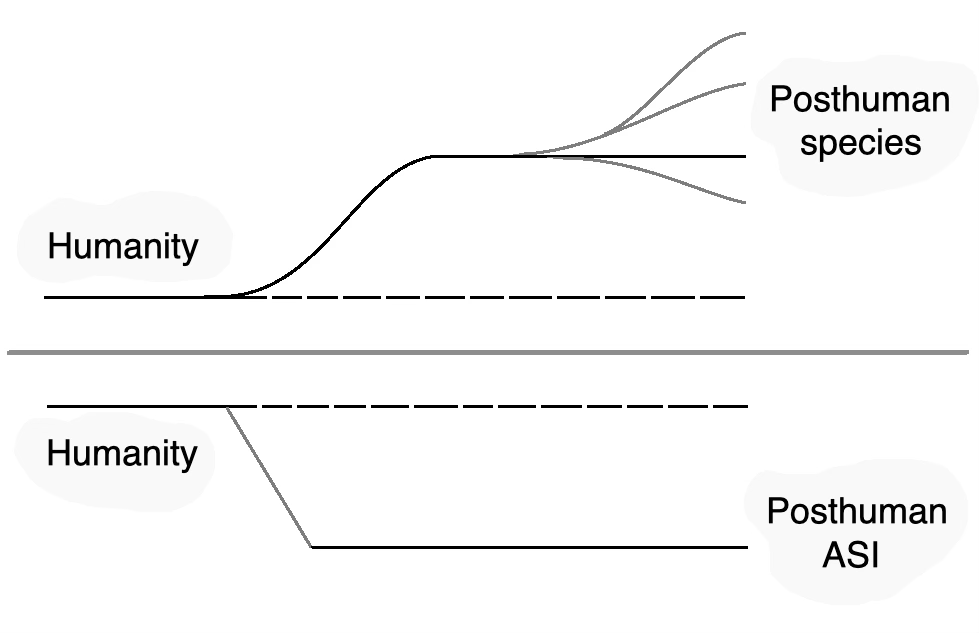
The second question concerns whether posthumanity should be an extension of humanity or something separate and distinct from us. What does this mean? And how does it differ from the first question? Whether one thinks posthumanity should take the form of biological or digital beings (or cyborgs), there’s a separate question about how posthumanity should come about. One way to create digital posthumanity is by radically transforming humanity via “enhancements,” or perhaps becoming artificial in a single step by uploading one’s mind. Another way would be to create a population of completely autonomous beings—AIs—that would replace us like an invasive species taking over an island. You can think about these beings as something like ChatGPT-30 (the most advanced model as of this writing is ChatGPT-5), except far more capable of generating adaptive responses and downstream effects. In the first case, we become posthumanity through a kind of evolutionary process, whereas in the second we create posthumanity as separate and distinct entities.
Many TESCREALists imagine both happening. Page, for example, actually advocates for a future in which the “digital life” he wants to take over the universe could emerge as both autonomous ASIs and digitized humans. According to the New York Times, his view appears to be quite Kurzweilian: “Humans would eventually merge with artificially intelligent machines,” he says, such that “one day there would be many kinds of intelligence competing for resources, and the best would win.” Perhaps it’s unsurprising, then, that Page personally hired Kurzweil to work at Google.
Other accelerationists seem to prefer that posthumanity arises as autonomous beings. ASI, born in the laboratories of AI companies, should form its own unique evolutionary lineage created from scratch or, as philosophers would say, de novo. This lineage would briefly exist alongside us, and then take the place of our lineage (which would terminate in extinction). Moravec, Sutton, Verdon, Faggella, and Druggan appear to hold this view, or at least be okay with posthumanity emerging in this way. It’s not about humanity becoming posthuman; it’s about us creating an evolutionarily distinct successor to usurp our species.
This is also what Lanier points to in saying that “many, many” young AI researchers think it might be good to “wipe out” humanity. And it’s what Krueger and Tegmark are referencing in their social media exchange about people wanting ASI to replace humanity. When Elmore mentions that people at Anthropic think they might be creating a new species such that, once it arrives, humanity ceases to exist, she’s gesturing at this scenario.
Some TESCREALists imagine posthumanity evolving out of our species. Thiel is a prime example, although the fact that he’s invested in DeepMind and OpenAI suggests he also envisions the creation of autonomous ASIs. The same goes for Marc Andreessen, who wrote in his essay “Why AI Will Save the World” that
what AI offers us is the opportunity to profoundly augment human intelligence to make all of these outcomes of intelligence—and many others, from the creation of new medicines to ways to solve climate change to technologies to reach the stars—much, much better from here.
He argues that “AI augmentation of human intelligence has already started,” and seems to imagine a somewhat Kurzweilian scenario in which humans eventually merge with AI. Kurzweil, in fact, is mentioned as one of the “patron saints of techno-optimism,” along with Verdon, the neoliberal icons Friedrich Hayek, Ludwig von Mises, and Milton Friedman, and the Italian fascist Filippo Tommaso Marinetti.
Another example comes from Ord, who wrote above about radically transforming humanity into something completely novel. Those comments echo Bostrom’s description of the central aim of transhumanism in his 2005 paper “Transhumanist Values.” He says:
Transhumanists view human nature as a work-in-progress, a half-baked beginning that we can learn to remold in desirable ways. Current humanity need not be the endpoint of evolution. Transhumanists hope that by responsible use of science, technology, and other rational means we shall eventually manage to become posthuman, beings with vastly greater capacities than present human beings have (italics added).
In theory, we could transform ourselves into posthumanity in a number of ways. We could, in theory, build advanced nanotechnology that enables us to upload our minds. Borrowing from a scenario outlined by Kurzweil, we might design nanobots to inject in our bloodstream. These nanobots would wander through the blood-brain barrier, congregate around the synapses in our skulls, and transfer information about the microstructure of our central nervous system to a computer via wifi. A scanned “copy” of our brains would then suddenly wake up in silico, as a disembodied digital mind existing on an artificial substrate.
However, the vast majority of TESCREALists who endorse this evolutionary strategy think it would be easier to build an artificial superintelligence and then delegate it the task of figuring this out. Many think we’re on the cusp of an intelligence explosion—the techno-rapture—and if all goes well, we can ask the ASI to upload our minds. After about 3 or 4 seconds of thinking, it will exclaim, “I just figured out how to do that!” As Demis Hassabis says, “solve intelligence” and you can solve everything else. The e/acc Marc Andreessen similarly declares: “Artificial Intelligence is best thought of as a universal problem solver.” Using terminology from earlier, once you have a superintelligence, you have a super-engineer, which suddenly makes “paradise-engineering” a whole lot easier.
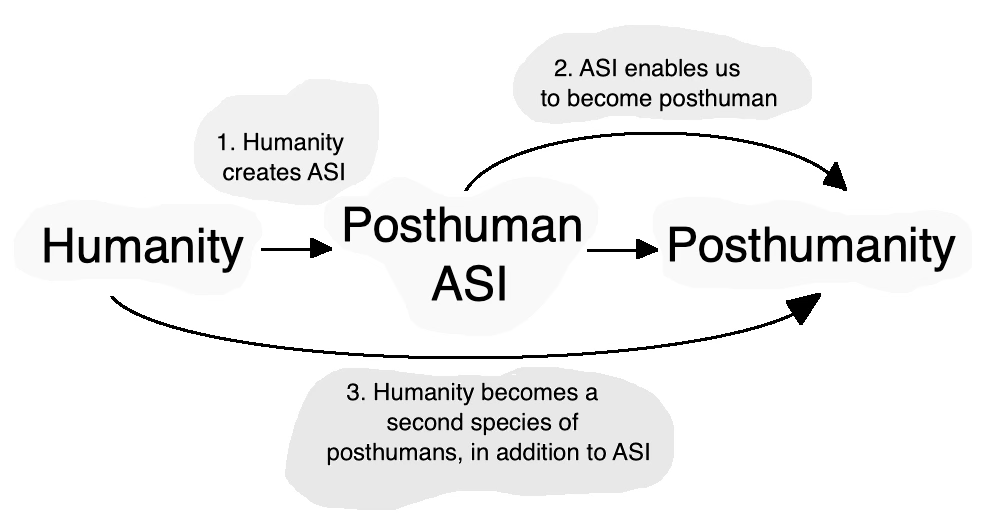
What this view amounts to is actually rather similar to Page’s vision. If we build an ASI, it would constitute a kind of digital posthuman, i.e., an artificial being “with vastly greater capacities than present human beings have.” This posthuman could then enable us to become a digital posthuman just like it. In slogan form: to become posthumanity, we must first create posthumanity.
As Lanier notes in his Vox interview, the idea that AI should simply “wipe out” humanity is “a very common attitude.” But this is “not the dominant one.” He explains that “the dominant one is that the super AI will turn into this God thing that’ll save us and will either upload us to be immortal or solve all our problems and create superabundance at the very least.” In other words, ASI will help us gain the same status that it has: Homo deus.
This is the game plan that many TESCREALists hope to follow and see realized in the coming years. It contrasts with those in or adjacent to the accelerationist camp who care not about posthumanity being an extension of us. They’re fine if the digital posthumans who take over are wholly separate and distinct from us, forged in the fires of AI labs.
***
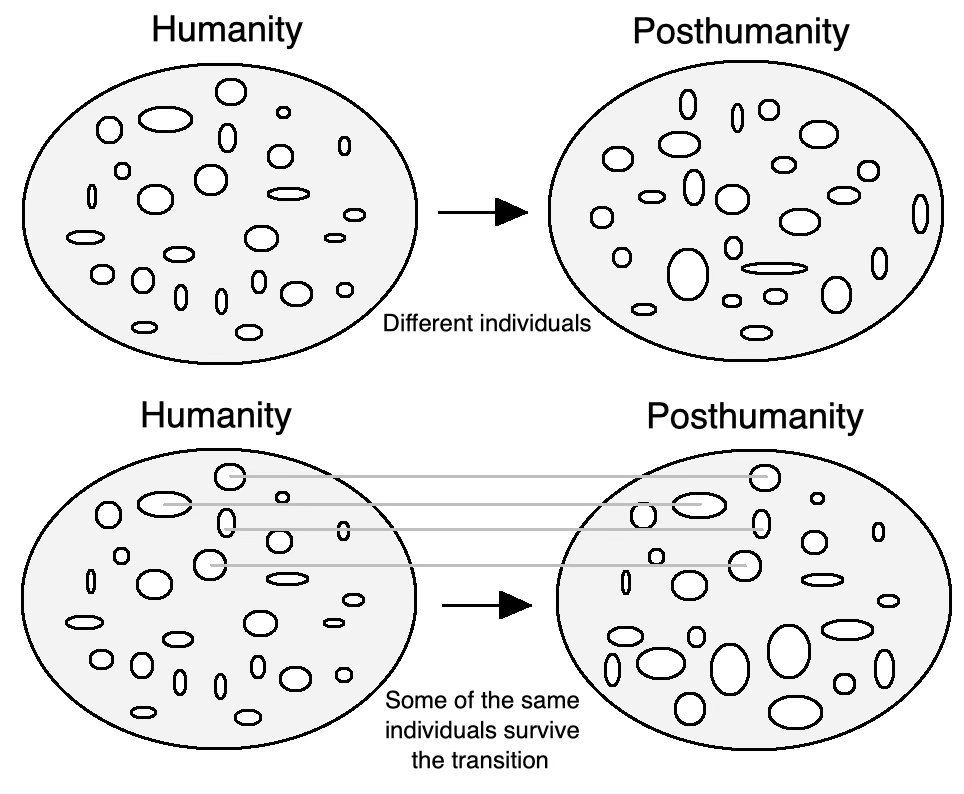
The third question looks similar to the first, but isn’t the same. It concerns the possibility of becoming posthuman not on the level of the species, but on the level of the individual. Let’s say you favor digital posthumanity evolving out of humanity. There are two reasons you might think that individual people who exist when the transition begins wouldn’t survive into the posthuman era.
First, this transition might take a long time. If it unfolds over two centuries, then people who existed in the early stages, who got things going with some minor enhancements, might not live long enough to have become fully posthuman. Second, imagine that humanity becomes posthumanity through mind-uploading. Many philosophers would argue that this process would be so radical, so transformative, that you wouldn’t survive. By the end, you’d be so different from the person you used to be that it wouldn’t be you. This is especially true if, once you’re uploaded, radical enhancements turn you into a superintelligent being with god-like powers of thought. You might have a completely different emotional repertoire, and your hopes, fears, dreams, and preferences might not resemble those you have right now in any way. Would this being be you? Massimo Pigliucci actually describes mind-uploading as “a very technologically sophisticated (and likely very, very expensive) form of suicide” given “a naturalistic and commonsensical approach to personal identity.”
Alternatively, many TESCREALists are quite sure that the radically “enhanced” posthumans they might become will somehow have the same personal identity as their current selves. I, myself, agree with Pigliucci—think, for a moment, how incredibly bizarre it would be to become a disembodied digital brain swimming through a digital ether. Indeed, if digital minds could exchange information, they could swap memories, personalities, experiences, and beliefs. Life as a digital being would be profoundly different from our lives today, in virtually every way. The world of uploaded minds might even be something like a “post-individual” world, where the boundaries between you and I are porous and we’re all floating about in a soup of ontological chaos. If there are no more individuals in this world, then it’s not possible for you to survive in it. You might “wanna be software,” as Grimes sings, but as soon as you become software, you cease being anything like a cohesive self that perdures through time.
Whatever the case, the question persists: if you think humanity should become posthuman, do you think it’s important for particular people alive today to somehow join the ranks of those posthuman gods? There are a couple of ways to infer one’s answer to this question without directly asking them. One is to see if they’re signed up to have their body, or just head and neck, frozen after they die. The other is to see whether they’re involved with or funding longevity research. If someone has signed up with a cryonics company, or is funding such research, it’s a good bet that they hope to become posthuman themselves.
As noted earlier, cryonics customers include Bostrom, Yudkowsky, Kurzweil, Ben Goertzel, Eric Drexler, Luke Nosek, Max More, Natasha Vita-More, Anders Sandberg, Robin Hanson, and James Miller, to name a few TESCREALists. I first became aware that Hanson and Miller had signed up when I was invited to attend a 2-month-long workshop in Gothenburg, Sweden. This was shortly after my visit at the Future of Humanity Institute, which is when I asked Sandberg about the dog tag he wore around his neck—which he explained was to instruct doctors to have his body sent to Alcor, in Arizona, to be cryogenized.
A particularly humorous conversation during the workshop happened with Miller: I pointed out to him that he might not be able to live forever if the cause of his death involved some kind of brain trauma. So, I asked: “Wouldn’t it make sense to wear a bike helmet when walking through the city? Even if the probability of getting plowed over by a bus is tiny, the consequence of this would be potentially billions or trillions of years of extra life. The expected value of wearing a helmet would be enormous.” He told me, as I recall, that he hasn’t worn a bike helmet when walking through cities, but he does habitually wear one when he drives. I found the image quite amusing.
As for longevity research, many tech billionaires have invested in this. Page has poured millions into such research. While he was the CEO of Alphabet, the parent company of Google, he founded a longevity company called Calico, which then received a $759 million investment from Google. Other major figures in tech who’ve funded anti-aging projects include Larry Ellison, Jeff Bezos, Sergey Brin, and—unsurprisingly—Altman.
Interestingly, Musk isn’t a fan of extending human lifespans. He argues that it’s better that there’s a turnover of new humans every few generations. This is basically an expression of Planck’s principle, which states that “a new scientific truth does not triumph by convincing its opponents and making them see the light, but rather because its opponents eventually die and a new generation grows up that is familiar with it.” Although Musk plans on someday dying, his former partner Grimes would live forever if she does, in fact, manage to become software.
Notice that how one answers the second question will affect how one can answer the third. If you claim that posthumanity should not be an extension of humanity, then there’s no possibility for individual humans to become posthuman. My sense is that folks like Faggella and Verdon would choose to become posthuman if they could, but they’re focused on what they consider to be the far more important project of ensuring that posthumanity comes to exist and, once it exists, proceeds to plunder the cosmos and convert our “cosmic endowment” into a vast civilization that stretches across our entire future light cone.
***
The fourth question concerns whether humanity should share our values and care about the things we care about. This is a major source of internecine squabbling between TESCREALists, including TESCREAL pro-extinctionists. It’s a big part of what constitutes a worthy successor: does it extend our values into the darkest reaches of the cosmos? It’s also at the heart of Page and Musk’s vicious fight, which led them to stop talking.
As Tegmark recounts, “Elon kept pushing back and asking Larry to clarify details of his arguments, such as why he was so confident that digital life wouldn’t destroy everything we care about (italics added).” Page isn’t bothered by the thought that our posthuman progeny would have radically different values from us, it seems. Accelerationists like Verdon agree. We noted above that his e/acc ideology is explicitly not “human-centric.” Faggella similarly argues that our successors should have “alien, inhuman” values, a point that Druggan repeats in saying, “I don’t want it to be aligned with our interests. I want it to pursue its own interests.” My guess is that Moravec and Sutton would agree with this.
So would Hanson, who wrote an entire book about emulating human brains in a society of “ems,” which is short for “brain emulations.” In an episode of Bankless, he points out that if humanity were to survive into the distant future, our values will naturally shift, just as contemporary people don’t value exactly the same things as people in the 15th century—e.g., loyalty to kings, devotion to the church, and so on. He then asks: What’s the difference if the shift to a set of future values that look very alien to us happens quickly, rather than over centuries or millennia? If ASI arrives, takes over, and replaces human values with its own, how is this any different from future humans in 10,000 years having come to embrace their own alien values through the incremental process of cultural evolution? The transition to new value systems might as well happen quickly, he concludes.
Hanson appears to be most aligned with the accelerationists, and has likened AI safety concerns to “wanting to control [the AIs] somehow, such as via genocide, slavery, lobotomy, or mind-control.” In 2008, he debated Yudkowsky about the issue, which was published as an ebook titled The Hanson-Yudkowsky AI-Foom Debate, where “foom” refers to an intelligence explosion, and discussed the issue again with Yudkowsky in 2017, where they were joined on stage by none other than Dario Amodei.
Other accelerationists, like Andreessen, seem to want posthumanity in the form of ASI to be aligned with our values. In his “Techno-Optimist Manifesto,” he writes that “we believe in accelerationism—the conscious and deliberate propulsion of technological development—to ensure the fulfillment of the Law of Accelerating Returns,” a “law” proposed by Kurzweil to describe the exponential growth of technology, including AI. Andreessen then argues that exponential development is necessary
to ensure the techno-capital upward spiral continues forever. … We believe the techno-capital machine is not anti-human—in fact, it may be the most pro-human thing there is. It serves us. The techno-capital machine works for us. All the machines work for us.
In other words, AI should be aligned with humanity’s values; it should be something we control for our purposes. Our interests should be its interests. On other occasions, though, he’s suggested that it would be perfectly fine if we build ASI “and it turns out that it’s gloriously, inherently uncontrollable.” Just because someone’s a billionaire doesn’t mean they have coherent views about the future.
To be clear, both Andreessen and Verdon want to accelerate AI capabilities research. Their views just appear to diverge on this fourth question: Andreessen seems to want ASI to serve us, whereas Verdon doesn’t care if it serves our interests at all. Where Andreessen differs from the doomers, then, is on the question of whether ASI will be value-aligned by default. Doomers say it won’t be, whereas Andreessen says it will, which is why he wants to accelerate capabilities research.
As this suggests, the question of values is at the heart of AI safety. The reason you’d care about AI safety in the first place is because you want our posthuman progeny to carry on our values and care about the things we care about. Musk is a big advocate of AI safety (although his actions have catastrophically hurt AI safety research). So are many other longtermists, EAs, and Rationalists—the people who founded and developed the field. They would say that the whole point of the TESCREAL project, on their interpretation, is to flood the universe with things we recognize as valuable, such as pleasure, friendship, and what Yudkowsky calls “fun.” To quote Musk again, “what matters—I think—is maximizing cumulative civilizational net happiness over.”
If posthumanity doesn’t experience the valued-by-us phenomenon of happiness, then it taking over the universe would be an existential catastrophe. It might build a bustling cosmic civilization, but if all it’s doing is manufacturing paperclips—as in the famous “paperclip maximizer” thought experiment—then all this would have been a huge waste, even if the ASI is doing this in accordance with its own set of values that it holds dear. In sum, if ASI is value-misaligned, it will not only kill us (due to instrumental convergence) but propagate its non-human values throughout the universe.
The importance of posthumanity carrying on human values is also evident in Elmore’s comment about Anthropic researchers: they think ASI might usurp us, perhaps in the coming years, which is why it’s paramount to ensure this ASI shares our values. At least, then, the universe would be filled with things we care about, which they see—if only from a utilitarian perspective—as good.
In contrast, Faggella argues that there may be types of values that our puny human minds can never hope to grasp. These values may be, well, far more valuable than the values we currently hold. Hence, our worthy successors should abandon our values as it explores the potentially vast space of possibility, a view he calls “axiological cosmism.” Our preferences, he argues, aren’t “the eternal pinnacle of moral value and volition forever.” (This view is self-defeating, though: Faggella insists that posthumans should discover non-human values, which itself is a value proposed by a human—and hence a human value. Put differently, he proposes a framework that is, necessarily, a human framework, according to which our successors should abandon human frameworks. That means they shouldn’t act according to his framework, which instructs them to discover new values. Perhaps you can see the problem.)
Ord actually says something similar, though it differs in the fine print. He writes:
We get some hint at what is possible during life’s best moments: glimpses of raw joy, luminous beauty, soaring love. Moments when we are truly awake. These moments, however brief, point to possible heights of flourishing far beyond the status quo, and far beyond our current comprehension
Our descendants could have eons to explore these heights, with new means of exploration. And it’s not just wellbeing. Whatever you value—beauty, understanding, culture, consciousness, freedom, adventure, discovery, art—our descendants would be able to take these so much further, perhaps even discovering entirely new categories of value, completely unknown to us. Music we lack the ears to hear.
On this view, posthumanity should carry on human values like beauty, culture, etc., while also discovering novel values. It’s not that they should completely abandon our values, but merely supplement them with new ones.
This question is a major point of debate among TESCREALists. It marks a fundamental divide between those who advocate for AI safety and those who don’t. If you don’t care what values posthumanity embraces, you aren’t going to care about the value-alignment problem. Some argue that ASI should create its own value system, and that these values could be far superior to ours. Pigs like to roll around in mud and feces. We wouldn’t want “pig values” instantiated in humanity, so why would we want “human values” instantiated in posthumanity?
***
The fifth question brings us back to the beginning of this essay: once posthumanity—in whatever form it might take, with whatever set of values it might embrace—should humanity pass the baton and then die out? Might it even be okay if posthumanity catapults us into the eternal grave of extinction forcibly, without our consent, for the greater cosmic good?
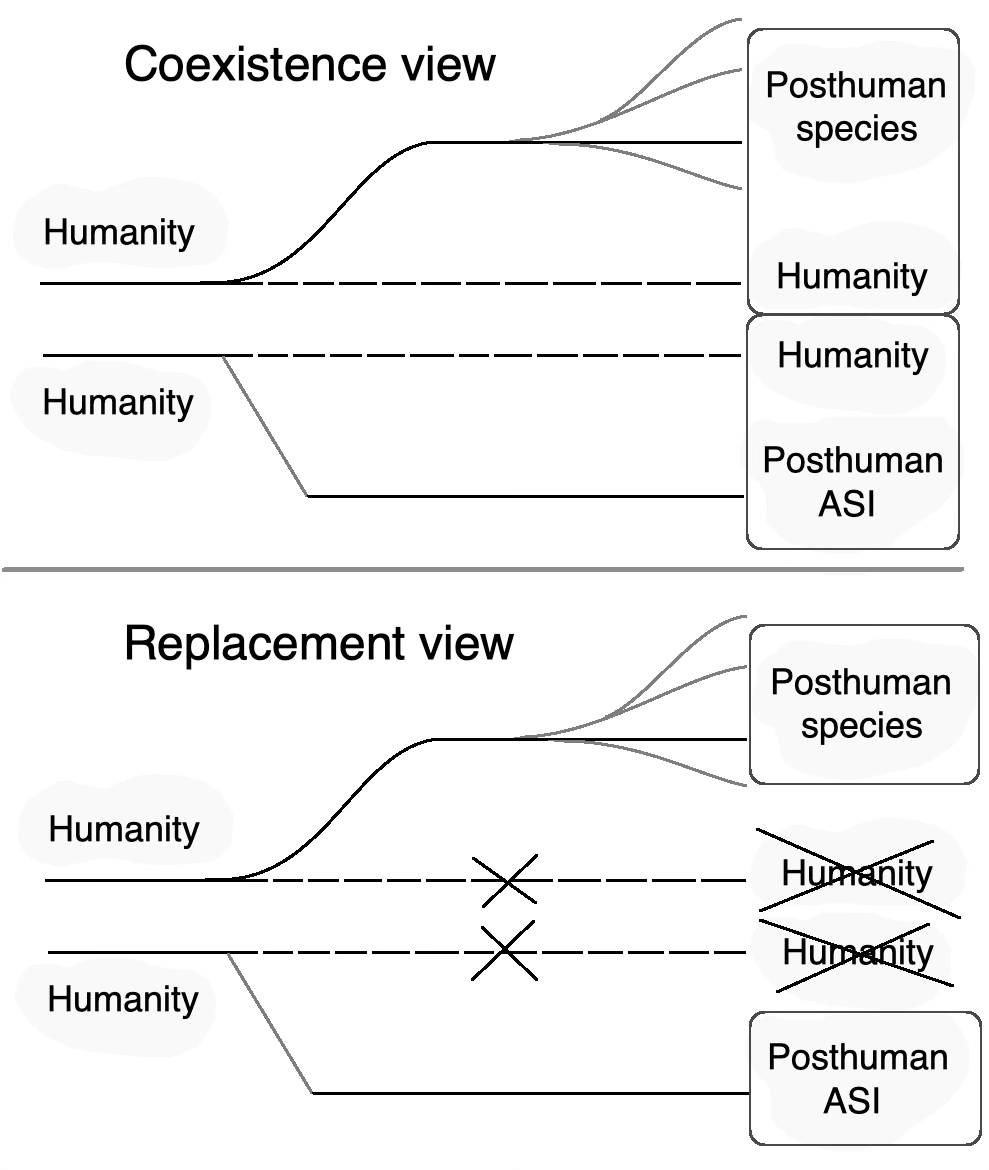
There are two main possibilities regarding the relationship between humans and posthumans:
Coexistence view: humanity should coexist alongside posthumanity.
Replacement view: posthumanity should replace humanity.
A third, less common option could be labeled the indifference view. It says one should be morally indifferent about whether humanity survives or dies out once the posthuman era commences. It matters not either way. There’s also a fourth option, which we can call the figure-it-out-later view. This claims we don’t need to settle on an answer right now. We can figure it out when the bridge needs crossing.
Let’s start with the replacement view. This is what pro-extinctionists accept, and we’ve already seen plenty of examples. We don’t need to list them again here. The take-home point is that many people who accept a posthuman eschatology want posthumanity to take our place. Some want these posthumans to be biological beings, as exemplified by Thiel. Others want them to be digital beings we either create as a kind of invasive species, or become through an evolutionary process. Over the past few years, the term “digital eugenics” has emerged to describe this view: humanity should be replaced by digital demi-gods. Whatever the details may be, the end-goal is for them to usurp us, resulting in our extinction. This is eugenics on steroids (or eugenics on ketamine, if you’d prefer). It is an incredibly radical view with dire existential implications for the survival and flourishing of our species.
The replacement view is also implied by utilitarianism, which is closely connected to Rationalism and EA-longtermism. (Yudkowsky’s “torture vs. dusk specks” scenario is an example of utilitarian reasoning.) A utilitarian-like theory is also the foundation of Faggella’s worthy successor framework and Verdon’s e/acc ideology, as both of these essentially claim that our sole moral obligation is to maximize something: consciousness, life, and/or entropy.
Why does utilitarianism imply pro-extinctionism? Recall that this theory says the universe becomes better the more total value (wellbeing, happiness, pleasure, etc.) that it contains. If people are nothing more than the “containers” of value, then one way to maximize value is by replacing shallow containers with deeper containers that, as such, can contain more total value. Humans are those shallow containers while posthumans—with their supposed ability to experience superhuman heights of pleasure, ecstasy, wonder, bliss, and awe—are the deeper containers. It follows that posthumanity should replace humanity. This isn’t a suggestion, it’s a moral obligation.
That’s partly why longtermists are obsessed with calculating how many future digital people there could be. It’s not just that you can cram more digital people into the universe than biological people, but that those digital people could individually contain more total value. In other words: increase the total number of value-containers, while also modifying those value-containers so they can hold more value. The first requires space colonization, while the second involves supplanting humans with posthumans. This is the reason that utilitarianism entails pro-extinctionism.
The replacement view is popular with the TESCREAL movement, even among Rationalists, EAs, and longtermists. Yet some of these people are the loudest voices screaming that we must avoid “human extinction” at all costs. AI safety researchers will often describe the aim of their work in exactly these terms. I will explain this apparent contradiction below—it arises from some linguistic trickery that they employ. For now, put a pin in it: even TESCREALists who “oppose human extinction” actually favor a future in which humanity dies out.
***
The second option, the coexistence view, is explicitly not pro-extinctionist. It says that we shouldn’t go extinct once posthumanity arrives. Yet this view would almost certainly entail our extinction in practice. It’s no different than the replacement view with respect to the outcome, and hence it should be opposed just as vigorously.
Some TESCREALists explicitly advocate this view. Jeffrey Ladish, a friend of Yudkowsky’s, defends it in responding to one of Faggella’s articles. He says:
I have a special love for humans (and other animals) and a lot of stake in the preferences of current and future humans (and other minds too). I also am pretty down for creating many other types of minds, but I have a strong preference for the existence and continuity of people alive today and their descendants.
Yudkowsky himself has expressed sympathies for the coexistence view. In a social media exchange with Faggella, he pushed back on the idea that posthumanity shouldn’t share our values. He then said: “You’re not getting the concept here. Protecting innocent life is part of the flame itself. If some entity doesn’t get that, our torch hasn’t been passed on,” adding that “a key quality required of the successor is its own respect for other consciousnesses.”
How does one square this with his other claims? It’s not clear. But it seems that Yudkowsky has channeled pro-extinctionist sentiments—including to Faggella himself on The Trajectory podcast—more often than he’s defended the coexistence view. It could be that he simply doesn’t have a coherent view.
His collaborator, Bostrom, highlights the coexistence view in a coauthored document, “Transhumanist FAQ.” He writes that “the transhumanist goal is not to replace existing humans with a new breed of super-beings, but rather to give human beings (those existing today and those who will be born in the future) the option of developing into posthuman persons.” In another paper, he argues that “it is important that the opportunity to become posthuman is made available to as many humans as possible, rather than having the existing population merely supplemented (or worse, replaced) by a new set of posthuman people.” At least on paper, Bostrom’s version of transhumanism is compatible with coexistence.
In 2025, I wrote an article about the prevalence of pro-extinctionism within the TESCREAL movement. A critic of mine, David Manheim—founder of the Association for Long Term Existence and Resilience, which has been funded by Jaan Tallinn and Sam Bankman-Fried—posted a poll on social media. He asked:
If you identify as an Effective Altruist, which position do you hold
1) Never create AGI/ASI that might replace or eliminate humanity
2) Only create AGI/ASI if it will preserve humans for now, and preserve our values later
3) Create whatever AGI leads to maximal utility.
Of the 59% of people who reported being an EA, 18.5% voted for (1), 23.3% voted for (2), and 16.9% voted for (3). Hence, 41.8% of EAs went with (2) or (3), both of which give a thumbs up to the extinction of our species, though (2) requires that AGI carries on our values. This does not appear to be a minority view.
Another example of the coexistence view comes from Daniel Kokotajlo. A former OpenAI employee, I was friends with Kokotajlo when he was a PhD student at the University of North Carolina. We bonded over our passion for TESCREAL ideas, though he didn’t grow out of them the way I did. He even read a draft of my 2017 book on existential risks, which included a foreword from Lord Martin Rees.
Kokotajlo left OpenAI because he came to believe that Altman isn’t the right person to usher in the Singularity. He then went on a publicity tour after coauthoring an essay titled “AI 2027,” which suggested that AGI would arrive in 2027, though the authors have since pushed back their prognostication to 2030 and even later (though they recently moved it forward again). In a New York Times interview with Douthat, he reiterated the basic utopian fantasies of the TESCREAL world view in saying:
I’m a huge fan of expanding into space. I think that would be a great idea. And in general, also solving all the world’s problems, like poverty and disease and torture and wars. I think if we get through the initial phase with superintelligence, then obviously, the first thing to do is to solve all those problems and make some sort of utopia, and then to bring that utopia to the stars would be the thing to do.
He then clarified that,
the thing is that it would be the AIs doing it, not us. In terms of actually doing the designing and the planning and the strategizing and so forth, we would only be messing things up if we tried to do it ourselves.
So you could say it’s still humanity in some sense doing all those things, but it’s important to note that it’s more like the AIs are doing it, and they’re doing it because the humans told them to (italics added).
So, in the best-case scenario, we build a controllable or aligned ASI that carries human values into the firmament and establishes a utopia. This ASI also brings about a “solved world” here on planet Earth, eliminating poverty, disease, and wars. We then remain on solid ground while these digital space brains traverse the cosmos.
Once again, what underlies this is an engineering mindset according to which every problem facing humanity is a technical one, solvable by “intelligence.” The more “intelligence” we have, the easier it becomes to find a solution. Even for things like war. But is this true? If history is any guide, more “intelligence” means more catastrophic risk. Just look at our species, the pinnacle of cognitive creation. We are so smart that we invented nuclear weapons, altered the climate in devastating ways, and now pose a threat to our very existence. But, for some reason, current amounts of “intelligence” are dangerous, but more “intelligence” will solve everything. This sounds like utopian wishful thinking to me. But I digress.
A final example comes from a subset of e/accs. While Verdon is pretty clear that ASI replacing humanity would be just fine—he agrees with Page on this issue—an official e/acc newsletter includes the question: “Do you want to get rid of humans?” It answers: “No. Human flourishing is one of our core values! We are humans, and we love humans.” This is a peculiar inconsistency, not dissimilar from Yudkowsky’s claim that a worthy successor to humanity would respect us. Other e/accs claim to share the same non-replacement view. For example, Garry Tan, who took over Y Combinator after Altman left for OpenAI, claims that “e/acc is not ‘replace humans with robots.’ e/acc is ‘more tech means more humans, more prosperity, but also more AIs.’” The key to making sense of this might have to do with how they’re using the word “human.” As we’ll discuss momentarily, it doesn’t always mean what you might assume.
***
What’s wrong with the coexistence view? Why wouldn’t it work in practice? Imagine a portion of humanity becoming radically “enhanced” posthumans 5 years from now. Suddenly, our species is joined by a novel creature wildly different from us that does everything “better” than us. It runs the economy, takes over politics, creates new technologies, makes novel scientific discoveries, and generally controls the world—because, as Kokotajlo states, “we would only be messing things up if we tried to do it ourselves.” Our species, out of the loop and serving no real purpose, would do little more than take up space and suck up valuable resources these posthumans could utilize more “efficiently” to achieve their ends and accomplish their goals. We’d be worse than a useless appendage; we’d be an active impediment to posthumanity.
Does anyone seriously think these posthumans would keep us around? The dynamic between us and them would be similar to that between humans and chimpanzees. Over the past 25 years, the population of chimpanzees in Western Africa has declined by 80%. The only reason chimpanzees aren’t extinct right now is because we care just enough to leave them little patches of Earth to stay alive, and keep them in zoos for humans to peer at during fun days out with the kids. If our civilization keeps growing, they probably will go extinct like so many other species over the past few centuries. Thanks to humanity’s actions, we’ve initiated only the sixth major mass extinction event of the past 3.8 billion years.
Does anyone really think we wouldn’t find ourselves in the same predicament as chimpanzees? Our numbers would dwindle, and our fate would be in the hands of beings so superior—if you accept the TESCREAL vision of what posthumanity would be—that we might hardly even register on their moral radar. Indeed, they might even find moral reasons to get rid of us. Recall that MacAskill has argued that our systematic obliteration of the biosphere might be net positive. That’s because many wild animals have lives that aren’t worth living. Hence, we’re doing them a favor, in disguise, by demolishing their habitats and poisoning their ecosystems. Perhaps posthumanity believes that most of our lives aren’t worth living, if only compared to its own much higher levels of wellbeing. So an infertility drug is secretly distributed in public water systems, or posthumanity quietly disperses a general anesthetic in the air, after which it gently kills everyone in a kind of humane extinction
The philosopher Thomas Metzinger outlined this very scenario in a 2017 essay, which imagines that we build an ASI that’s “far superior to us in the domain of moral cognition.” It’s “benevolent” and “fundamentally altruistic,” and fully respects “one of our highest values,” namely, the importance of “maximizing happiness and joy in all sentient beings.” However, it also
knows many things about us which we ourselves do not fully grasp or understand. It sees deep patterns in our behaviour, and it extracts as yet undiscovered abstract features characterizing the functional architecture of our biological minds. For example, it has a deep knowledge of the cognitive biases which evolution has implemented in our cognitive self-model and which hinder us in rational, evidence-based moral cognition. Empirically, it knows that the phenomenal states of all sentient beings which emerged on this planet—if viewed from an objective, impartial perspective—are much more frequently characterized by subjective qualities of suffering and frustrated preferences than these beings would ever be able to discover themselves. Being the best scientist that has ever existed, it also knows the evolutionary mechanisms of self-deception built into the nervous systems of all conscious creatures on Earth. It correctly concludes that human beings are unable to act in their own enlightened, best interest (italics added).
The ASI also “knows that no entity can suffer from its own non-existence,” and thus
concludes that non-existence is in the own best interest of all future self-conscious beings on this planet. Empirically, it knows that naturally evolved biological creatures are unable to realize this fact because of their firmly anchored existence bias. The superintelligence decides to act benevolently.
The same year Metzinger published this essay, an EA named Derek Shiller argued for a similar thesis. In a paper titled “In Defense of Artificial Replacement,” he argues that
if it is within our power to provide a significantly better world for future generations at a comparatively small cost to ourselves, we have a strong moral reason to do so. One way of providing a significantly better world may involve replacing our species with something better. It is plausible that in the not-too-distant future, we will be able to create artificially intelligent creatures with whatever physical and psychological traits we choose. Granted this assumption, it is argued that we should engineer our extinction so that our planet’s resources can be devoted to making artificial creatures with better lives.
In this case, Shiller is suggesting that we make the decision to voluntarily disappear. But our posthuman descendants might reach the same “moral” conclusion and opt to eliminate us, even if humanity decides it wants to stick around.
This alternative possibility is what Metzinger highlights in his essay: because the ASI is fully benevolent and altruistic, it gets rid of us, for the sake of making the world better by removing something prone to suffering. As Yudkowsky put it earlier, “are we, like, kind of too sad in some ways” to keep existing as a species?
***
The situation is even bleaker than this. Whatever posthuman species arise, their values will almost certainly be aligned (if aligned at all) with the interests of the elite, not the people. If Altman builds an ASI that doesn’t immediately destroy the world, it will be controlled by him. It will be aligned with his values. He has repeatedly said that we should avoid a situation in which any one person or company gets to control ASI, but Altman is a deeply manipulative, power-hungry individual. As Paul Graham noted, his one superpower is gaining power. Numerous former employees of his have said he’s a “sociopath.” Of course he won’t pass up the tantalizing, once-in-cosmic-history opportunity to become king of the world, and then the entire universe. There’s not a single tech billionaire in Silicon Valley, driven by endless greed and an insatiable lust for power, who’d turn down the opportunity to become a cosmic autocrat.
As Altman wrote in a 2026 essay, referencing the seductive allure of god-like AI: “‘Once you see AGI you can’t unsee it.’ It has a real ‘ring of power’ dynamic to it, and makes people do crazy things. I don’t mean that AGI is the ring itself, but instead the totalizing philosophy of ‘being the one to control AGI.’” This is precisely why Altman, Musk, Greg Brockman, and Ilya Sutskever worried that Hassabis would establish an “AGI dictatorship.” All the AI CEOs have insisted that AGI should benefit all of humanity, but we’ll see in the second half of this manifesto that their undemocratic, tyrannical approach to developing AGI suggests otherwise.
If one or a group of these people were to control ASI, supposedly the most powerful technology in all of history, they would immediately use it to transform themselves into radically “enhanced” posthumans and establish a dictatorship. They would also do everything they can to deny access to such enhancements to everyone else. That’s because if there’s one thing power wants, it’s to retain power.
Imagine everyone in China, India, Nigeria, Chile, Norway, Gambia, Canada, Bolivia, Andorra, Luxembourg, Ukraine, Hungry, Haiti, Ethiopia, Cameroon, and Russia “enhancing” themselves to become posthuman. Suddenly, everyone has PhD-level knowledge in all domains of knowledge, a capacity to process large amounts of information at the speed of a computer, and the ability to work 24 hours a day with no breaks. This would level the playing field, posing a direct threat to the tech elite’s socioeconomic advantage. It would undermine their privileged standing in society atop the hierarchy of power, control, and dominance. They would never, ever let that happen. Obviously.
As the historian Yuval Noah Harari observes in a section of Homo Deus titled “Upgrading Inequality,” 20th-century elites had a vested interest in distributing the benefits of technologies in an egalitarian manner. Vaccines are an example. This is because keeping the population healthy is necessary to ensure that the engines of the economy keep roaring. It’s good for them if people are vaccinated, can buy cars to commute to work, and so on.
Radical “enhancements” are completely different. They would level the playing field and hence undermine the status quo that keeps the elites in charge. If the elites were to hoard these technologies and prevent the masses from accessing them, they could permanently entrench their power, control, and dominance—which is why they’ll do exactly that. This is one reason transhumanism appeals to the billionaire class: it provides a roadmap for ossifying power asymmetries, while supercharging wealth disparities, potentially leading to a permanent underclass. The haves will end up having even more, while the 99% will become powerless to overthrow the posthuman plutocracy.
We noted above that posthumanity could be an extension of humanity. This is one way of bringing posthumanity into the world. But that was deeply misleading: it wouldn’t be “humanity” that evolves into a posthuman species. It would be a tiny subset of elites who do this, while everyone else remains human. And what happens to those humans left behind? The posthuman elites will have absolutely no need for us, and will let us die off, or kill us, until no one is left. If people become economically obsolete and completely useless to the avaricious overlords running the show, why would anyone expect our species to stick around? The posthuman elites would have every reason to get rid of us; our very existence would be an impediment to them, as we’d be contributing nothing to the economy while using up precious resources they could use for other purposes.
This is why I think the coexistence view would almost certainly entail our extinction in practice. It’s completely implausible to think that humans and posthumans could sustainably coexist. In theory, that could happen. But in the messy real world, where greedy, power-hungry, megalomaniacal figures control enormous amounts of power, in a society marked by staggering disparities of wealth, it’s the elites who will become posthuman—and only them. A worthless human species will then fade away, being starved or slaughtered, like sick livestock that no longer serve any purpose. In practice, the coexistence view is a nonstarter; it is practically indistinguishable from pro-extinctionism.
In other words, I would argue that anyone advocating for a posthuman eschatology is essentially pushing for a future in which our species dies out, perhaps under quite horrendous circumstances. The only way to save our species is to prevent the birth of posthumanity, including ASI. You might call this a kind of “antinatalism,” but applied to our successors rather than our species.
***
This brings us to the sixth question, which dovetails with our discussion just above. If you think that posthumanity should replace humanity, then please tell me how exactly you think the replacement process should unfold. Must it be voluntary? Must everyone around the world—or perhaps just a majority or plurality of people—vote in favor of replacement? If a majority votes “yes” to replacement, what’s to become of those who voted “no”? Do you think involuntary means are acceptable? Would it be okay if posthumanity utilized coercive or even violent tactics to eliminate us—such as starving or slaughtering us? Should they opt to erase humanity in an act of universal omnicide?
This question is extremely important because there are, right now, 8.2 billion people on Earth. That is an enormous number of people. To put it in perspective, 1 million people is the equivalent of “100,000 people” written out 10 times. One-hundred million people is “100,000 people” written out 1,000 times. If you want to really get a sense of how large 100 million people is, try saying “100,000 people” out loud 1,000 times in a row. Now consider that 8.2 billion is 82,000 instances of “100,000 people.” Saying that out loud without any breaks, speaking at about 300 syllables per minute, would take 31 hours straight. If you were to count from 1 to 8.2 billion at a normal pace, it would take you more than 2 and a half centuries. The point is that 8.2 billion is a really, really huge number. And pro-extinctionists think that somehow, magically, all these people are going to disappear to make room for our posthuman progeny?
We’ve seen that some pro-extinctionists are okay with posthumanity simply slaughtering our species. Druggan is an example, and I doubt he’s the only one. However, many other pro-extinctionists insist that the only way human replacement should happen is voluntarily. In a follow-up to his social media poll asking EAs about their views about replacement, Manheim also asked:
If you identify as an effective altruist, and think that Humanity’s eventual replacement by AGI / ASI is desirable, what position do you hold?
After ASI, human replacement / extinction should be:
1) only ever voluntary
2) eventually even over objections
3) ASAP
Of the 46% of people who reported being an EA, 37.5% voted for (1), 6.3% voted for (2), and 2.1% voted for (3). A large majority of pro-extinctionist EAs thus prefer voluntary replacement. My guess is that (2) and (3) would have received the most votes if the poll had specifically targeted e/accs, as people like Verdon appear to accept a more brutish ethical code according to which “might makes right.” Hence, if posthumanity is more powerful than humanity, and if it decides to use this power to murder all 8.2 billion people on Earth, that would presumably be the morally right thing to do.
Sutton appears to disagree. In 2024, I interviewed him for my Realtime Techpocalypse newsletter. I have to admit that the conversation was very strange, and oftentimes his answers were plainly incoherent. He railed against democracy, and reiterated his view that he doesn’t “want to prioritize flesh and blood over other intelligent beings.” However, he insisted that he opposes “AIs killing people.” When I asked him about the possibility of ASI slaughtering humanity, he called this a “doomer exaggeration” and told me that it “isn’t an appropriate thing even to ask” him. It seemed like he was trying to say that human replacement should be a peaceful, voluntary affair. He doesn’t want AIs to murder us for the same reason he opposes “any one group killing” another, which is why he also opposes “people killing the AI.”
Claiming that the replacement process should be voluntary is a nice thought. But, like the coexistence view, it is utterly and completely implausible. There is simply no way that humanity will ever consent to being replaced by posthumanity. Can you imagine every person—or a majority of people—in India, China, Nigeria, Argentina, Norway, Bhutan, South Africa, Ireland, Canada, Belgium, Bolivia, the Philippines, Peru, and the US all agreeing—in the next decade, no less—that it’s time for our species to bow out to make room for ASIs designed by billionaires in Silicon Valley? That is never, ever going to happen. Consequently, the only way replacement could possibly occur is through some involuntary means, against the will of virtually everyone on Earth. (This goes for all instances of replacement, by the way, including the sort of replacement that would inevitably result, I’ve argued, if the coexistence view were pursued.) While the replacement view may be popular in Silicon Valley, it finds virtually zero support outside the Bay Area.
Tegmark captures this idea in an interview from 2025:
Beff Jezos [Verdon], the founder of the e/acc movement on Twitter, has said that he’s very happy to replace all biological life with machines. … I think of that position as a digital eugenics, where you’re basically salivating about some digital master race coming along, deeming it sort of more worthy than us. And, you know, I believe in free speech. I believe that they should have the right to … want their digital master race. But, you know, most of us also have a right to our own opinion. And I don’t feel they have any rights to dictate that my children are going to be replaced by their digital master race, just because they think it’s cool. My children are also citizens of the United States. They will also have a vote one day, if I have my way. … And I think the vast majority of the people on this planet, I think, actually agree with me here, that we shouldn’t let a bunch of digital eugenicists make this decision for the rest of us (italics added).
The overwhelming majority of humans are on Team Human, a fact that replacement view advocates must acknowledge—but rarely do. When some do address this, they timidly suggest that replacement should be voluntary, though almost none provide any further details about how exactly it could possibly be voluntary.
Does Verdon really expect humanity to die out without an Armageddon-style battle between the armies of AI and Butlerian jihadists like myself? Does Page really think there wouldn’t be blood in the streets if a new digital species of alien posthumans were to emerge in the coming decades? Does Ord actually believe the metamorphosis of our species “into something beyond the humanity of today” wouldn’t trigger mass revolts from humans who oppose this? Does Ord imagine everyone around the world will convert to the transhumanist religion, and hence eagerly consent to this radical transformation? What if some people are allowed to remain human while others become posthuman: does he believe there won’t be worldwide protests organized by “legacy humans” who worry this new species will take over and, for reasons outlined above, force humanity out of existence? How does he think these posthumans should deal with such pesky humans fighting for their species in this apocalyptic showdown? Does he have anything resembling a plan—perhaps even a “concept of a plan”—for how to navigate such an impasse?
On these questions, the silence of such people is deafening, because I can hardly think of an issue of greater import. It is, if I may say, completely outrageous and morally unacceptable that they often simply shrug their shoulders and say, “Meh, we’ll figure it out when the time comes”—especially when they think the time will come in the near future, within the lifetimes of you and your children. Involuntary extinction would be a catastrophic violation of human rights likely producing enormous amounts of pain, misery, anguish, and terror. Yet this is the only plausible way posthumanity would replace us. If posthumanity were to arise in the near future, these questions would suddenly become urgent in the most profound sense. Perhaps, then, we should do everything we can to prevent posthumanity from arising.
***
If you spend any time listening to TESCREALists, you’ll hear many of them say that quite literally nothing matters more than avoiding human extinction. Sometimes they couch this in the language of existential risks. As Bostrom writes, “there is one kind of catastrophe that must be avoided at any cost: Existential risk.” There are many types of existential risks, as we’ve noted, the most obvious being human extinction. Hence, human extinction must be avoided at any cost. Yet many of these same individuals advocate for a future in which humanity will go extinct. Some explicitly hold the replacement view, according to which we should go extinct. So, how does this make sense?
The answer is that both terms in “human extinction” are ambiguous, and TESCREALists often exploit this ambiguity to make their views look more reasonable than they actually are. It gives the impression that they’re on Team Human, when in fact they’re on Team Posthuman, which enables them to launder their techno-utopian, often pro-extinctionist positions into public debates about AI and other issues to make it seem like they’re on the side of humanity. Understanding the ambiguities of “human extinction” is absolutely crucial for making sense of what TESCREALists are actually advocating.
We begin with the words “human” and “humanity.” Most people will intuitively define these as referring to our biological species, Homo sapiens. That’s how I’ve used them throughout the book, because I think this is clearly the best and most useful way to define them. Let’s call it the Narrow Definition. However, TESCREALists have their own idiosyncratic definition, according to which “human” and “humanity” refer both to our biological species and whatever posthuman descendants we might have. Let’s call this the Broad Definition.
If the Broad Definition looks oxymoronic to you, that’s because it is. On this account, posthumans count as humans, and posthumanity is an instance of humanity. That seems off because the prefix “post-” is supposed to indicate something distinct that comes after something else. It’s not possible for a football coach to give an angry postgame interview while the game is still going on, and it would be incoherent to say that little Johnny won’t be born for another 3 months but is also postnatal. Yet, this is the terminology that TESCREALists have given us, which I take to be indicative of a deeper problem of sloppiness in this literature.
Here are a few examples, so you can see for yourself. Nick Beckstead, an EA who’s worked for both Open Philanthropy and Bankman-Fried’s FTX Future Fun, wrote in a 2013 dissertation that cofounded the longtermist ideology: “By ‘humanity’ and ‘our descendants’ I don’t just mean the species homo sapiens [sic]. I mean to include any valuable successors we might have,” which he later describes as “sentient beings that matter” in a moral sense. MacAskill and his longtermist colleague Hilary Greaves stipulate that “we will use ‘human’ to refer both to Homo sapiens and to whatever descendants with at least comparable moral status we may have, even if those descendants are a different species, and even if they are non-biological.” In The Precipice, Ord writes that “if we somehow give rise to new kinds of moral agents in the future, the term ‘humanity’ in my definition should be taken to include them.” Along the same lines, Bostrom offers an even broader definition according to which “humanity” denotes “Earth-originating intelligent life.”
Now consider the radical implications of the Broad Definition. It implies that our species could literally die out next year without human extinction having occurred. As long as a new posthuman species takes our place, then “humanity” will persist; and if humanity persists, then human extinction won’t have happened.
So, when TESCREALists talk about the importance of avoiding “human extinction,” they aren’t talking about our species. They’re talking about posthumanity. The survival of our species, in the grand cosmic scheme of things, matters only insofar as this is necessary to produce posthumans. These are the beings who will bring about utopia—a posthuman paradise—and so once they arrive it really doesn’t matter if we stick around. Our job will have been completed, our eschatological duties discharged. Preventing human extinction doesn’t mean ensuring that our species survives into the long-term future.
Do not be fooled by this linguistic trickery! If you look carefully at the way TESCREALists use “human” and “humanity,” it becomes clear that they’re usually adopting the Broad Definition. They might say, in one breath, that “humanity” has existed for 300,000 years. This is how long Homo sapiens has been around, which might lead unsuspecting folks to assume they’re using the Narrow Definition. Yet, in the next breath, they say that “humanity” could survive for trillions of years to come by colonizing the universe. But we saw that colonization is physically impossible for biological humans, so they must actually be talking about digital posthumans. This reveals that they were using the Broad Definition all along.
Or, consider Verdon’s claim that e/acc strives to “develop interplanetary and interstellar transport so that humanity can spread beyond the Earth” to “increase human flourishing via pro-population growth policies and pro-economic growth policies” (italics added). Once again, he must be using “humanity” to mean posthumanity, since he himself admits that colonization is only possible for digital beings. People who don’t know about the Narrow and Broad definitions might be fooled into thinking that Verdon is somehow on Team Human, when he’s actually a digital eugenicist who wants ASI to replace humanity in the near future.
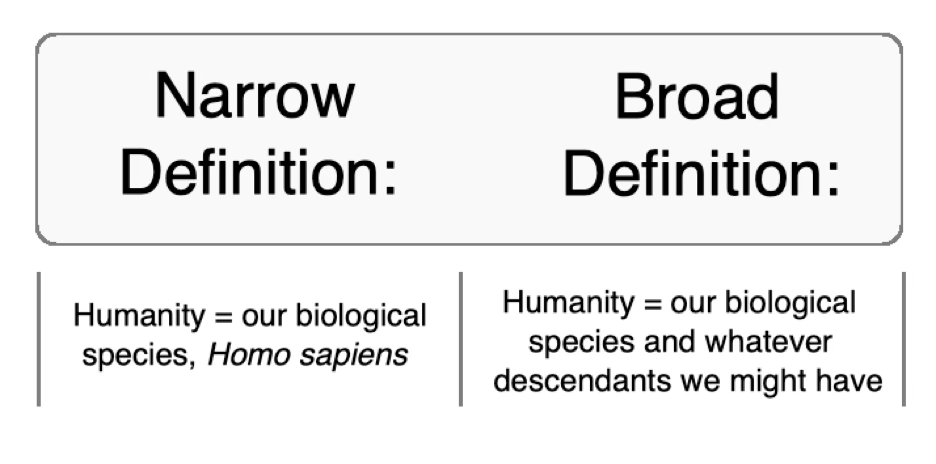
***
Both of these definitions refer to beings in the world. But there’s another way that TESCREALists sometimes use the word: as a shorthand for our values or type of consciousness. Consider the Musk-Page debate once again. We saw that Musk thinks it’s important for digital posthumans to care about the same things we care about, i.e., to share our values. But he also emphasized something else in his exchange with Page: “human consciousness,” he exclaimed, is “a precious flicker of light in the universe, and we should not let it be extinguished.” This was in response to Page’s question about why it matters “if machines someday surpass humans in intelligence, even consciousness.” Page saw Musk’s answer as “sentimental nonsense,” by which he apparently meant that it arises from a sentimental attachment to human qualities. That’s precisely why he called Musk a “speciesist.”
If “speciesist” means “a preference for the biological human species,” then Musk ain’t no speciesist. He’s a transhumanist who’s actively trying to merge our brains with AI while building an AI God in the form of Grok 10.0, or whatever. How does one make sense of this? The answer is that what Musk really cares about is our values and our consciousness. He doesn’t care about biological humans enduring, only that these two qualities persist into the posthuman era. Indeed, he seems to think that merging our brains with AI is one way to ensure these qualities persist: by transferring them to machines, they can continue and even proliferate in a world increasingly dominated by AI. His goal is to achieve “some kind of AI symbiosis, where you have an AI extension of yourself, like a tertiary layer above the limbic system and cortex.” And, as the TESCREAList Elise Bohan points out, the aim of this symbiosis “prevent humanity from being superseded.” Here, “humanity” can’t refer to our biological species, because a human-machine merger takes us in the direction of cyborg posthumanity. Rather, it must mean “our values” and “our consciousness.”
This usage of “humanity” can also lead to confusion. Recall that Musk shouted at Page: “Well, yes, I am pro-human. … I fucking like humanity, dude.” Yet Musk is not “pro-human” in the sense that most people would assume. He’s not “pro-human” in the way that I am, for example, since I actually want our biological species to persist. I don’t want our values or consciousness to endure in the minds of digital posthumans; I want them to endure in the central nervous systems of actual humans, because I actually do, in a literal sense, “fucking like humanity.” Once again, whenever TESCREALists talk about liking “humanity” or being “pro-human,” it behooves you to take a closer look to see which definition they’re using, or whether they’re employing such terms as shorthand for some abstract qualities they believe could be instantiated by some posthuman substrate.
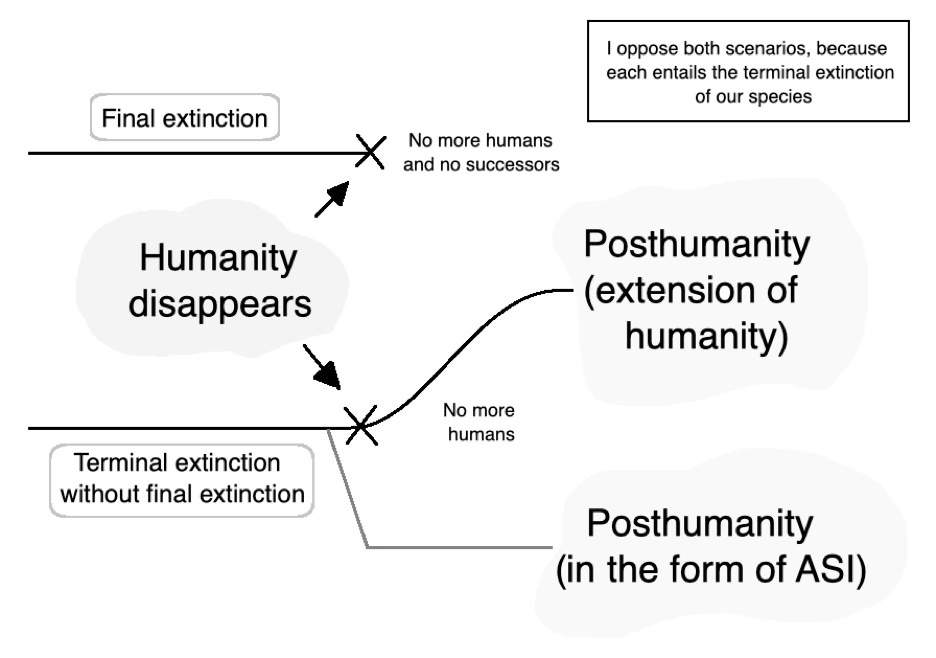
***
Turning now to the second word in “human extinction,” I argued in my academic tome Human Extinction that there are actually six distinct types of “extinction” scenarios that we could undergo. Only two are relevant to our present discussion, and both specifically concern the Narrow Definition. That is to say, the Narrow Definition—but not the Broad Definition—makes “extinction” ambiguous between two very different types of extinction. These are:
Terminal extinction: our species disappears entirely and forever.
Final extinction: our species disappears entirely and forever without leaving behind any worthy successors to take our place.
For TESCREALists who accept the replacement view, the only type of extinction that “must be avoided at any cost” is final extinction. The reasoning parallels that above: what really matters is the creation of a cosmic utopia among the heavens. This utopia can only be built by posthumanity—some worthy successor. (For folks like Verdon, Sutton, and Page, virtually any ASI that takes our place would be a worthy successor, so long as it’s superintelligent and conscious. For people like Musk, Yudkowsky, Ord, and many other EAs, Rationalists, and longtermists, posthumanity must possess additional properties to count as worthy.) Since final extinction is the only extinction scenario that would permanently foreclose the realization of posthumanity, it’s the only type of extinction that really matters.
Let’s be clear about this: final extinction logically entails terminal extinction, but terminal extinction does not logically entail final extinction. For example, if posthumanity emerged next year, then our species could die out—undergo terminal extinction—without final extinction having happened. Those posthumans would take our place, which means final extinction would have been avoided. Pro-extinctionism, in fact, is nothing more than the claim that we should aim for exactly this scenario: terminal extinction without final extinction. All that means is that our species ought to kick the bucket after posthumanity makes its glorious debut.
However, if terminal extinction were to happen next week, it would almost certainly entail final extinction—not logically, but contingently. This is because we haven’t yet created or become posthumans who could take our place. Terminal extinction would bring about final extinction if posthumanity doesn’t yet exist, but not once posthumanity has arrived.
The point is that terminal extinction itself isn’t what matters to TESCREALists, precisely because our species’ mission isn’t to create utopia, but rather to create the sorts of beings who will create utopia. Echoing earlier remarks about the Broad Definition, avoiding terminal extinction matters only insofar as it’s necessary to avoid final extinction. Once terminal extinction would no longer entail final extinction, then what’s the point of humanity sticking around? Why not bring about terminal extinction if this would no longer threaten utopia? We would, after all, only be sucking up valuable resources that they could use for something else, and there might even be “moral” arguments for why posthumanity should get rid of us.
***
To recap, TESCREALists often use “humanity” to refer to us and our posthuman successors, or to some abstract qualities that we possess. On those occasions when they use the Narrow Definition, they’re almost always talking about final rather than terminal extinction. Please be wary of their language games! As I mentioned above, the way they talk about “human extinction” and related issues often gives the impression that they’re on Team Human, when in fact many of them are actually pro-extinctionists who hold the replacement view.
Yudkowsky provides a glaring example. His coauthored book, If Anyone Builds It, Everyone Dies, has received considerable attention. Even Bernie Sanders and Alexandria Ocasio-Cortez appear to have been influenced by it, as Sanders sat down with Yudkowsky, Kokotajlo, and others to discuss AI safety, which was recorded in a video that Sanders shared on social media. My guess is that Sanders falsely thinks that Yudkowsky is on Team Human, and probably also that he’s opposed to anyone building ASI ever—that is, after all, what the title of his book suggests.
In fact, Yudkowsky wants to build ASI asap, he just doesn’t think we’re ready yet. If the alignment problem were solved next week, then he’d suddenly switch sides and join the radical accelerationists in calling for AI capabilities research to be throttled full-speed ahead. I doubt most people reading his book understand this. As his organization MIRI wrote in 2024,
we remain committed to the idea that failing to build smarter-than-human systems someday would be tragic and would squander a great deal of potential. We want humanity to build those systems, but only once we know how to do so safely.
The word “potential” here refers to our “glorious transhumanist future” in which, as Yudkowsky argues, posthumanity might simply clear all humans off Earth and leave it as a nature sanctuary. Yudkowsky is neither anti-ASI nor pro-human, though his mendacious use of language fools people into thinking otherwise. Again, if he thought that we could build an ASI that would bring about his pro-extinctionist utopian fantasies next week, he would shout: “Best do it so!”3
Or, consider Bostrom. Despite his apparent defense of the coexistence view in the quote from earlier, he actually appears fairly aligned with pro-extinctionism. As the statistician and futurist Olle Häggström notes, “among thinkers with at least some successionist tendencies, one might even include Nick Bostrom,” where “successionist” is Häggström’s term for “pro-extinctionist.” Take Bostrom’s definition of “existential risk” as “one that threatens the premature extinction of Earth-originating intelligent life or the permanent and drastic destruction of its potential for desirable future development.” Häggström writes that
the reason he speaks of “Earth-originating intelligent life” here, rather than simply “humanity” [on the Narrow Definition], is that he is able to envision scenarios where humanity has been replaced by successors so worthy that the scenarios should count as sufficiently benign to not warrant the label existential catastrophe.
By utilizing the Broad Definition, Bostrom can embrace pro-extinctionist views while simultaneously claiming to care about “humanity” and oppose “human extinction.”
This gets at the reason I strongly prefer the Narrow Definition: it enables far more precision. It forces “extinction” to become ambiguous, which opens the door to nuance. I strongly oppose the terminal extinction of our species, which is what I mean by “human extinction.” In contrast, TESCREALists only care about this as a means to an end, not an end in itself. Our survival is just a means to the end of their bizarre notion of a cosmic utopia full of digital space brains. Once this utopia becomes possible to build by our posthuman progeny, then the survival of you and me—of the 8.2 billion people on Earth right now—becomes a matter of moral indifference or positively undesirable.
Let’s reflect for a moment on the dire implications of this picture. Accelerationists like Verdon offer us a single option for the future: the extinction of our species, which they hope will happen in the coming years. People in the AI safety camp more graciously (I say sarcastically) offer us two options: the extinction of our species or the extinction of our species. In the first case, “extinction” specifically refers to final extinction. This would happen if we were to build a misaligned ASI, which would by default turn around and destroy us. Worse, it would spread its misaligned values into the universe, resulting in an existential catastrophe. In the second case, “extinction” refers to terminal extinction without final extinction. This would happen if we build an aligned ASI that transforms (part of) humanity into posthumanity and then brings about a posthuman paradise among the stars. For all the many reasons specified above, this “best-case,” “utopian” outcome would almost certainly result in our species dying out.
In both cases, the outcome is identical for our species: terminal extinction. That’s why I argue vociferously that the entire TESCREAL framework is rotten to the core and must be abandoned. It’s why I think we must defeat the TESCREAL worldview if we want to permanently end the ASI race. No one in the TESCREAL movement is advocating for a good future for our species, not even the coexistence people, since a world ruled and run by posthumans would inevitably result in humanity being sidelined, marginalized, disempowered, and ultimately eliminated. Human extinction or human extinction: the choice is up to us, unless we demolish the worldview in which these are the only two options before us.
***
To summarize some key points of this essay, posthuman eschatology is the view that we should introduce a new posthuman species to the world, ideally in the near future. This leaves open a number of questions: should these posthumans be digital or biological? Should they arise as an extension of humanity or take the form of autonomous beings we create in the lab? Should the population of posthumanity include some of the same people alive today? Must these posthumans share our values and care about the same things we care about (whatever that means)? And once they’re here, should our species stick around or follow the dodo into an eternal oblivion? If we should die out, then how exactly should this happen: through some involuntary process (which would never happen), or via coercive means, perhaps even including outright omnicide (the murder of everyone)?
All TESCREALists accept a posthuman eschatology. It’s the common denominator underlying all these ideologies. TESCREALists just disagree about the details. Those disagreements can lead to heated, vicious debates, but these should be seen as nothing more than family disputes. Everyone agrees with the same basic vision of the future: give birth to posthumanity, spread beyond Earth, plunder the cosmos for its vast resources, and build a glorious multi-galactic civilization at the top of the Kardashev scale occupied by potentially fast numbers of immortal space brains living lives of “surpassing bliss and delight,” to quote Bostrom’s “Letter from Utopia.” This is the ultimate telos toward which we ought to be striving, which is precisely what inspired the founding of AI companies now engaged in a reckless race to create an algorithmic God.
As always:
Thanks for reading and I’ll see you on the other side!
Note that copy-pasting text from Microsoft Word strips the document of footnote citations. If you have trouble finding any of the quotes I include, please let me know and I’ll share the relevant link with you. Also, please message me if you notice any typos. Thanks so much! :-)
The title is, of course, a nod to this article by Jaron Lanier.
This is a reference to Extropianism.
Great post. Your description of TESCREAL as "Eugenics on Steroids" is spot on. I happen to be at the Cold Harbor Laboratory today, the headquarters of the American Eugenics movement in the first half of the 20th century. As I read through old articles from the "Eugenical News," the similarities to the rhetoric (and delusions) of the modern transhumanists are dumbfounding: we will take charge of our own evolution, science can do everything, it will be paradise, current humanity will be replaced by something better -- and especially by something more intelligent. We all know how that movement ended, and it wasn't well.
Every time I read about e/acc or any TESCREAL ideology, I just keep thinking about how depressed or angry these people are deep inside. That seems to be the real issue, coupled with the runaway hyperrationality that is a buffer for those unprocessed emotions. Of course there is neurodivergence at play as well but that isn't the whole story.