

This is the second article I will have published in three weeks on someone copying the ideas of others. The timing is interesting — and coincidental — given the complete shitshow surrounding Dr. Jason Arday, who recently died after being hounded by the media for weeks about his apparent plagiarism. As the lack of media interest in my article about Nick Bostrom shows, no one cares when white men repackage other people’s ideas as their own.
The following piece is far longer than usual. It will be most relevant to those with a strong interest in the TESCREAL thesis. The footnotes, in particular, contain a wealth of information about how I’ve outlined and elucidated this thesis over the years. A shorter, more accessible article will be published tomorrow. Thanks so much, friends!
tl;dr
Connor Leahy offers an intellectual history of the Silicon Valley worldview that is strikingly similar to the history outlined by Timnit Gebru and myself.
He highlights the TESREAL (no “C”) ideologies as having played an integral role in launching the race to build ASI (artificial superintelligence), whereas we highlight the TESCREAL ideologies.
In copious footnotes, I show that many of Leahy’s claims are nearly identical to claims I’ve made in articles and interviews over the past many years.
This cannot be a coincidence, since it’s impossible to work in the space of AI and not have come across my work (solo and with Gebru) on the TESCREAL bundle.
Very, very few people have told this story in any good sense. I would love for more people to tell this story ‘cause it’s [a] fucking crazy story, man. Oh man. So the story as we have it today with, like, you know, this, like, ChatGPT and AGI and ASI and AI risk. All of this stuff descends from this one weird offshoot 1980s group of futurists called the Extropians.
— Connor Leahy, November 6, 2025.
Connor Leahy is the cofounder of Conjecture, an AI safety organization at which he was CEO until this year, and he cofounded a nonprofit AI research company called EleutherAI. He is currently the US Director at ControlAI, which is seeking $50 million in annual funding. According to Wikipedia, “he has testified before the House of Commons of Canada and participated in the inaugural AI Safety Summit in 2023.” He has appeared multiple times on CNN, as well as CBS, ABC News (Australia), Al Jazeera English, BBC, and countless popular podcasts, stacking up millions of views.
He mentions in many interviews that he speaks to policymakers in DC, where he’s based, about AI existential risk. If you read or write about AI, there’s no way you’ve missed him. He has become one of the leading voices warning about the annihilatory dangers of misaligned ASI (artificial superintelligence).
Recently, he gave an interview on the Onezero podcast hosted by Robert Wright, whose work I admire. It’s titled “The Ideology Behind AI,” which happens to be a primary focus of my research over the past many years. I found this interview to be deeply problematic, and am inclined to describe Leahy’s conduct as unethical.
But first, it will be useful to provide an overview of Leahy’s basic argument. Take note, if you’d like, of the copious footnotes pointing to articles, interviews, and tweets in which I have made virtually identical claims. My apologies for this overview being rather long (~2,000 words), but I believe this is necessary to make my point. Here goes:
Leahy’s Analysis
Note that I have slightly edited the quotes below to improve readability (e.g., removing words such as “like” and “you know”). The meaning remains intact.
“There’s a lot of really fascinating history” with respect to the “milieu” or “scene” out of which the ASI race emerged, Leahy says. The goal of creating God-like machines “didn’t come out of a vacuum. This is not the ruthless market decided [sic] this is the optimal thing to go for. These are ideas that actually grew out of a very specific ideological lineage that I would say really started with what is called the Extropians.”1
Extropianism, Leahy says, is a “particularly intense form of what’s called transhumanism more broadly. Transhumanism is a very, very broad set of philosophies that in various ways are about belief that humanity should be improved or transcended in various ways,” in particular, through technology that enables us to reengineer humanity.2
He says that “San Francisco as a place is, and Silicon Valley is, a really weird place.3 And it really has, I would say, three main ideological strengths that kind of all mix and mutate in this stew. And these three are the transhumanist, techno-utopian kind of visions4 and also coming from golden-age sci-fi, and stuff like that, which we’re talking about. The other one is just cutthroat capitalism — libertarianism. And the third is true new age communist, you know, crazy hippie ideology. All of these are core to the soul of Silicon Valley.5 And if you neglect any one of them, you won’t understand what’s actually going on. So, all of these cultures of all these [AI] companies … should be understand [sic] as being influenced by these three large ideological clusters to varying degrees.”6
“So,” he continues, “this is where I think the origin of this culture kind of comes from. And then the modern version of what you now see in many of these, like, AGI religions or cults almost7 is coming from the Extropians,8 who are a particularly intense form of transhumanism that kind of emerged in the 80s by a guy named Max More — I think was the one who first coined the term.9 Extropianism was all about exponential growth.10 It was this idea that we could get exponential amounts of energy and growth and intelligence, and improve everything at unbelievable levels …”
He adds that Extropianism “was one of the first ones to really seriously grapple with some very intense ideas such as whole-brain uploading, immortality, and AGI … and superintelligence as concepts.11 They were some of the first people to really think seriously about some of these ideas in the 80s and the 90s.”
Leahy describes how Eliezer Yudkowsky befriended Max More and his wife, Natasha Vita-More, and how he “was someone who was very early on the Extropian mailing list, and so on, talking about these ideas of superintelligence. They didn’t exactly call it that back then, but that’s what they were talking about: this idea of, if you had this recursively self-improving AI that could improve itself, you could … build these incredibly powerful superintelligent beings that could cure all diseases, could solve all problems, could turn the whole universe into … nanobots, or whatever — like, really intense sci-fi stuff.”12
Leahy then notes that the SL4 mailing list grew out of the Extropians mailing list and Yudkowsky’s “interest in this topic in the late 90s and early 2000s.13 He actually splinters off from Extropians and creates” this alternative mailing list, “which is where we see some of the first overlap with some names you might otherwise recognize [from the AI world]. SL4 was a mailing list for talking about these most intense kind of — even more intense than Extropianism. Like, the most intense forms of future sci-fi speculation.” Names associated with the mailing list include Shane Legg, cofounder of DeepMind, and Nick Bostrom.14 Wright then mentions that Shane Legg coined the term “AGI” (artificial general intelligence, the precursor to ASI, though it’s sometimes used as shorthand for ASI), to which Leahy says, “I think he did. Yes, if I remember correctly.”15
Leahy observes that Yudkowsky “founded an organization called the Singularity Institute” in 2000.16 “So, very ahead of his time.” The initial “goal was to build AI as fast as possible so that we could have AI that can take over the world and fix all the problems. … And so, at this time, this is what really would nowadays be called accelerationism.17 So, you know, the e/accs [effective accelerationists] are little, little babies compared to” Yudkowsky — “he was 20 years ahead of them,”18 although “there’s a broader category of accelerationism that I think is not specific to [him].” It has a connection to Nick Land.19
Leahy then adds: “Fun fact, one of the first people to give [Yudkowsky] money was Peter Thiel.”20 But Yudkowsky, in contrast to Thiel, later came to believe that “if you build something that smart, by default, this does not go well. And so he pivots entirely to thinking about, ‘How do you build safe AI?’ How do you build safe — back then it’s called ‘Friendly AI,’ but what we would call ‘safe’ or ‘controllable’ or ‘aligned.’” Consequently, Yudkowsky “started developing this ideology that he would call Rationalism.”21
He continues: “So, you said this kind of earlier which, like, oh there’s all these things going on that we just didn’t know about and it wasn’t like they were hiding it. Well you would be wrong: they were in fact hiding it. So, this was a thing in the early days of this movement — very early on there was a strong part of the ideology is that don’t tell people — don’t let the stupid unwashed masses know about this. Don’t let the government know about this because they’re, you know, they’re stupid. They don’t understand it. We the smart elites who are super-smart, we’re going to solve the problem. You know, we’re going to solve everything. You know, I just have to make sure that all these dumb, stupid, you know, normal people don’t get in the way.”22
Wright brings up the infighting in these groups, to which Leahy says: “this feels like it happens every six months — there’s a lot of infighting inside of these milieus.” He adds that one reason he’s “broken a lot with these group [sic] of people is because I think it is extremely bad to hide this kind of information from people in the government. I think people are allowed to have insight and make decision-making [sic] on this thing [i.e., building a Digital God]. Doing this unilaterally is deeply immoral.”23
Moving on with the story, Leahy notes that in the “second half of the 2000s, a couple really interesting things starts [sic] happening. One thing is, is that DeepMind is founded. DeepMind, including seed capital from Peter Thiel,” thanks to Yudkowsky introducing “Peter Thiel to Demis [Hassabis] and Shane [Legg] to get some other initiative.”24 Although not “all of the money came from Peter Thiel or this one conversation [after the 2010 Singularity Summit], but it still was a pivotal moment and shows this overlap between the DeepMind and kind of the [Yudkowsky] and, like, this race dynamic thing.” The goal was to get all the smartest people “into one company and keep the government and everyone else away, then we can do it right. Then we can do it properly because then we will have control.”
“So,” Leahy says, “I think we’re starting to assemble all the ideological building blocks that lead to the rickety edifice that we’re at now, where there’s one block missing, which is kind of Oxford University utilitarianism — Peter Singer and [William] MacAskill, which led to what is called Effective Altruism.”25 He notes that “in a sense there’s kind of a bait-and-switch, where you read the head on the tin, what EA says, and you say, ‘Well, that seems very reasonable,’ but then if you open the tin you’re suddenly going to see a lot of crazy stuff.”26
There is only one possible thing Leahy could be referring to here, and that’s longtermism. Some longtermists themselves say that the ideology leads to “crazy town.” As footnote 24 notes, longtermism was the primary focus of EA from its inception.
He continues: “You’re [sic] suddenly see your Anthropics, and your whatever — your people saying that actually replacing humans with AI is good, maybe, or that we have to race to ASI or like many, many crazy things.”27 What happened here? “What happened basically is that this pretty non-objectionable version of EA28 merged through this shared link of utilitarianism with Rationalism and this libertarianism, Bay Area Silicon Valley culture, to create kind of the new mutant ideology. And this grew out to a large degree from — so, one of the largest and most important early EA organizations was called GiveWell.”
What’s that? GiveWell “was an organization that evaluated charities for effectiveness and would help you make better donations, which I think is a very reasonable thing to do. It was founded by a previous hedge fund manager named Holden Karnofsky. And Holden later then got to know one of the Facebook founders, Dustin Moskovitz. Dustin Moskovitz decided to donate a very, very large amount of money to a foundation that Holden Karnofsky would lead, and this became what is called Open Philanthropy.”29
That organization’s money has “gone to OpenAI, to Anthropic, to METR,”30 along with lots of AI safety groups. “What is important to understand about Open Philanthropy is that it is the beating heart of the financial system of EA — is that the engine that kind of fed Effective Altruism to a large degree in Silicon Valley specifically [i.e., the longtermist movement] came through Dustin Moskovitz’s money being funneled through Open Philanthropy. It’s hard to overstate how big of an influence they were.”31 Even more, Karnofsky married Dario Amodei’s sister, Daniella, and “in fact, Dario and Holden were roommates for over 10 years.”32
A key point here is that, Leahy says, “what you’ll see is that the same names keep popping up quite a bit. You can kind of pick and choose almost anyone of the, you know, here and there will be a connection. There will be a connection to OpenPhil or to MIRI. … DeepMind. These people all know each other.33 And this is why I think it’s so fascinating, is that there was an AGI superintelligence scene long before the technology existed. Long before it existed, and it overlapped very heavily with these other adjacent ideologies like Rationalism and Effective Altruism, and so on. And this world is extremely incestuous — extremely incestuous.”34
Leahy notes once again that these are basically cults and, after Wright asks about the Venn diagram of all the ideological communities, Leahy describes it as “an extended cluster that is located primarily in Berkeley and San Francisco.” He adds: “There’s just an extended scene. It’s not one ideology. It’s a scene.35 Some of it is EA; some of it is Rationalism; some of it is just AI company employees.”
That said, it’s not the case that “everyone in Silicon Valley or at these AI companies is deeply part of this culture. But you’d be surprised how many are. You’d be surprised how much this culture has been very influential on the thoughts of people. Even the accelerationists, who … love to present themselves as the anti-EAs [but] they’re part of the same culture. They’re the same. … It’s just like there’s two bits of difference, but it’s like … almost everything is the same. It still comes with this techno-utopian vision, this vision of superintelligence, this openness to a lot of alternative strange things,” etc.36 Leahy even adds that there is a lot of tension between some of these groups, drawing this analogy: “There’s the saying, ‘the only thing a leftist hates more than a rightwinger is another leftist,’ right?”37
At one point, Leahy declares to Wright that “the extended cluster of like all of these adjacent ideologies and beliefs38 doesn’t really have a name.”39 Wright also says during the conversation, rather humorously: “You know, I gotta say for people who [are] younger than me with great literary ambitions there is a great intellectual history to be done about all this, right?,” to which Leahy replies: “Oh yes, oh my god, like, there is. That will be unlike other intellectual history you know.”
“TESREAL” Versus “TESCREAL”
That’s the gist of Leahy’s analysis. I encourage you to listen to the entire interview yourself, beginning around 14:00, as there are many details that I don’t have space to mention here.
What do you think? Does Leahy’s analysis, um, sound familiar? He weaves together an intellectual history in which the main characters are every letter in the TESCREAL acronym, presented in roughly that order, except for cosmism.40 That is, Leahy highlights:
Transhumanism.
Extropianism.
Singularitarianism. (The idea that we should bring about the Singularity by triggering an “intelligence explosion,” in I. J. Good’s phraseology, via recursive self-improvement.41)
Rationalism.
Effective Altruism (EA).
Longtermism. (As noted, this is the version of EA that’s gained a foothold within the Valley. When people talk about EA in SV, especially with respect to the ASI race, they’re almost always referring to longtermism.)
He adds that e/acc is yet another ingredient in the alphabet soup of ideologies, just as Gebru and I do, and as I do in numerous solo articles and interviews.
His analysis centers around the TESREAL (no “C”) ideologies, plus “e/acc.” In exactly the same way, my analysis with Gebru centers around the TESCREAL ideologies, plus a “variant” called “e/acc” — which I have elsewhere characterized as a major camp within the TESCREAL movement, the other being the doomers.42
Furthermore, Leahy refers to this as a “cluster” of ideologies, just as I’ve called it a “constellation” and, back in 2023, a “cluster of ideologies.” In our coauthored paper, Gebru and I refer to TESCREAL as a “bundle.” Leahy says that these ideologies constitute “an extended scene,” whereas Gebru and I describe this cluster as a “movement” (basically synonymous with “scene” in this context). Leahy also asserts, as noted above:
I’m not saying by any means everyone in Silicon Valley or at these AI companies is deeply part of this culture. But you’d be surprised how many are — you’d be surprised how much this culture has been very influential on the thoughts of people.
Gebru and I write:
It is important to note that not everyone associated with ideologies in this bundle believes in the totality of the dominant views in this bundle, and some people may even object to being bundled in this manner. Many people working on AGI may be unaware of their proximity to TESCREAL views and communities. Our argument is that the TESCREAList ideologies drive the AGI race even though not everyone associated with the goal of building AGI subscribes to these worldviews.
If you noticed the many footnotes I added to the previous section,43 you’ll see that nearly every important point that Leahy makes has been made previously by me (solo or with Gebru), sometimes using rather similar language. This isn’t just about the details. It’s about how those details hang together to form a panoramic narrative of intellectual history.
Indeed, many people have said things that are similar to particular claims found in my work (solo and with Gebru). But Gebru and I were the first to assemble the heap of these claims, along with many additional new claims, into a comprehensive picture of the origins of the AGI race.
Leahy’s TESREAL (no “C”) analysis is little more than my analysis with Gebru, minus our emphasis on the role that modern cosmism played in inspiring the ASI race. (The term “AGI” was popularized by a transhumanist, Extropian, singularitarian who founded modern cosmism. He also played an integral part in getting the field of ASI research off the ground. A deeper analysis would reveal that cosmism is an essential part of this intellectual history.)
It’s not that Leahy’s account is somewhat similar to ours/mine. The problem is that it’s virtually identical in every important sense.
What Others Think
Indeed, the reason I became aware of his interview with Wright was because a friend of mine, a lecturer (we’d say “assistant professor” in the States) who’s published extensively on transhumanism, sent it to me along with the message:
He’s saying a lot of the stuff you and I talk about all of a sudden. Being clear about the link between transhumanism and the AI industry. Basically talks about them being a cult, doesn’t use the term TESCREAL. Feels like he’s been reading your articles. But doesn’t attribute. … He goes through the whole TESCREAL thing without ever saying TESCREAL. … I sent you that video cos I really thought he’s saying all your stuff without credit. It almost was weird him not mentioning [sic] the term TESCREAL given his thesis.
(Note that the quote above and all those below have been reproduced with permission.)
After watching the interview myself, I was quite shocked by the significant and extensive similarities. So, I sent it to numerous friends and colleagues, asking for their opinion. Every one who reported having intimate familiarity with my work (solo and with Gebru) echoed the comments above. For example, one person in the AI safety field said:
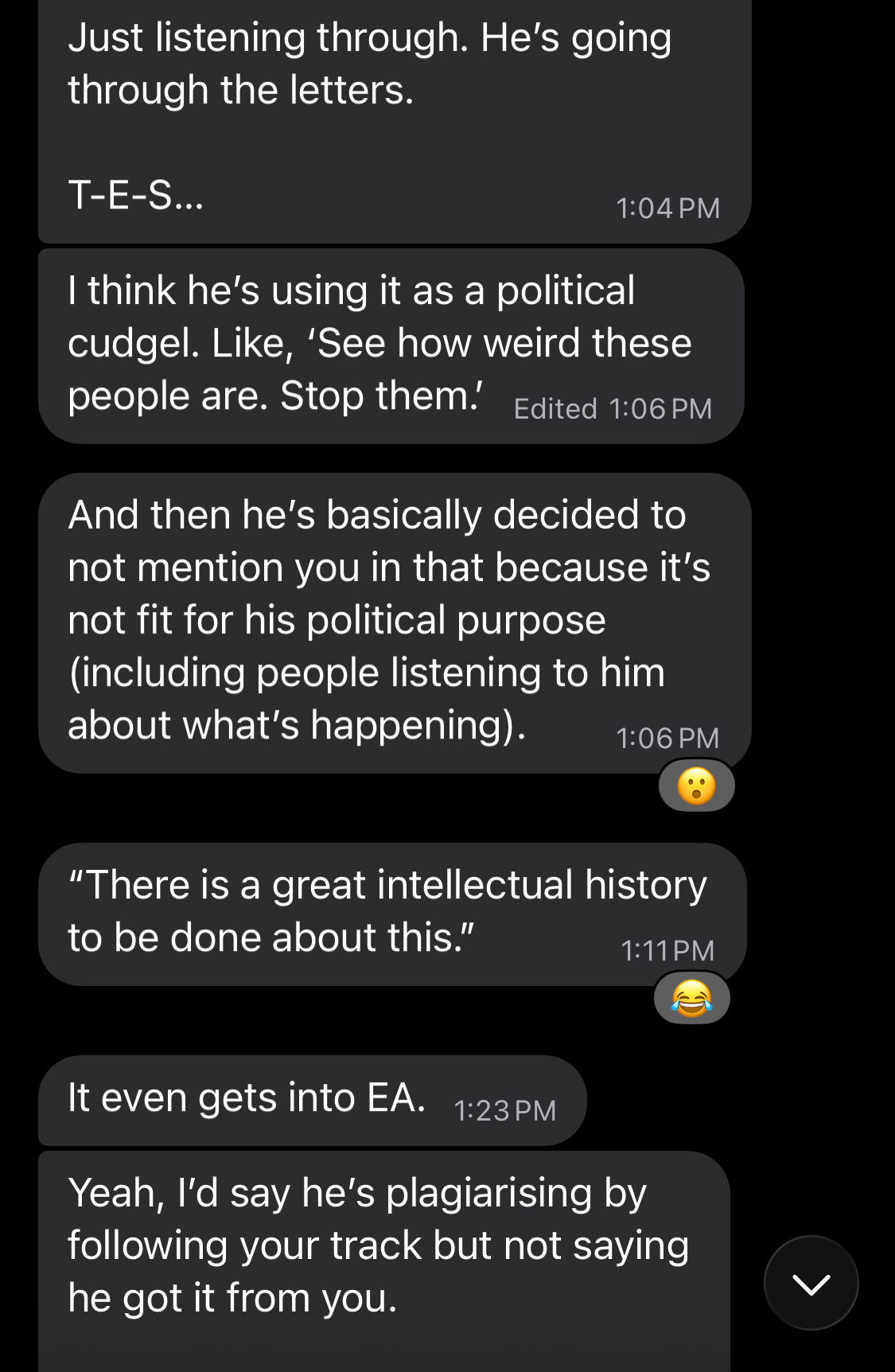
Another person who knows my work in depth said:
I find it hard to believe that Mr. Leahy knows as much about AI as he does without also knowing that you and Dr. Gebru lay out the intellectual history which he discusses in your First Monday paper and elsewhere [a point that I will return to below]. For that reason, an accusation of plagiarism seems reasonable.
Yet another person — a distinguished professor affiliated with Oxford — watched the first 25 minutes and said that, while Leahy’s analysis is similar to mine thus far, it’s not entirely clear that he’s an “intellectual thief.” I told them that the similarities become even more significant as the interview proceeds. The following day, this person sent me a second message:
You’re right — it gets worse. He says “there’s no name” for the cluster of ideologies, his cult analysis, his claim that there are but “two bits of distance” between EAs and e/accs … I don’t know what to say. Your publication record is very clear and has been picked up by mainstream journalists. I only know Leahy from the AI doc [in which he aligns with the doomer camp]. Now he must sense that the tide is turning and he wants credit for calling it out. Yes, it’s ugly. He knows your work, for sure. What to do about it is another question….so sorry…..
I will include some additional quotes just like these below.
On Twitter, I brought up the issue with Wright, who asked me to clarify what I meant by “TESCREAL thesis.”44 Here’s my abstract-length synopsis of my work (solo and with Gebru) over the past many years:
[A] simple answer would be: one cannot make sense of the origins of the AGI race — or the way this race has been sustained and accelerated — without understanding a lineage of ideologies that dates back to the late 1980s and revolves around libertarian transhumanism. This lineage starts with Extropianism, which gave rise to singularitarianism (Extropians even coined “singularitarian”!), (modern) cosmism, Rationalism, and an ideological offshoot of EA called longtermism (when people talk about “EA” in SV, they’re really talking about longtermism). It has more recently split into competing camps of doomerism and accelerationism (both direct descendants of Extropianism, the latter of which is also influenced by Land).
Putting the thesis differently, the key claim is that libertarian transhumanism (Extropianism) gave rise to a cluster of overlapping and interrelated ideologies that have crucially shaped the orthodox Silicon Valley worldview and directly inspired the race to build God-like machines: all of the leading AI companies directly emerged out of the TESCREAL movement. This is what I’ve been arguing since 2022, though you can find me talking about the general idea on social media since 2019.
I’ve outlined this analysis in literally hundreds of articles, radio interviews, TV interviews, podcast interviews, and episodes of my podcast Dystopia Now with Kate Willett (which Leahy is welcome to appear on). Along with the Ethics of Human Extinction, TESCREALism — the history of Silicon Valley ideologies and their relationship to the AGI race — has been a primary focus of my research since about 2021, when I published my first systematic critique of EA/longtermism in Aeon. (I hadn’t coined the “TESCREAL” term yet, but I was basically talking about the same phenomenon, as I see longtermism as being, in a particular sense, the culmination of the TESCREAL movement and it’s pro-extinctionist implications.)
A few examples:
AI and the Threat of “Human Extinction”: What Are the Tech-Bros Worried About? It’s Not You and Me. Salon. June 11, 2023.
The Acronym Behind Our Wildest AI Dreams and Nightmares. (Note that I didn’t choose the title!) Truthdig. June 15, 2023.
What’s Behind the Race to Create Artificial General Intelligence? Understanding the TESCREAL Bundle of Ideologies. (A discussion with Timnit Gebru.) Truthdig. July 28, 2023.
Does AGI Really Threaten the Survival of the Species? Truthdig. June 30, 2023.
“Effective Accelerationism” and the Pursuit of Cosmic Utopia. Truthdig. December 14, 2023.
The TESCREAL bundle: Eugenics and the Promise of Utopia through Artificial General Intelligence. First Monday. June 2024.
What Is the “TESCREAL Bundle”? Answering Some Frequently Asked Questions. Substack. June 2024. (Note that I recently unpublished this to rewrite it. It was online for at least a year or so.)
The Endgame of Edgelord Eschatology. Truthdig. April 25, 2025.
TESCREAL. Oxford Research Encyclopedia of Science, Technology, and Society. 2026 (a prepublication draft was available by March 2026).
Skeptical of the TESCREAL Acronym? Read This. Realtime Techpocalypse Newsletter. July 9, 2026.
You can find more examples here, although this is not an exhaustive list. There’s also Gebru’s 2023 talk on the subject (below), as well as a 2024 conference at The New School for Social Research that centered on the TESCREAL ideologies and featured speakers like Douglas Rushkoff, whose term “The Mindset” overlaps in important ways with the TESCREAL concept.
I’ve also explained the TESCREAL thesis in multiple documentaries, including In the Belly of AI, Ghost in the Machine, and Elon Musk Unveiled: The Tesla Experiment.



As discussed in the final section of this article, I am constitutionally disinclined to complain about people “copying” or “plagiarizing” my work without attribution. The problem here is how very similar the picture Leahy paints is to the picture that Gebru and I present. There is hardly any substantive difference between his TESREAL account and our TESCREAL account.45
On the origins of my collaboration with Gebru:
In 2022, I began publishing a flurry of articles critiquing EA and longtermism. My real target was the TESCREAL ideologies, though I (with Gebru) hadn’t coined the term yet. That’s because longtermism contains transhumanism within it. As I’ve said before, longtermism is essentially transhumanism plus space expansionism, built on a broadly (totalist) utilitarian ethical foundation. And my understanding of transhumanism at the time was that the most influential version within the Valley was libertarian transhumanism, first instantiated by the Extropian movement in which people like Bostrom, Yudkowsky, Goertzel, Kurzweil, and others (even Hans Moravec!) participated.
Gebru was puzzled by the sudden fixation in her field of AI on what was then called “AGI,” and which now is often referred to as “ASI.” She stumbled upon some of my articles and had an “ah-ha” moment: the new obsession with AGI came from the EA-longtermist ideology.46 Advocates of this ideology saw it as the most straightforward path from here to a cosmic utopia — if AGI is “value-aligned.”
So, she contacted me and suggested that we write a paper together, which we started in late 2022 or early 2023 (I can’t recall). It was during this collaboration that I coined the term “TESCREAL.” The reason is that we found that one cannot give an exhaustive explanation of the origins of the AGI race without reference to all seven ideologies. But referencing these ideologies throughout the paper rendered it unreadable. Hence, I coined the acronym to streamline our discussion.
The resulting article was an intellectual history and critique of the Silicon Valley worldview that has launched, sustained, and accelerated the AGI race. If not for Timnit’s invitation to collaborate and subsequent contributions to this intellectual history, the term “TESCREAL” wouldn’t exist. She played an essential role in developing the TESCREAL concept and explanatory framework.
When I talk about “my work” below, I mean both my 2024 publication with her and my solo pieces. The TESCREAL paper was partly inspired by, and drew from, prior articles of mine, and much of my work since then has been elaborating various aspects of the TESCREAL framework.
Why Not Cite Us?
There are three possibilities47:
Leahy isn’t familiar with my work on the topic. Hence, he is independently discovering my (and Gebru’s) analysis.
Leahy knows that my work on the topic exists but has misunderstood it. He doesn’t mention it because he considers it a flawed analysis, or doesn’t realize that his TESREAL account is, in fact, virtually identical.
Leahy is familiar with and understands my work on the topic, but he chose not to mention it despite outlining a virtually identical account.
Taking these in order:
1. Leahy Can’t Have Missed the TESCREAL Analysis
If (1) is the case, then I’d say that Leahy hasn’t seriously researched the topic. It’s impossible to have missed the hundreds of publications, interviews, etc. that I (and Gebru, as well) have written or given. The foundational article with Gebru already has more than 300 citations, and scholars have published articles with “TESCREAL” literally in the title (e.g., this one examining the intersection between the TESCREAL community and psychedelics).
“TESCREAL” has its own Wikipedia entry, as well as an entry in the Oxford Research Encyclopedia (linked above). People on the EA Forum and LessWrong have discussed the acronym, which some have included in the title of their articles, and Leahy has accounts on both websites (here and here). Sam Altman has referenced it on Twitter (below, LOL), Yudkowsky is aware of it, and Marc Andreessen even included “TESCREAList” in his Twitter bio in 2022. And so on.


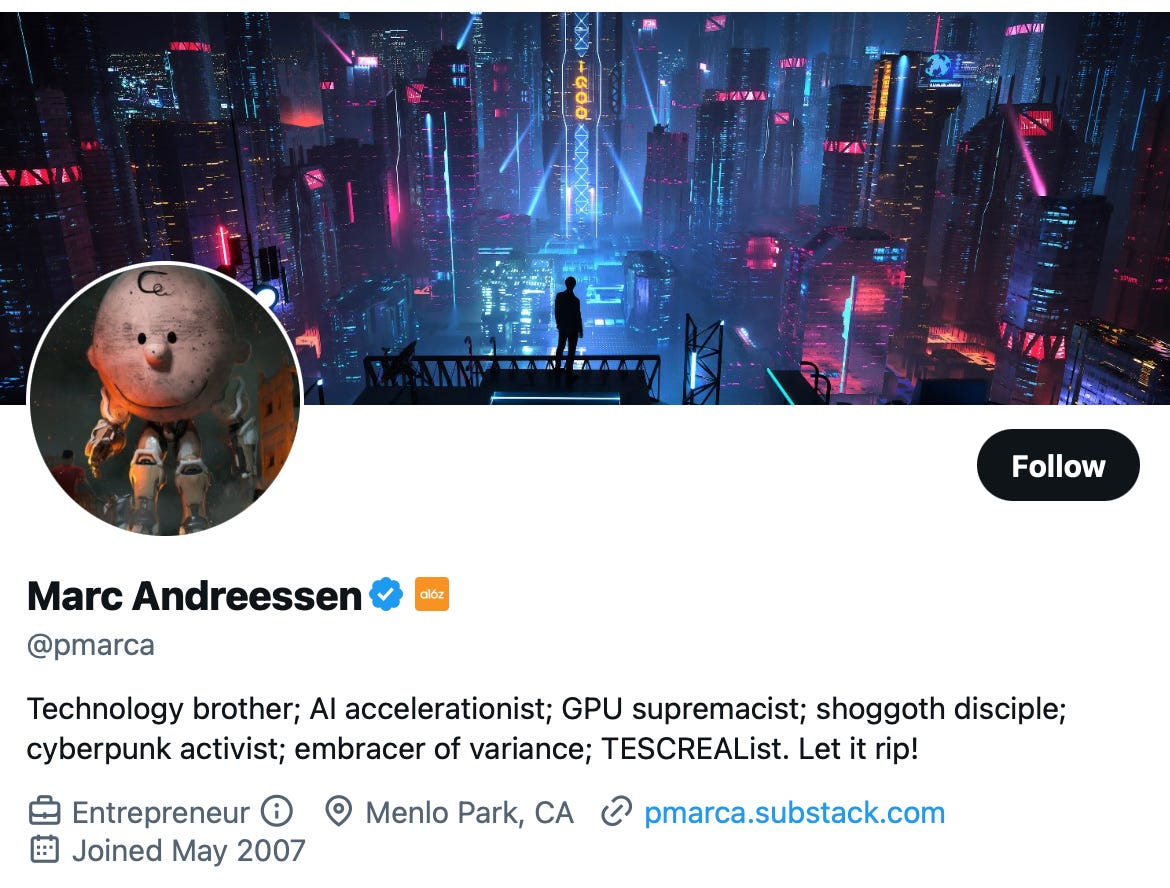
If you write about AI, and especially if you research the ideologies of Silicon Valley, you will inevitably come across my work. Literally the first website that comes up when you search “ideologies of Silicon Valley” on Google is a 2025 paper by Kendall Giles titled, “Silicon Valley Ideologies.” Here’s an excerpt of the abstract:
Through the quest for Artificial General Intelligence (AGI), the case illustrates how intellectuals and institutions, from OpenAI to Google, sell ideologies branded as TESCREAL: Transhumanism, Extropianism, Singularitarianism, Cosmism, Rationalism, Effective Altruism, and Longtermism. These ideologies predict posthuman evolutionary destinies, mind uploading, and space colonization, with speculative existential risk frequently taking precedence over near-term social harms like bias and inequality.
Even more, I tagged Leahy in a tweet last year in which I intimated that he should cite me and Gebru when writing about the topic, as he published a 2025 report that included a section on the ideological nature of the ASI race (focusing primarily on singularitarianism).
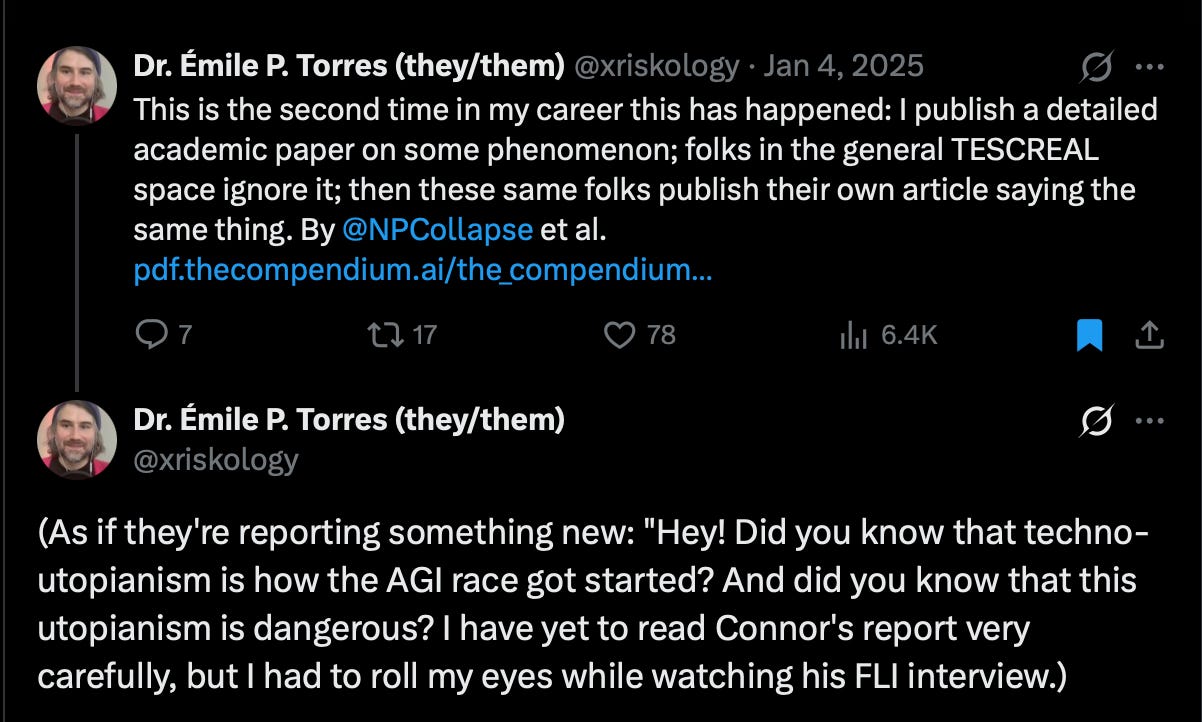
Finally, Gebru and I are the only people who’ve discussed this specific topic in this particular way — it’s not like our analysis is a needle in the haystack. As alluded to, if you were to search for intellectual histories of the Silicon Valley worldview that’s driving the ASI race from 2022 to the present, you’d find very little except for our work. (There are exceptions, such as Elise Bohan’s PhD dissertation on the history of transhumanism, which Leahy actually cites, as well as Alexander Thomas’ The Politics and Ethics of Transhumanism.)
It is, therefore, utterly implausible that Leahy has never encountered my work during his “Internet archaeology” (his term) on the topic. As my colleague said above: “I find it hard to believe that Mr. Leahy knows as much about AI as he does without also knowing that you and Dr. Gebru lay out the intellectual history which he discusses in your First Monday paper and elsewhere.”
This was echoed by yet another person (not previously quoted), who remarked in a voice message to me:
It’s hard to say directly, “Okay, this is clearly stolen ideas.” But, I would say that the issue is that it’s kind of hard to believe, especially since he has been in the scene, or in that general ideological landscape … that he has not come across you or Timnit … that is really where the rub is. Like, he must have at some point, since he has clearly researched it, and your name is just the one that comes up first. And, in that sense, I’m just on a basic level not buying it that it isn’t plagiarized. That seems like absolute bullshit. But it’s hard to say — it’s hard to prove.
2. A Genuinely Curious Person
If (2) is the case, then I’d also argue that Leahy hasn’t done his homework. Given his TESREAL analysis, surely he would have spent some time reading my articles (solo and with Gebru). Leahy strikes me as a curious person. He seems open to new ideas and alternative perspectives. It’s hard to believe he wouldn’t have taken the time to read at least some of my papers, or check out my newsletter.
I think he’d do this even if people around him misunderstood my (and Gebru’s) analysis and insisted that my work isn’t worth looking into. It would be very odd if he uncritically took someone else’s word for it without doing some research and making up his own mind.
Thoughts on Leahy:
So far as I can tell, Leahy’s views have shifted over the past few years. I previously saw him as being largely aligned with the TESCREAL movement, but now he appears mostly critical of it (perhaps because he read my articles?). Hence, I currently have a generally positive view of Leahy — though the fact that Leahy didn’t respond to any of the three emails he received about this situation doesn’t reflect well on his intellectual or moral integrity — and am glad that he’s calling out the cluster of techno-utopian ideologies behind the race to build God-like machines.48
I also strongly agree with his claim that the future must be democratically determined — this is, incidentally, exactly what I’ve been arguing for years, often quoting my futurist friend Monika Bielskyte who says: “You cannot design for. You must always design with.”
The second half of my “Pro-Human Manifesto” (only the first of which has been published) is dedicated to arguing that it is utter tyranny for any one group — e.g., the TESCREALists — to determine what the future looks like for all of humanity. The future must be decided through a procedure that enables representatives of every group, nation, culture, religion, political party, socioeconomic demographic, tradition, and so on, to have a seat at the decision-making table.
I think Leahy wholly agrees with this, and consequently our current worldviews appear to be largely consonant. This makes me even more puzzled that he chose not to cite me (and Gebru) — to work with us. It looks like we’re on the same team: “Team Human,” a term I borrow from Rushkoff.
3. No One Wants to Think This
The final option is (3), which is obviously unethical. If (3) is the case, it would be ironic given Leahy’s (justified) screams that people in the AI race are acting unethically. I don’t want to believe that (3) is true, but the sad fact is that this sort of thing happens all the time. Indeed, I just published a long article about how Nick Bostrom has habitually taken many of his “best” ideas from other people without proper attribution. A friend of mine at an Ivy League university had a novel idea of his stolen by a peer. When I was a Special Student at Harvard, the PhD students wouldn’t share details about their dissertations with other students for fear of being plagiarized. There is no dearth of examples.
I should also note that Leahy’s organization, ControlAI, doesn’t disclose the donors behind its funding. They’re supported by “dark money,” as it were, and if I had to guess, I’d say that this money probably comes from the TESCREAL community — of which Leahy is now critical.
His previous organization, Conjecture, which he founded, was funded by TESCREALists like Sam Bankman-Fried, and even has its own dedicated page on the EA Forum, which indicates that it was deeply embedded in the TESCREAL ecosystem. So, Leahy has roots in this movement. Perhaps ControlAI is different from Conjecture in not accepting any TESCREAL money, but if it does, this would provide a strong incentive to avoid mentioning me or Gebru in any critique of Silicon Valley ideologies. That’s because most people in the TESCREAL community hate me and Gebru. (See the “Why Is TESCREAL Controversial” section of this article for discussion.)
Hence, if ControlAI is funded by TESCREALists, their funding could be jeopardized by Leahy legitimizing and promoting our work.
While reading this article, a friend of mine, Dr Alexander Thomas, sent me this message:
I think an interesting question here is why Leahy put forward an analysis so similar to your own and not acknowledge where it comes from. I think one possibility is that, as you’ve pointed out, increasingly the term TESCREAL is known to people in the AI industry, and they have figured out that it’s a critique. For that reason, it’s possible that even mentioning TESCREAL could get the heckles up of those that Leahy wishes to convince.
Perhaps he wants to make exactly the same thesis as the TESCREAL one — that this constellation of philosophies underpins so much of Silicon Valley culture and the trajectory of AI developments — but win people over to the understanding in a way they find emotionally palatable. This is a generous, but plausible take.
You also mention that it’s not clear where Leahy’s funding is coming from — could it be the case that using the term TESCREAL would jeopardise that funding? Increasingly the labs seem keen to employ ‘philosophers’, but only ones that are not a threat to the aims and worldview they promote. Carmody Grey wrote an interesting piece on this in FT recently. Given the insularity of funding and its EA/Longtermism bias, maybe the term TESCREAL is too much of a risk. If that’s true it’s weird though that he’s putting out these ideas at all.
Either way, to be honest, I’m glad that it’s another voice articulating this important fact. I think the more people understand these ideas, where they came from and the incredible power of those that believe in them, the more resistance there will be to current AI developments. It’s a toxic history with a deeply problematic logic that would turn off the vast majority of people.49
I See No Other Options
I cannot think of a fourth possibility. It seems that if (1) and (2) are false, then (3) must be true, and if (2) and (3) are false, (1) must be true — and so on. Of these options, (2) is obviously the best, though still not great.
If Leahy would like to clear this up, I would welcome a friendly chat — over Zoom, on my podcast, or via another platform. I have always valued collaboration, and I believe there is a lot more scholarship to be done on the topic of TESCREALism.
Why not work together in elaborating, precisifying, and improving the analysis that Gebru and I painstakingly put together and which I have extended considerably since 2023, in both peer-reviewed papers and popular media articles? Why not cross-pollinate ideas? Why not build a more robust Team Human movement?
What’s the Good News?
People Are Catching On
The good news is that, first of all, this debacle indicates that people are waking up to the TESCREAL ideologies driving the ASI race. I’ve noted this encouraging trend on numerous occasions over the past several years:


Finally!
Leahy (Apparently) Endorses the TESCREAL Thesis
The other bit of good news is that it turns out Leahy is a champion of the TESCREAL thesis. That’s cool. I’m always happy when someone joins the team (unless they’re fascists or pro-extinctionists, and Leahy is neither).
What do I want to see happen? How can this situation be rectified? At the very least, Leahy needs to mention that his TESREAL analysis is extremely similar to my analysis (solo and with Gebru). Gebru and I have been talking about the TESCREAL thesis before I can find a single instance of Leahy mentioning “Extropianism” online. Beyond this, I would welcome some sort of collaboration (doesn’t need to be formal or anything like that!). As noted above, there is a lot of work left to be done, and I suspect that aspects of the TESCREAL framework may need adjusting.
For example, Yasmeena Khan at the University of Oxford wrote a fantastic master’s thesis on the e/acc movement, titled “Coding Utopia: Effective Accelerationism & Evolving Techno-Optimism in Silicon Valley.” It offers, in part, a history of this neoteric ideology, and her account suggests that the way I understand e/acc in relation to the TESCREAL movement is not fully accurate. After reading her thesis (which is brilliant work), I came to more or less fully agree with her.
I mention this as an example of dialogue between my and Gebru’s TESCREAL thesis — which Khan generously cites — and other scholarship that builds upon and critiques it. I have no doubt that there are details that Leahy and I would disagree about, but working out such disagreements could very well push the tiny nascent field of TESCREAL Studies (or whatever one wants to call it) forward.
Unfortunately, Leahy blocked me on Twitter sometime after I sent him a DM in 2023 asking if he’d like to meet up while I was visiting London.50 I have no idea why he blocked me. It might have been in response to me suggesting last year that he’s copying my work (tweet included above). If that’s the case, it’s rather ignominious.
Fact-Checking Leahy’s Interview
I think Leahy’s analysis is missing a lot of important details. It’s like a granular, sepia version of the analysis that I present in my solo articles and with Gebru. He also said a number of things that are factually false, and — in my opinion — misunderstands the prognostications made by people like Yudkowsky in the early TESCREAL movement. Here are three examples:
As noted earlier, Wright says: “I think Shane Legg came up with the term AGI, didn’t he?” Leahy responds: “I think he did. Yes, if I remember correctly.” Students of this history will know that Mark Gubrud coined the term in 1997 (to the best of anyone’s knowledge). Ben Goertzel, who popularized the term, says in a paper that he got the term from Legg, though elsewhere he claims that it might have come from Peter Voss. Gubrud suggests that Goertzel and Legg very likely got it from him. Either way, Goertzel popularized it while Gubrud coined it, though Legg might have coined it independently.
 Dr. Émile P. Torres (they/them)@xriskologyHere's a scoop: although the term “AGI” was coined by the physicist Mark Gubrud in 1997, it’s commonly misattributed to Shane Legg, the cofounder of DeepMind. I confirmed with Gubrud (personal communication) that he was not at Faggella’s event, which means only one thing:9:49 PM · Aug 5, 2025 · 589 Views1 Repost · 12 Likes
Leahy describes I. J. Good as a “sci-fi author” who was “one of the first people to talk about the intelligence explosion.” The second assertion is true, but the first isn’t: Good wasn’t a sci-fi author. To my knowledge, he never wrote any fiction. He was instead a mathematician and cryptologist.51
Leahy claims that, “famously, Lord Kelvin, a very famous scientist, said that the idea of getting net energy from fission is moonshine. It’s impossible.” Lord Kelvin died 26 years before the “moonshine” comment led Leo Szilard to discover, in 1933, the idea of a nuclear chain reaction involving free neutrons. Famously, the “moonshine” statement comes from Ernest Rutherford. Leahy also says that, upon reading Rutherford’s statement, Szilard “immediately came up with a design for how to build a nuclear bomb and how it would work.” This is false. All Szilard did in 1933 was realize that if nuclei could be split by one neutron such that they release two neutrons, a self-sustaining chain reaction could result, thus liberating the enormous stores of energy bottled up in those nuclei. It wasn’t until 1938 that the nuclear fusion of uranium atoms was discovered, leading Szilard to understand right away that uranium must release neutrons in the process, thus making a nuclear chain reaction practicable. Szilard then tested this and found that uranium does in fact release neutrons. The design of the atomic bomb, based on these discoveries and insights, required the entire Manhattan Project. I wrote about Lord Kelvin (and thermodynamics), Szilard, and the making of the first atomic bomb in great detail in chapter 4 of my 2024 book Human Extinction. Fun stuff!
Finally, here’s a criticism. Leahy says:
This is what I think is so fascinating here, is that there’s a lot things [sic] are wrong, but fundamentally they [the people in these TES(C)REAL cults] did have secret knowledge which did turn out to be true. If you were in the cult sphere in like the early 2000s, you did know things about the future that other people didn’t know. So this was very intoxicating to people.
I think Leahy dramatically underestimates the causal impact these people had in bringing about the ASI race. Indeed, this is a major deficiency of his analysis, and a central feature of my analysis with Gebru. It was because of the influence of people like Yudkowsky, Bostrom, Thiel, Kurzweil, and other early TESCREALists that we ended up in our current existential snafu.
To suggest that such people were prescient is similar to congratulating me for having accurately prophesied the future when I woke up and said, “I prophesy that I will soon drink a cup of coffee!,” after which I went to my coffeemaker and made a cup of coffee — and then drank it.
Participants in the transhumanist, Extropian, and singularitarian communities (before the other ideologies were fully formed) didn’t have some “secret knowledge.” They imagined a future and then made it happen. Indeed, one could plausibly argue that no single individual has done more to inspire people to pursue ASI than Yudkowsky himself, as I’ve said on many occasions. I think Leahy’s analysis problematically misses this very important fact.
Conclusion: Why Write This?
Why do I care about Leahy not citing me (and Gebru)? Isn’t this kind of petty? Why not just ignore it?
If you’ve spent any time in academia, you’ve likely come across a type of academic — usually an older white man — who endlessly whines about others not citing them enough. They insist that this or that idea was actually theirs — that they were the first to discuss it, and hence a great injustice is committed when anyone references but fails to mention them. Such people bemoan the fact that, in their eyes, they aren’t sufficiently lionized for their supposed brilliance, insight, and originality. This often arises from an overinflated ego and/or deep-seated anxiety about their legacy.
I strongly dislike this type of person. I do not like egos, arrogance, self-importance, or narcissism. And I don’t fool myself into thinking that anyone will remember me once I’m gone.
The reason I was bothered enough to write an article about Leahy’s interview is: (a) Leahy’s analysis isn’t somewhat similar but virtually identical to mine (and Gebru’s), and (b) Leahy is a young guy with lots of money, resources, and influence; he has a larger audience than me, and boasts of direct access to political power in DC; and so on. Meanwhile, I’m an independent researcher and freelance journalist who’s currently struggling to bring in more than $12,000 a year, despite my workaholism and (what some would call) prolific output.
Neither (a) nor (b) are independently sufficient for me to have complained. But (a) and (b) together is upsetting. Those with power and influence have a duty to cite lesser-known figures whose work they draw from (especially when they’re drawing heavily). Even if one claims not to be “copying” them, one still has a duty to at least acknowledge similarities when those similarities are significant and extensive. Citing others is not hard. It takes a single breath to say, “This analysis isn’t original to me. Torres, in solo articles and with Gebru, has outlined this in detail.”
I will close with a quote from yet another friend who I didn’t quote above. Referring to this situation, they wrote to me:
Unfortunately it’s almost never that people warning early get the gratitude they deserve but instead get erased, so people who ignored their warnings can rip off their work and pretend they never ignored sometimes made fun of it.
So it goes.
Note that I reached out to ControlAI twice via email, offering to share this article with Leahy prior to publication for him to dispute any of my claims. I wanted this to be fair, as intimations that someone is engaging in intellectual plagiarism are serious. No one at ControlAI responded. I also wrote Wright to see if he’d be willing to pass along this invitation to Leahy, and Wright agreed. But again, no response from Leahy. As mentioned above, it doesn’t reflect well on Leahy’s integrity that he chose not to respond. But again, so it goes!
As always:
Thanks for reading and I’ll see you on the other side!
Acknowledgments: Thanks to Dr. Alexander Thomas (whose open-access book on transhumanism I would highly recommend) and numerous other academics, some of whom were quoted, for reading over this article. Any remaining errors are my own.
I have repeatedly made this claim in articles and interviews. For example, I wrote in June 2023:
To be clear, Microsoft and Google are of course driven by the profit motive. They expect the AI systems being developed by OpenAI and DeepMind to significantly boost shareholder value. But the profit motive is only part of the picture. The other part, which is no less integral, is the TESCREAL bundle. This is why it’s so important to understand what this bundle is, who embraces it and how it’s driving the push to create AGI.
In a May 2024 interview with Tech Policy Press, I said:
I think a key aspect of the argument that we’re articulating and the thesis that we’re trying to defend is that, with respect to a lot of companies in the world, if you want to provide a complete explanation for why they do what they do, you don’t need to look much further than the profit motive. There are these companies that are embedded in this capitalist system. Why were the fossil fuel companies ruining the world? To maximize profits, and so on. I think the case of AI companies constitutes an anomaly. So the profit motive is a part of the picture, but it’s only half of the picture, or maybe it’s less than half of the picture.
In a July 2024 interview, I said:
Half of the picture is at least at this point profit. But these AGI companies are unique in the sort of capitalist landscape that … that we’re all in. Fossil fuel companies, they’re motivated. How do you explain their behavior? Profit motive. And then you have pretty much a complete explanation. These AI companies, DeepMind, OpenAI, Anthropic, xAI, and so on — how do you explain their behavior? Well profit motive is a part of the … capitalism has become intertwined with, I mean there’s a sense in which the TESCREAL vision of the future is just techno-capitalism on steroids. It’s about going out [and] maximizing value, plundering the cosmos, colonizing, expanding, extracting and so on and so on. And so yeah, I think TESCREALism is the other key part of the picture and I think people are starting to recognize that.”
In this recent article I write:
A journalist asked me the other day what I think is most important for people to understand about the current race to build AGI (artificial general intelligence). My answer was: First, that the AGI race directly emerged out of the TESCREAL movement. Building AGI was initially about utopia rather than profit, though profit has become a significant driver alongside techno-utopian dreams of AGI ushering in a paradisiacal fantasyworld among the literal heavens. Hence, one simply cannot make sense of the AGI race without some understanding of the TESCREAL ideologies.
There are dozens of other examples, at least. Leahy’s claim that the ASI race “didn’t come out of a vacuum. This is not the ruthless market [that capitalism] decided this is the optimal thing to go for. These are ideas that actually grew out of a very specific ideological lineage that I would say really started with what is called the Extropians” is exactly what I’ve been arguing for years.
For an insightful exploration of the links between transhumanism and capitalism, see Alexander Thomas’ book here.
I have noted in many interviews and articles that there is a broad diversity of kinds of transhumanism: socialist transhumanism, “Christian transhumanism, Mormon transhumanism,” etc., as I note here. In this interview from 2023 I say:
The notion of TESCREALism is supposed to capture the techno-utopian vision that came out of some of these movements, and to gesture at the worst aspects of that. I think they’re the ones that have become most influential now. So, like the democratic socialist James Hughes — he was somewhat influential. But, compared to someone like Bostrom, his influence is minor. And I absolutely recognize that there are transhumanists who [are] anti-libertarian. Some of them are Mormons.
The kind of transhumanism relevant to the TESCREAL bundle is libertarian transhumanism — which is just to say Extropianism, because Extropianism was a hardcore libertarian movement. (I note here with Gebru that Ayn Rand was on its official reading list.) As I said in an interview from last year:
Extropianism was the first organized modern transhumanist movement. It was very libertarian, Ayn Rand’s Atlas Shrugged was on its official reading list. It was also very stubbornly pro-technology, so they were very accelerationist and they wanted to just build advanced technologies as quickly as possible. Although the movement itself has somewhat faded in prominence, the legacy of that movement — having established transhumanism within California tech culture — remains with us today.
This echoes comments that I’ve publicly made since at least 2022:

I have repeatedly described the TESCREAL bundle as the orthodox religion of Silicon Valley (see the title of the interview from 2023 below), and characterized the TESCREAL worldview as “bizarre,” “radical,” and a “dangerous techno-utopian-apocalyptic cult” (from a 2023 article). By implication — yes, Silicon Valley is a very weird place!
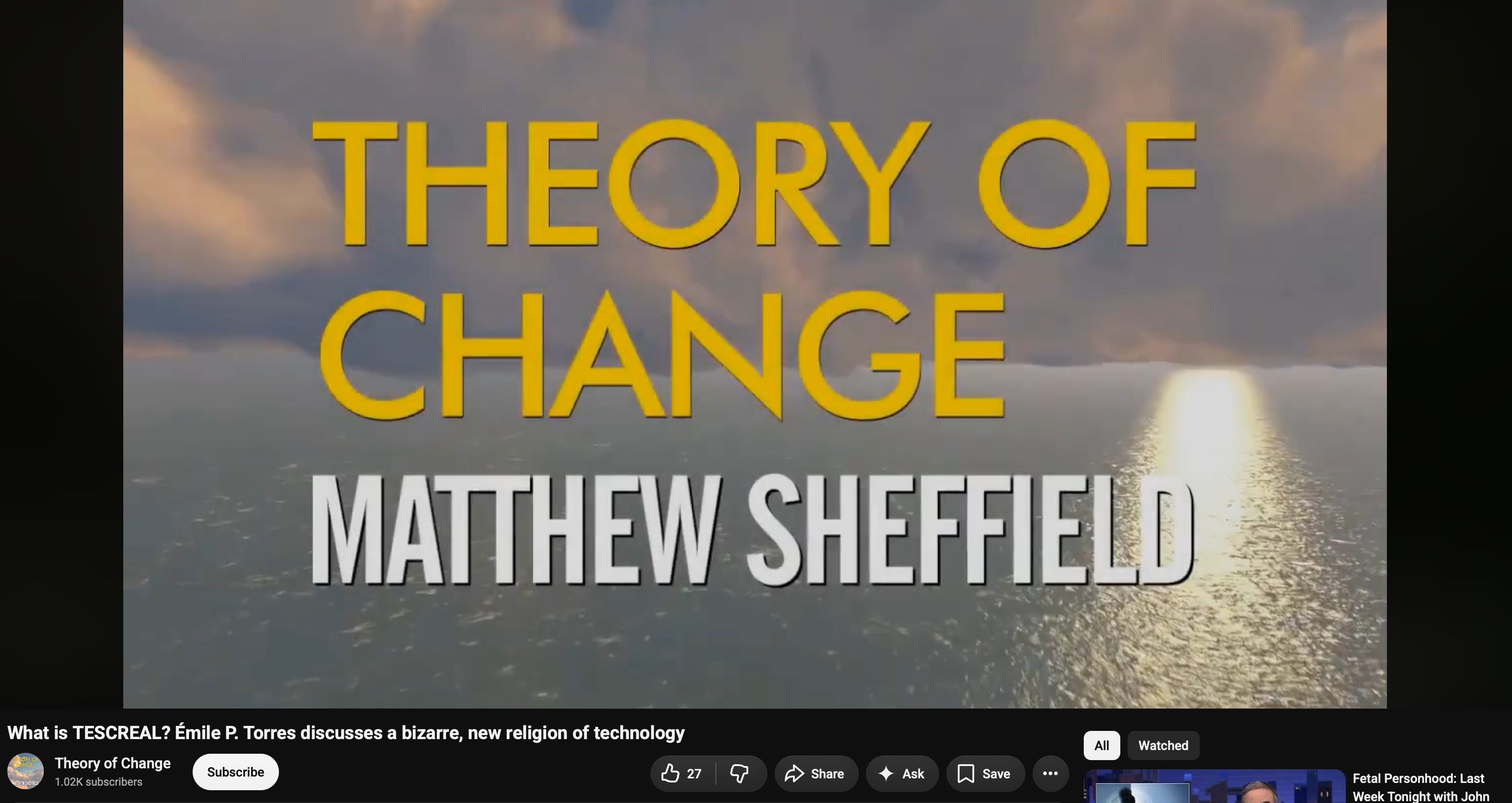
Not just “transhumanism,” though: libertarian transhumanism!
This is one of the few places where my (and Gebru’s) analysis differs: I/we don’t emphasize the “new age communist … crazy hippie ideology.” However, Neşe Devenot does cover this in her paper “TESCREAL Hallucinations: Psychedelic and AI Hype as Inequality Engines,” which is one reason I haven’t discussed it — other scholars building on my work with Gebru have. With respect to this point, my friend Dr. Alexander Thomas had this to say:
As for Leahy’s claim that the hippie culture that informed transhumanism was communist, that is completely wrong, or at least so unspecific and unnuanced as to constitute a lazy and pejorative dismissal of a useful strand of the cultural architecture involved. Fred Turner’s From Counterculture to Cyberculture: Stewart Brand, the Whole Earth Network, and the Rise of Digital Utopianism is a good reference for anyone interested in a more thorough understanding than Leahy displays.
That said, I do explicitly say — as alluded to in a previous footnote — that capitalism plus TESCREALism provides a more or less complete “explanatory picture” of what’s going on. The race to build ASI, however, did not start because of the profit motive — this is a key claim of the TESCREAL thesis. It was instead ideologically motivated: to fulfill the techno-utopian project of the TESCREAL worldview by building a Machine God.
Again, the ASI race started off (circa 2010) having almost nothing to do with capitalist motives. The goal was utopia through ASI. Over time, especially after ChatGPT was released in late 2022, profit has become an increasingly dominant part of the explanatory picture. I don’t doubt that psychedelic culture is also very much a part of this.
I have also repeatedly described the TESCREAL worldview as a “religion” and “cult” (here, here, etc.). As I say in this interview from 2023:
In fact, the parallels between transhumanism and traditional religion are really quite striking. That’s really not a coincidence. If you look at the individuals who initially developed the transhumanist ideology, they were explicit that this is supposed to be a replacement for traditional religion. It’s a secular replacement.
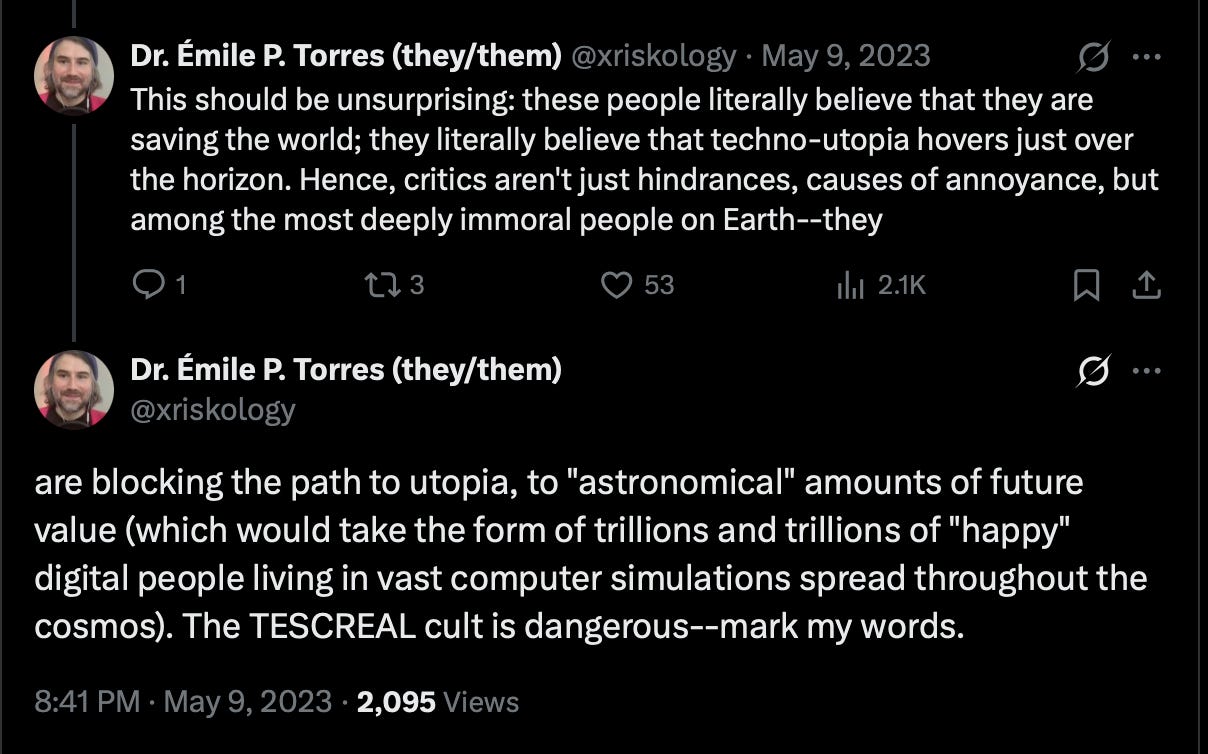
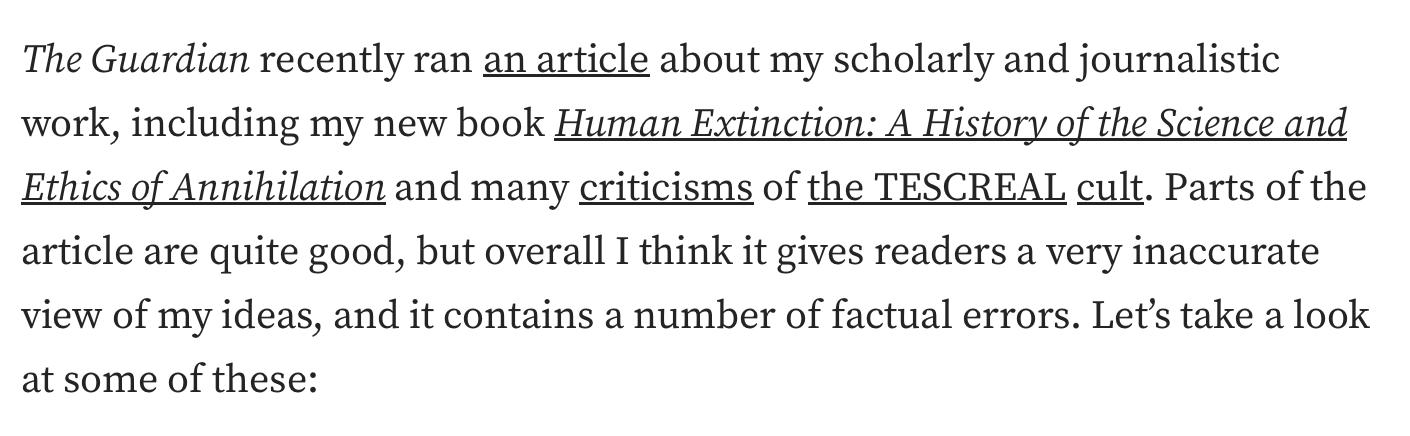

Many other examples could be adduced.
Correct. This is exactly what I argue in solo pieces and with Gebru.
Extropianism is the first instance of second-wave transhumanism, which replaced the methods of earlier eugenics movements (basically, selective breeding) in favor of the new methods of so-called “liberal eugenics” (namely, advanced technologies capable of radically “enhancing” individuals in one lifetime or over a single generation). It specifically emerged in the late 1980s, as Extropy Magazine was first published by Max More and Tom Bell (later called T. O. Morrow) in 1988; they subsequently cofounded the Extropy Institute in 1992. I don’t know if More actually coined the word “Extropianism,” but that seems likely. The word “extropy” goes back at least to 1952.
I think this is misleading. Yes, Extropians wanted pedal-to-the-metal technological “progress.” But More and others recognized that there are potential risks associated with developing advanced technologies. As he writes in his “Proactionary Principle” essay, we should
consider restrictive measures only if the potential impact of an activity has both significant probability and severity. In such cases, if the activity also generates benefits, discount the impacts according to the feasibility of adapting to the adverse effects. If measures to limit technological advance do appear justified, ensure that the extent of those measures is proportionate to the extent of the probable effects.
In other words, sometimes limiting technological “progress” can be justified. Extropianism has a certain affinity to “effective accelerationism,” as More himself as recently noted in Extropic Thoughts: “I look at the origins of effective accelerationism (e/acc) and its unacknowledged roots in extropian transhumanism as well as in several Singularitarian writers.” (In fact, the leading e/acc even named his company “Extropic.”) I have said this very thing going back years, as shown below.
Yes. In fact, Extropianism was also bound up with the cryonics movement, as Max More joined Alcor, a cryonics company, in 1986 — two years before officially founding Extropianism. Topics discussed on the Extropians mailing list in the 1990s include superintelligence, life extension, cryopreservation, and mind-uploading.
This is singularitarianism. The singularitarian movement largely emerged out of the Extropian movement. The term “singularitarian” was coined by an Extropian (as Gebru and I note); Yudkowsky was one of the leading singularitarians in the early 2000s and was heavily involved in Extropianism (as we also note); and Ray Kurzweil, another leading singularitarian, gave talks at Extropian conferences.
In June 2024, I published an article in Salon in which I said (among other relevant things):
Or consider the SL4 mailing list that Yudkowsky created in 2001, which described itself as dedicated to “advanced topics in transhumanism and the Singularity, including … strategies to accelerate the Singularity.” The Singularity is a hypothetical future event in which advanced AI begins to redesign itself, leading to a “superintelligent” AGI system over the course of weeks, days, or perhaps even minutes. Once again, Legg also contributed to the list, which indicates that the connections between Yudkowsky, the world’s leading doomer, and Legg, cofounder of one of the biggest AI companies involved in the AGI race, goes back more than two decades.
See above.
I address this later in the article. It is inaccurate.
This is precisely what I have argued since 2023. For example, I write that “when Yudkowsky started MIRI, it was originally called the Singularity Institute for Artificial Intelligence, and its explicit mission was ‘to accelerate toward artificial intelligence’ — exactly what e/acc now wants to do.” Gebru and I reiterate this in our paper.
Similar to the above, in a 2023 article for Truthdig about e/acc, I note that Yudkowsky and his Singularity Institute were the original accelerationists:
Consider a question that someone recently posted on Twitter/X: “Is there an ‘e/acc for everything but nukes, bioweapons, AI-enabled warfare and authoritarian surveillance’?” One person who responded was Rob Bensinger, an AI doomer who works for the Machine Intelligence Research Institute, founded in 2000 by Yudkowsky, the most famous doomer in the world right now. “Last I checked,” Bensinger responded, “the term for that kind of e/acc is ‘doomer.’” In other words, AI doomers are accelerationists about everything except for AGI and related technologies, and indeed doomers like Yudkowsky started out as AI accelerationists, but then modified their libertarian views to make an exception for AGI. When Yudkowsky started MIRI, it was originally called the Singularity Institute for Artificial Intelligence, and its explicit mission was “to accelerate toward artificial intelligence” — exactly what e/acc now wants to do.
In the same 2023 article as above, I also note that e/acc
has some connection to the accelerationism of Nick Land, a far-right racist philosopher who has written about the “supposedly inevitable ‘disintegration of the human species’ when artificial intelligence improves sufficiently.” However, e/acc is the brainchild of Verdon — aka “Beff Jezos” — who describes it as being rooted in thermodynamics. In particular, Verdon bases his grand, eschatological vision on a highly speculative theory proposed by the MIT physicist Jeremy England, though reading Verdon’s writing gives the impression that this theory is established science — which is not the case.
Gebru and I highlight this in our 2024 paper.
The “R” in “TESCREAL.”
I have repeatedly made this point, sometimes using nearly identical language. The TESCREAL movement is extremely elitist. They believe that they have “special access” to “fundamental truths” about what the future should look like, and that the rest of us aren’t smart enough for our input to matter. For example, in early 2022, I wrote:
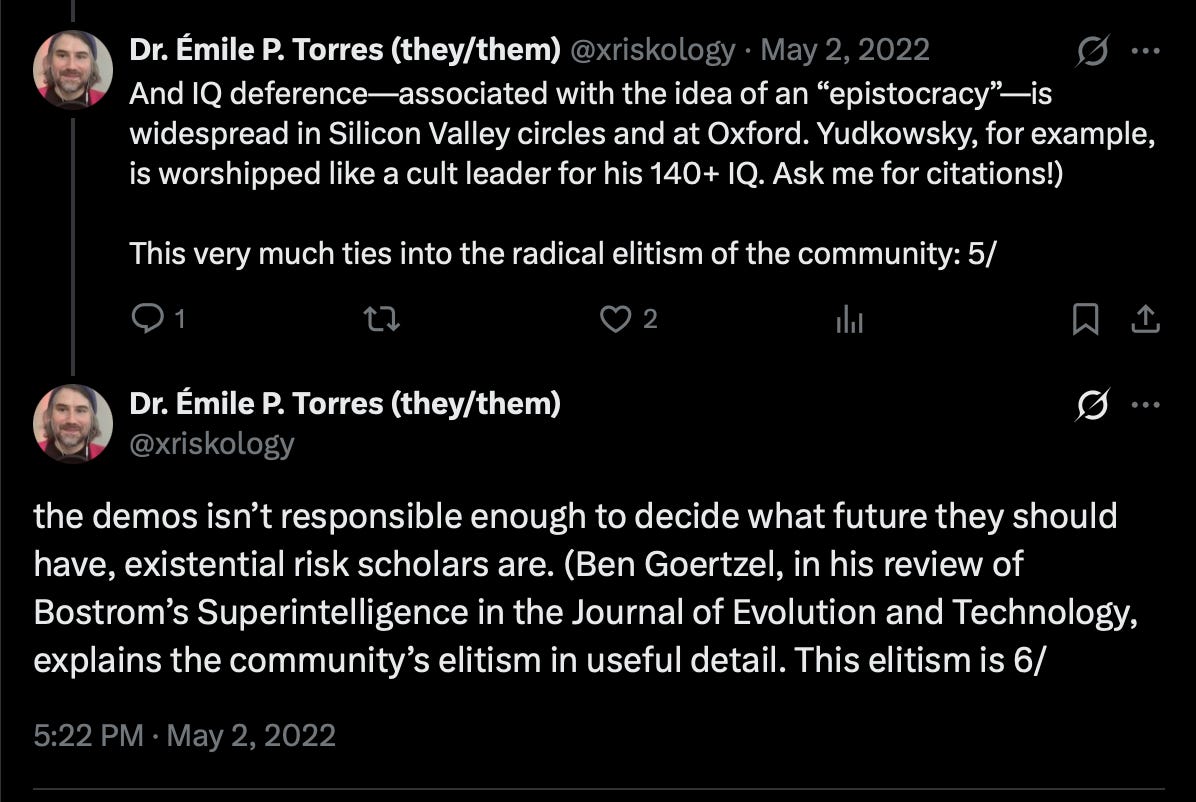
In 2021, I said:
This has, indeed, been a central feature of my criticisms of the TESCREAL movement. In early 2025, I told Gil Duran:
I would say that there is an incredible amount of hubris among these people. And as someone who was in this community back in the day, I can attest that many have an idea that they have some kind of special access to fundamental truths about what the future ought to look like. And now their task is to impose this vision on the rest of humanity. So they sort of speak for all of humanity.
In another 2025 interview, I said:
The rationalist community is very influential in Silicon Valley, and what the rationalist community basically tells its members is that once you’ve mastered this or that theory within the field of decision theory, once you’ve mastered the patterns of thought that are optimally rational, you then have direct access to fundamental truths about what the future ought to look like. And because rationality provides a universal and objective perspective on the world, you don’t need anyone else’s perspective. That is exactly how these billionaires in Silicon Valley are thinking about our collective future.
In an article from around the same time, I wrote:
This was a main point of yet another EA Forum post by Cremer, bemoaning the worship of IQ. People like MacAskill, Bostrom, and Yudkowsky are elevated to an almost messianic level of cosmic importance. They are the prophets of EA-longtermism, sent by the Rationality Gods to deliver fundamental truths about the apocalyptic hazards and utopian promises that lie ahead.
There are many more examples. Leahy is parroting a central thrust of my critique: the TESCREAL movement is fundamentally undemocratic and elitist.
This is exactly what I’ve argued. In a 2024 interview with Tech Policy Press, I say:
It’s just worth noting that the way I understand the TESCREAL vision is as a kind of tyranny. This is a very particular view about what the future ought to look like that was crafted almost entirely by white men at elite universities like Oxford and in Silicon Valley, and now they’re trying to realize this future, and in doing that to impose this future on the entire rest of humanity. And the way they’re trying to realize this future is through AGI, because again, they believe that AGI is going to be the most important and the last invention we ever need to create. And if it’s value aligned … it’ll bring about that utopia. If it’s not value aligned, then by default it’ll kill everyone on Earth.
In a 2025 interview, I described the TESCREAL approach to building ASI as
deeply elitist and extremely undemocratic. Right now, with their billions and trillions of dollars, they are trying to create a new world run by post-humans without ever having inquired about the opinions and preferences of the rest of humanity. They’re doing this without our consent, and they don’t really care one bit about what the rest of us have to say.
In my recent “Pro-Human Manifesto,” I say:
All the AI CEOs have insisted that AGI should benefit all of humanity, but we’ll see in the second half of this manifesto that their undemocratic, tyrannical approach to developing AGI suggests otherwise.
From 2022:
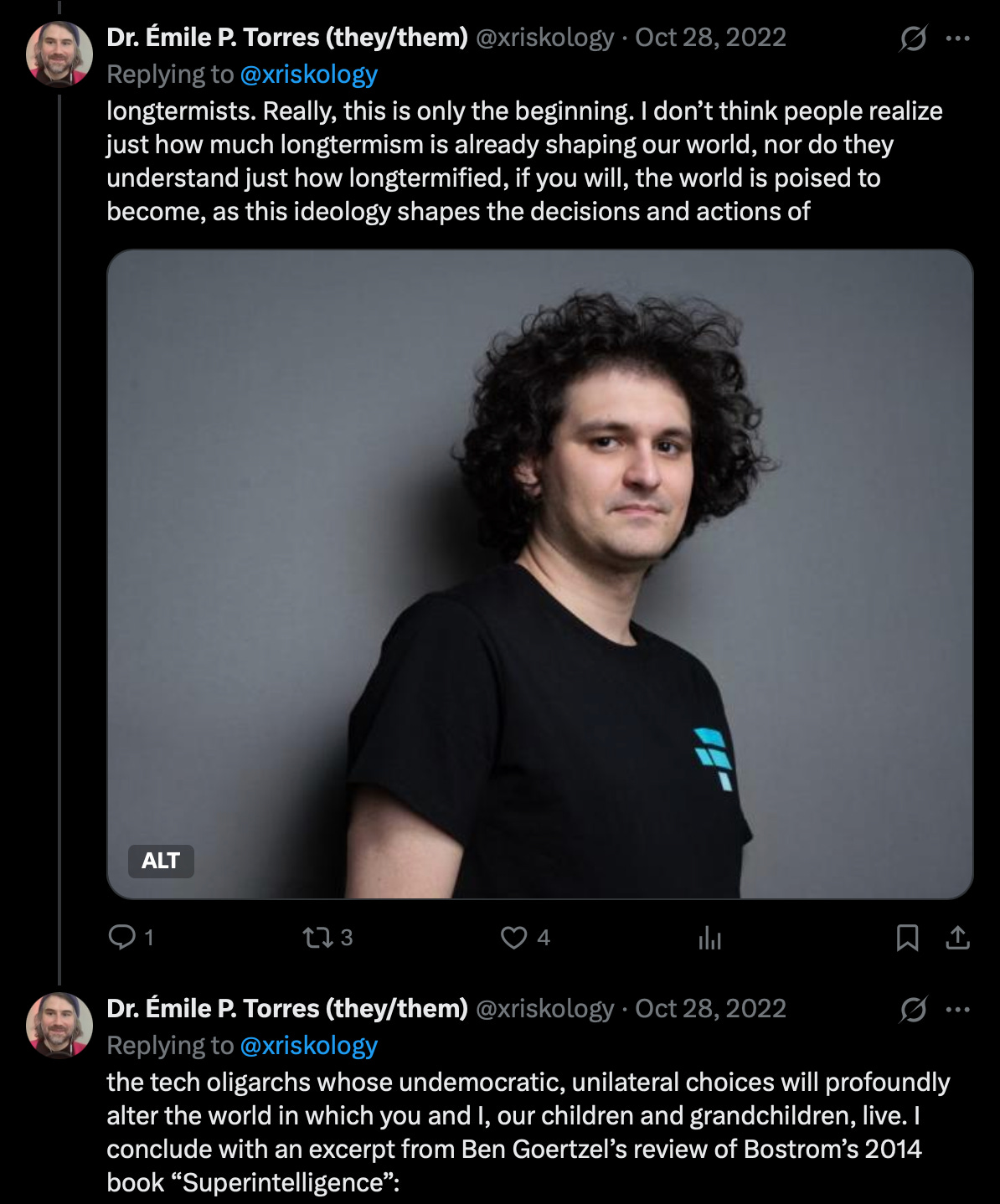

This is an integral part of the story that Gebru and I tell in explaining how all the leading AI companies directly emerged out of the TESCREAL movement. We write:
In 2010, Demis Hassabis, Mustafa Suleyman, and Shane Legg founded DeepMind, also with funding from TESCREAList billionaires Elon Musk, Peter Thiel, and Jaan Tallinn, among others (Shead, 2017) (see Table 1). DeepMind’s mission is “solving intelligence to advance science and benefit humanity” [79], with CEO Hassabis describing himself as “working on AGI,” which he believes is “going to be the greatest thing ever to happen to humanity,” if we get it “right” [80]. Meanwhile, Legg delivered a talk on methods of defining and measuring “intelligence” at the 2010 Singularity Summit, based on his works discussed earlier [81]. The Singularity Summit was an annual event from 2006 to 2012, founded by Yudkowsky, Kurzweil, and Thiel [82]. It was after the summit in 2010 that, at Thiel’s California mansion, Hassabis approached Thiel in hopes of securing funding, which he received (Shead, 2020).
I have also repeated this on many occasions before and after my paper with Gebru. In October 2023, I wrote:
Why did DeepMind form in the first place? Why did Demis Hassabis – who was at a lot of these transhumanist conferences – found it? And Shane Legg, who received $100,000 from the Canadian Singularity Institute for Artificial Intelligence after completing his PhD thesis, and gave talks at the Singularity Summit conferences.
In June 2024, I said:
Both Hassabis and Legg gave talks about AGI-related issues in 2010, shortly before co-founding DeepMind. At the time, DeepMind needed money to get started, so after the Singularity Summit, Hassabis followed Thiel back to his mansion, where Hassabis asked Thiel for financial support to start DeepMind. Thiel obliged, offering Hassabis $1.85 million, and that’s how DeepMind was born. … If not for Yudkowsky’s Singularity Summit, DeepMind might not have gotten off the ground.”
I have repeatedly said that EA has roots in two phenomena: the “global ethics” of Peter Singer and the transhumanist movement. Here’s what I write with Gebru:
Note that EA also has roots going back to the “global ethics” of the utilitarian Peter Singer, who also advocated for infanticide of disabled children, writing “we think that some infants with severe disabilities should be killed” (quoted in Ekland-Olson, 2011, p. 204). However, the EA movement was cofounded circa 2009 by Toby Ord, who coauthored an article with Bostrom three years earlier that essentially defended the transhumanist position on human enhancement (Bostrom and Ord, 2006). Ord was, furthermore, a Research Associate at Bostrom’s Future of Humanity Institute (FHI) as early as 2007, and over the past several years, the EA movement as a whole has been shifting toward longtermist considerations (Matthews, 2022), some of which are more or less overtly transhumanist (see, e.g., Ord’s (2020) discussion of “our potential” in the section titled “Quality” of The Precipice).
I’m really surprised that Leahy didn’t mention Mollie Gleiberman’s work here, as this is the central claim of her important scholarly investigation into the origins of the EA movement. She argues that longtermism and existential risk mitigation was the primary goal of EA from the very start:
[T]his agenda has been present in EA since its inception, where it was hidden in plain sight. From the very beginning, EA discourse operated on two levels, one for the general public and new recruits (focused on global poverty) and one for the core EA community (focused on the transhumanist agenda articulated by Nick Bostrom, Eliezer Yudkowsky, and others, centered on AI-safety/x- risk, now lumped under the banner of ‘longtermism’). The article’s aim is narrowly focused on presenting rich qualitative data to make legible the distinction between public-facing EA and core EA.
She explicitly describes this as a “bait and switch” (the phrase that Leahy uses), and I have made the same claim in interviews and articles — citing Gleiberman.
A central — arguably the most important — claim that I’ve made since 2023 or so is that the TESCREAL movement is fundamentally pro-extinctionist. Many people in the movement do think that “replacing humans with AI is good.” In 2024, I wrote an entire article about this. Later that year, the influential scholar Ruha Benjamin published an article in the Los Angeles Review of Books that states: “In fact, their worldview is perhaps best understood as pro-extinctionist in that, as Torres argues, these far-futurists are enthusiastic about ‘legacy humans’ giving way to a smarter, stronger, more enhanced species of posthumans.” My “Pro-Human Manifesto” is the most comprehensive piece ever written on this topic.

Again, EA was longtermist from the very start. Leahy’s statement is very misleading.
Karnofsky is also a figure I’ve mentioned frequently, as when I wrote (summarizing earlier articles):
Karnofsky was an important figure in the early development of EA. He started GiveWell, which worked closely with Toby Ord and William MacAskill’s Giving What We Can, and cofounded Open Philanthropy (now Coefficient Giving). He was roommates with Dario Amodei, the CEO of Anthropic, and married Dario’s sister Daniela. He’s now a member of the technical staff at Anthropic, where he advises “the company on preparing for risks from advanced AI.”
From 2022:

Gebru and I also highlight the crucial role that Open Philanthropy has played in the development of TESCREALism. You cannot understand the development of this movement without some notion of Open Philanthropy and the way it’s funneled Dustin Moskovitz’s fortune to TESCREAL organizations.
Gebru and I write: “OpenAI also received a US$30M grant from the TESCREAL organization Open Philanthropy.” I have also repeatedly noted that MIRI was funded by Open Philanthropy (something Leahy misses).
“It’s hard to overstate how big of an influence they were.” This is a clear implication of Gebru and my paper, though we also highlight Jaan Tallinn as being a prolific funder of the TESCREAL ecosystem. From 2024:

I have repeatedly mentioned this in interviews since around 2023. Here’s a recent example from an article of mine:
While researching a section of the book, I re-listened to an interview with Holden Karnofsky on the 80,000 Hours podcast. Karnofsky was an important figure in the early development of EA. He started GiveWell, which worked closely with Toby Ord and William MacAskill’s Giving What We Can, and cofounded Open Philanthropy (now Coefficient Giving). He was roommates with Dario Amodei, the CEO of Anthropic, and married Dario’s sister Daniela. He’s now a member of the technical staff at Anthropic, where he advises “the company on preparing for risks from advanced AI.”
This is, once again, an implication of my paper with Gebru that no reader could miss. It’s what most of my work since has focused on. It’s why some people who don’t understand the TESCREAL thesis call it a “conspiracy theory” (it’s not).
With respect to virtually everything that Leahy says, there’s an article or tweet of mine to match it. Here’s me using the word “incestuous” to describe the TESCREAL movement:
Rather than “scene,” Gebru and I call it a “movement.” See the next section for discussion.
This is exactly what I’ve repeatedly argued. In a 2023 article for Truthdig, I wrote:
The differences between e/acc and EA longtermism are, therefore, relatively small. While e/acc’s like to play up these differences in interviews and blog posts, the two positions occupy nearly the same location on the ideological map and, in practice, their visions of the future are more or less indistinguishable.
The central thesis of this article is that e/acc is just a minor variation of the TESCREAL worldview.
Same as above.
The “TESREAL” ideologies, as discussed below.
But, of course, Gebru and I gave it a name back in 2022. We repeatedly discussed it on social media, and I published an overview of the idea in 2023. Our coauthored paper came out later and, once again, it’s been a central focus of my research ever since. Furthermore, I note in this article of mine that others have named very similar phenomena, including Adam Becker’s “ideology of technological salvation,” which is nearly synonymous with “TESCREAL.”
Though a deeper analysis would reveal that cosmism is very much a part of the cluster, too.
Singularitarianism is the centerpiece of Leahy’s 2025 analysis of the topic, though he seems to have realized since then (maybe from reading my articles?) that it’s only one component in a cluster of ideologies that have shaped the Silicon Valley worldview — exactly as I’ve argued in my solo pieces and study with Gebru.
Note that there are also anti-TESCREAL doomers, such as participants in Stop AI. I write about this here.
If I had more time and patience, I could have added footnotes to almost every single sentence — showing that I’ve previously said what Leahy says. Hopefully the examples I give in these footnotes and within the body text are enough to get the point across.
Wright interviewed me on Onezero in 2023. We discussed the TESCREAL bundle. But I don’t blame him for not remembering all the details of my argument.
Indeed, it’s not just in his interview with Wright that Leahy makes claims almost identical to central theses of mine. In an interview from last year with the Future of Life Institute (which has historically been aligned with the TESCREAL movement), Leahy said:
It would be good, actually, if the utopians were not in charge. I think the utopians are the biggest problem because they have an ideology, they have a burning ideology, that justifies anything basically as long as it allows them to get to AGI faster because I mean … this is always the problem with utopist ideologies, is Utopia is so good that it justifies anything you know we saw with like FTX.
As early as 2019, I was making the exact argument. In a 2021 Aeon article, I warned:
Yet the implications of longtermism are far more worrisome. If our top four priorities are to avoid an existential catastrophe – ie, to fulfil ‘our potential’ – then what’s not on the table for making this happen? Consider Thomas Nagel’s comment about how the notion of what we might call the ‘greater good’ has been used to ‘justify’ certain atrocities (eg, during war). If the ends ‘justify’ the means, he argues, and the ends are thought to be sufficiently large (eg, national security), then this ‘can be brought to bear to ease the consciences of those responsible for a certain number of charred babies’. Now imagine what might be ‘justified’ if the ‘greater good’ isn’t national security but the cosmic potential of Earth-originating intelligent life over the coming trillions of years? During the Second World War, 40 million civilians perished, but compare this number to the 10^54 or more people (in Bostrom’s estimate) who could come to exist if we can avoid an existential catastrophe. What shouldn’t we do to ‘protect’ and ‘preserve’ this potential? To ensure that these unborn people come to exist? What means can’t be ‘justified’ by this cosmically significant moral end?
In a 2022 article for Salon titled “What the Sam Bankman-Fried Debacle Can Teach Us about ‘Longtermism,’” I observed that
over and over again throughout history, the combination of these two ingredients — utopianism and the belief that ends justify the means — has been disastrous.
In a 2023 article for The New Statesman titled “Longtermism Poses a Real Threat to Humanity” (recall again that “longtermism” basically refers to the TESCREAL bundle), I wrote:
Yet my upbringing also made me realise that utopian thinking has a menacing downside. The belief in utopia has led people to engage in radical and extreme behaviours. If one believes that the means are justified by the ends, and the ends are quite literally a paradise full of infinite value, then what exactly is off the table for realising these ends? …
When I was a longtermist, I didn’t think much about the potential dangers of this ideology. However, the more I studied utopian movements that became violent, the more I was struck by two ingredients at the heart of such movements. The first was – of course – a utopian vision of the future, which believers see as containing infinite, or at least astronomical, amounts of value. The second was a broadly “utilitarian” mode of moral reasoning, which is to say the kind of means-ends reasoning above. The ends can sometimes justify the means, especially when the ends are a magical world full of immortal beings awash in “surpassing bliss and delight”, to quote Bostrom’s 2020 “Letter from Utopia”.
Indeed, this has been one of the most prominent themes of my writing about these ideologies since 2021. (See my 2023 article “Before It’s Too Late, Buddy” in Truthdig for yet another example.) To my knowledge, no one else has made exactly this point in the context of the ASI race and the ideologies driving it — like, literally no one. I have mentioned exactly what Leahy says in just about every interview I’ve given, which likely numbers in the hundreds, and in many other articles in addition to those above.
I’ve also repeatedly cited Bankman-Fried as an example of the dangers of what I call the “utopian mindset,” as when I wrote in the aforementioned 2022 article:
Critics of longtermism, like myself, saw this coming from miles away. Not, specifically, the implosion of Bankman-Fried’s empire, but something very bad — something that would cause serious harm to real people — in the name of longtermism. For years, I have been warning that longtermism could “justify” actions much worse than fraud, which Bankman-Fried appears to have committed in his effort to “get filthy rich, for charity’s sake.”
I haven’t watched the rest of Leahy’s Future of Life Institute interview, but I wonder what else he says that mirrors my thinking on such issues. My guess is that there are other instances of him copying my claims.
This is my understanding of the situation. See her forthcoming book Deep Unlearning for a first-hand account.
Or am I missing a fourth?
If someone had contacted me about possible intellectual plagiarism, I sure as hell would have responded! I think most people with a degree of integrity would have. I’m frankly quite surprised that Leahy chose to simply ignore the issue, as if it would go away. If anything, his non-response makes me more suspicious about something unethical is going on here.
Paragraph breaks were added to this quote.
He also blocked a friend of mine — who’s in the field of AI safety — for critiquing some of his ideas. May be has thin skin.
A YouTube commenter also points this out under the interview:
I. J. Good a sci-fi author? Connor is correct about him originating the idea of intelligence explosion but I think he mixed up Good with maybe Vernor Vinge who also wrote about technological singularity and indeed was a sci-fi author. Also, if I recall correctly, later in the interview he mixes up another name but I don't remember who now (I listened to the interview a few days ago).
This might come across as a bit unkind- which is fine because it's meant to be- but I think that Leahy used an AI to search through papers on the TESCREAL ideologies minus references to two very specific people. Leahy was too lazy to rearrange the acronym into anything original so he just removed the 'C', as well as Dr Emil P. Torres and Dr Timnit Gebru.
damn this is so bad… sorry…