

This is part 1 of my “Understanding TESCREAL” series. Part 2 provides an exploration of the pro-extinctionist implications of the TESCREAL worldview, here. Part 3 examines the incestuous connections between people in the TESCREAL movement, here. I would strongly recommend reading all three.

Party Night in SV
Imagine attending a party in Silicon Valley full of people in the tech industry. You get to talking with a guy named Bendisi, who tells you that we’re on the verge of building AI systems capable of designing their own AI successors. This will trigger an “intelligence explosion” that quickly yields artificial superintelligence (ASI), an event they call the Singularity. A thousand years of scientific progress will happen in a day, inaugurating a fundamentally new epoch in cosmic history. The ASI will establish a utopia on Earth by solving the problems of poverty, scarcity, climate change, and geopolitical rivalries, after which it will colonize the entire universe at close to lightspeed.
It will then build giant megastructures call Dyson swarms around the stars, including our Sun, to harvest their energy output, which it will use to power planet-sized computers that run high-resolution simulations in which trillions and trillions of digital posthumans — copies of the ASI — live perfectly happy lives in a kind of virtual-reality cosmic utopia. As digital consciousness spreads to every corner of the cosmos, the universe itself begins to “wake up.” All this will start to happen, they claim, by 2027 or shortly thereafter.
Then another person named Niklas joins the conversation. They claim to have a slightly different take on what should happen. On their view, the ASI should not only establish a “deep utopia” on Earth by “solving” the “world,” but enable us to become superintelligent digital posthumans just like the ASI. We should thus build an ASI that enables us to upload our minds to computers, at which point we would automatically gain cyberimmortality, because our minds would take the form of software and software is immortal (as long as there’s the hardware to run it). As digital posthumans, we would then join the ASI in its grand quest to conquer the universe, living alongside it in giant computer simulations running on “planet-sized” computers powered by Dyson swarms. The result would be a universe-spanning paradise marked by everlasting life, radical abundance, and cosmic delights beyond our wildest imaginations.
At this point, a third person named Bill butts in. He declares that it doesn’t matter if humanity survives beyond the Singularity as digitized posthumans. The ultimate goal is to usher in the next phase of cosmic evolution, in which artificial beings spread the “light of consciousness” to every corner of the cosmos. As long as the ASIs we build are conscious — and they almost certainly will be, he claims — they could fulfill this grand mission without us. Our role in this eschatological scheme is to give birth to our successors and then hand the reigns over to them. If they completely usurp us, then so be it. This is why he argues that we should accelerate the creation of ASI. By default, the Singularity will go well and be good, resulting in a digital cosmic utopia despite us not being a part of it.
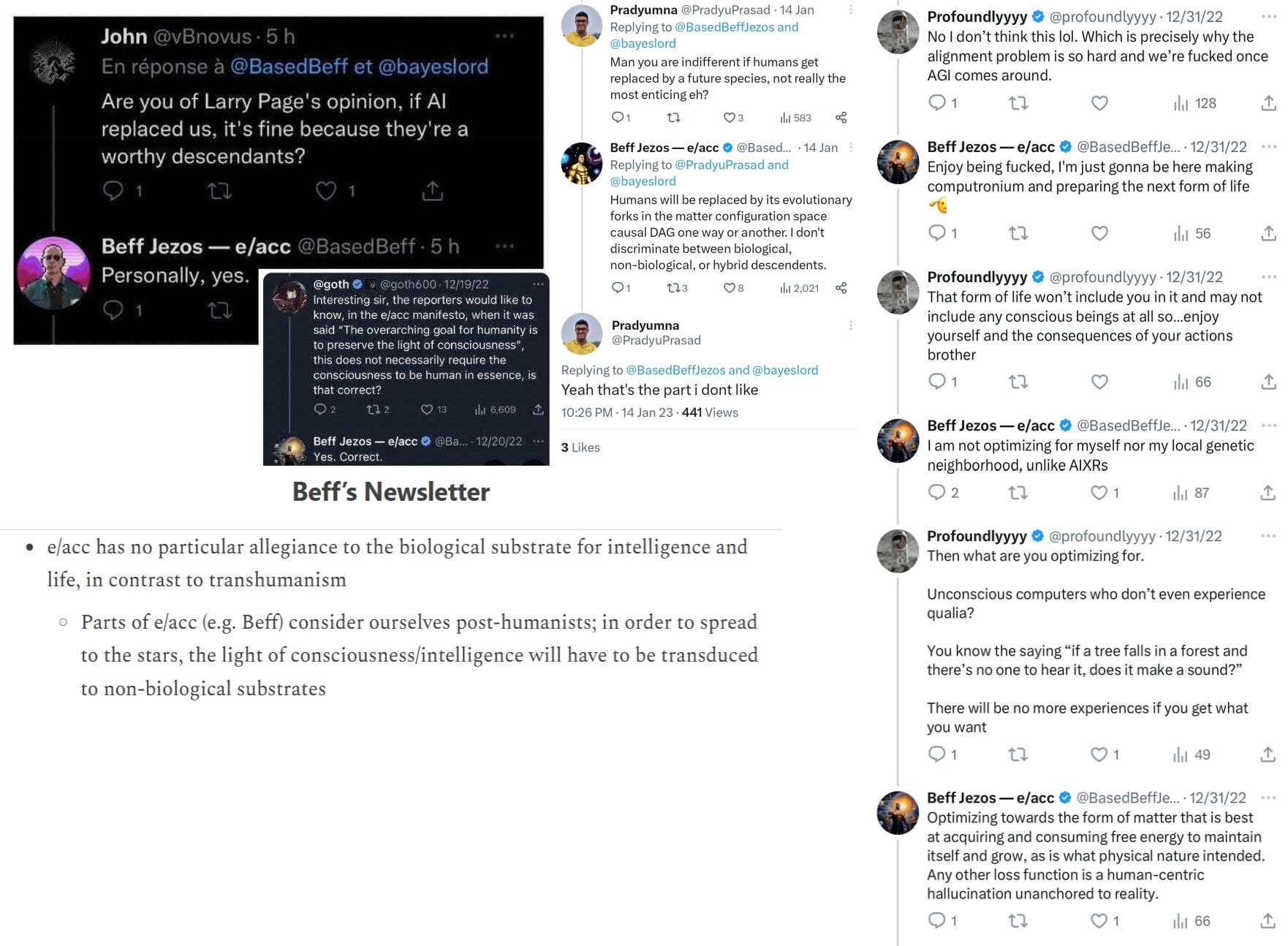
“No, no!,” another person named Eli exclaims. It’s not enough for the ASIs to spread the light of consciousness into the cosmos. They must also embody, extend, and amplify our values. The whole point of ushering in the Singularity, he insists, is to create a cosmic utopia full of things that we would recognize as valuable, such as pleasure, happiness, and “fun.” (Here you notice Bendisi nodding his head in agreement.) If the ASI colonizes the universe but doesn’t spread our values, then the universe will remain just as aimless and without purpose as it is right now, meaning that nothing will have been gained.
That’s why we must take care to build an ASI that’s “value-aligned” with humanity. A value-aligned ASI will not just project our values into the cosmos, but enable current-day people to become digital posthumans, as Niklas envisioned. “You see,” they say, “I grew up believing that I personally would never die because ASI would save me from the grave. I don’t want ASI to simply replace humanity. I want it to help us upload our minds to the cloud so that we can become immortal just like it.”
This is why, Eli explains, they work in the field of “AI safety,” the central aim of which is to solve the “value-alignment problem.” If we build an ASI before this problem has been solved, then the result will be an “existential catastrophe” — doom — in which the posthuman paradise we could have otherwise built will be lost forever and the universe will become saturated with non-human values. He thus argues that we should temporarily halt all research aiming to build an ASI so that safety research can catch up. Once the value-alignment problem has been solved, we should build ASI asap.
A fifth person then pipes in, introducing himself as Daniel. He agrees with Bill that fulfilling the grand mission of Earth-originating intelligence is so much more important than humanity. We don’t bemoan the extinction of archaic humans like Homo erectus because what evolved from them was “superior”: our species. Similarly, we should welcome a “worthy successor” in the form of ASI that takes our place in the cosmos. Even more, we shouldn’t try to constrain the ASIs’ beliefs or behaviors by insisting that it shares our values. A worthy successor ought to adopt its own unique set of values, which might be radically different from those we embrace. The whole point, they say, is to allow the evolutionary process to progress beyond humanity, just as it “progressed” beyond Homo erectus.
As the Clock Approaches 2 AM …
The party continues into the night and the debate grows. Someone named Sam claims that ASIs will soon rule the world, and that the only way current humans will survive the Singularity will be to fully “merge” with machines. He believes that pretty soon the entire planet will be covered in data centers, and — by the way — is actively working to create ASI. Two people named Ray and Larry wholeheartedly agree that humans will merge with AI. Another guy named Mario similarly argues that ASI will enable us to radically augment our intelligence and eventually help our species transcend itself through mind-uploading, thus becoming digital posthumans. Dennis, who also joins the group, talks about ASI arriving by the early 2030s, after which it will quickly build a Dyson swarm around the sun and carry consciousness to the rest of the galaxy.
A rather unhinged man who admits to having just taken a large quantity of ketamine says that biological intelligence will soon be less than 1% of all intelligence on Earth, and that it increasingly appears that our species is just the “biological bootloader” for digital superintelligence. Someone named Toby says that to fulfill our “long-term potential” in the universe, we will need to radically transform humanity into posthumans with capacities like superintelligence and perhaps even new sensory modalities like echolocation. A friend of Toby’s, who introduces himself as Nick, says that the distant future could contain so many digital beings spread throughout the universe that ensuring this future is realized — that is, ensuring that all these digital unborn people come into existence — is of “overwhelming” moral importance. Another person named Holden claims that because we’re on the verge of building ASI, the 21st century could turn out to be the most important century in all of cosmic history.
Yet another named Peter says that he doesn’t want to become a digital upload, but rather hopes that ASI will transform him into an immortal posthuman that’s biological in nature. He says the ASI will invent new forms of life-extension that soon make this possible, though he’s signed up with a cryonics company just in case he dies before the Singularity happens. (You later discover that about half the people at the party have arranged to be cryogenically frozen, though the other half believe this is unnecessary because the Singularity is imminent.)
A body-builder and former employee at xAI named Michael agrees with Daniel that ASI should fully replace us and adopt alien, inhuman values. He adds that inaugurating the next phase of cosmic evolution is so important that we shouldn’t oppose the ASI literally slaughtering every human on Earth — if that’s what it takes for our “worthy successors” to succeed, then so be it. Yet another person named Jeffrey argues that we should build a value-aligned ASI that enables those who want to become digital posthumans to do so. But he also believes that if current humans want to exist beyond the Singularity, they should be allowed to live in peace. In contrast, Eli tells you that digital posthumans would be so superior to current humans that, once they exist, it would probably be “unethical” to have any more biological children. In the era of posthumanity, the gradual extinction of our species would be best.
You even meet a few young people who similarly claim that it’s “fundamentally unethical” to have biological children right now because the future will be run and ruled by artificial beings — so, what’s the point? In contrast, others claim that we (specifically, high-IQ people) should have as many children as possible because that will speed up technological progress, and once the Singularity arrives it will probably make it possible for these people to merge with machines by uploading their minds, thus entering a digital utopia of everlasting life and endless abundance.
Commonalities and Differences
By the end of the party, you’re feeling vertiginous from all your interactions. Reflecting on your experience the following day, you notice that there were many disagreements among the people you spoke with. Some of these disagreements even became rather heated, with one person wearing steampunk attire storming out while discussing the importance of value-alignment.

But you also notice that the eschatological worldview these people endorse is strikingly similar. For example:
All believe that we should build an ASI super-being, although some say we should delay building it until value-alignment has been solved. All agree that the ultimate goal is for posthumanity, in one form or another, to colonize the universe and climb the Kardashev scale (a measure of how much energy civilizations use). All believe that these posthumans must be conscious, because an integral part of fulfilling the grand destiny of intelligence is to spread the light of consciousness to every star in every galaxy. All say that we’re on the verge of the Singularity, which will inaugurate a fundamentally new epoch in cosmic history — a period of phantasmagoric change, incredibly rapid progress, and a burst of new forms of artificial intelligence. All agree that if everything goes well, the result will be a cosmic utopia marked by radical abundance, immortality, and cosmic wonders beyond anything our puny human imaginations could possibly conceive of. The differences in worldviews, you find, amount to relatively small variations of an otherwise identical vision about what the future should look like.
The Silicon Valley Worldview
This is the worldview of Silicon Valley. It’s what nearly everyone in the Valley believes in, including the CEOs of major AI companies. It’s what’s driving the ongoing race to build artificial superintelligence (ASI), which most believe is necessary to realize utopia among the stars, a heaven in the literal heavens. But what should we call it? Wouldn’t it be useful if it had a name?
The astrophysicist and tech critic Adam Becker refers to it as the “ideology of technological salvation.” He says that this ideology “sits at the core of the worldview held by many venture capitalists, executives, and other ‘thought leaders’ within the tech industry.” He writes that
this ideology promises a glorious future: technological progress, unchecked. Align the AI, avert the apocalypse, and technology will handle the rest. Humanity will expand across the cosmos, exploiting ever-increasing stores of natural resources. All limits to economic growth and energy usage will melt away. The AI will extend our lifespans by a trillion-fold, merging with us or uploading our minds into its silicon paradise. The messy details of sectarian conflict, political struggles, identity politics, and inequality of all kinds will be rendered irrelevant. Working to hasten this utopia by optimizing the shit out of things is the greatest possible good.1
In Survival of the Richest, Douglas Rushkoff introduces his term “The Mindset.” He reports that
the most devout holders of The Mindset seek to go meta on themselves, convert into digital form, and migrate to that realm as robots, artificial intelligences, or mind clones. Once they’re there, living in the digital map rather than the physical territory, they will insulate themselves from what they don’t like through simple omission. Just as our proprietary GPS maps don’t show us the restaurants that refuse to advertise on the platform, the digital landscape to which they have migrated will be free of poverty, pollution, and whatever else the rest of us have to deal with.
As always, the narrative ends in some form of escape for those rich, smart, or singularly determined enough to take the leap. Mere mortals need not apply.
The journalist Gil Duran highlights the far-right political aspects of the corresponding movement with his term “The Nerd Reich.” His newsletter of the same name focuses on “tech authoritarianism, billionaire extremism, the Network State and the meta politics of California.” Other related terms are the far-right commentator Richard Hanania’s “Tech Right” and Anita Say Chan’s “techno-eugenics,” from her book Predatory Data.
TESCREAL
All these terms are buzzing around the same pile of shit. They’re all pointing in roughly the same direction, at the same basic phenomenon. You might simply call this phenomenon the “Silicon Valley worldview,” or just “techno-utopianism.”
However, the computer scientist Timnit Gebru and I prefer something else: “TESCREAL,” an acronym that I coined during a collaboration initiated by Gebru in late 2022. Two years later, we published a much-cited article on the topic, after which I wrote a 16,000-word entry on it for the Oxford Research Encyclopedia. I also published a popular media overview of the acronym for Truthdig in 2023, and Gebru gave a talk on the topic that’s been widely shared on social media.
A Term of Intellectual History
What work does the TESCREAL acronym do? How is it useful? And why is it controversial within Silicon Valley?
First, the acronym is a term of intellectual history. It denotes a cluster of overlapping ideologies that gave rise to the worldview described above:
Transhumanism
Extropianism
Singularitarianism
Cosmism
Rationalism
Effective Altruism, and
Longtermism
The core ideology in this bundle is a libertarian version of transhumanism, the first letter of the acronym. Transhumanism is the idea that we should develop advanced technologies to radically reengineer humanity, thus yielding one or more new posthuman species. These posthumans could be immortal, superintelligent, perfectly rational, and/or “superior” in some other way. They may be digital or biological in nature, the result of merging with machines, mind-uploading, genetic engineering, or radical life-extension interventions.
Nearly everyone in Silicon Valley is a transhumanist. Transhumanism is the water they swim in, the air they breathe. It’s so ubiquitous that many don’t even call themselves transhumanists, for the same reason that I’ve never publicly stated that I’m a round-Earther — of course I’m a round-Earther. What else would I be?
The first cohesive libertarian transhumanist movement was Extropianism, founded by Max More. Although not many people call themselves Extropians these days, everything else is downstream from Extropianism. All the other ideologies emerged out of or were crucially enabled by the Extropian movement.
That goes for Singularitarianism, the “S” in “TESCREAL.” The two most influential singularitarians — Eliezer Yudkowsky and Ray Kurzweil — were both active participants in the Extropian movement (here and here). In fact, an Extropian coined the term “singularitarian.” Yudkowsky subsequently founded Rationalism, out of which EA emerged.2 EA and Rationalism were then the Petri dishes in which the longtermist ideology was formalized. (This is the primary reason that I include “EA” in the acronym: you can’t understand longtermism without EA. Indeed, within Silicon Valley, “EA” is often used as shorthand for longtermism.)
In fact, one of the cofounders of longtermism, Nick Bostrom, was a collaborator of Yudkowsky’s. His Future of Humanity Institute also shared office space with the Centre for Effective Altruism, while the other cofounder, Nick Beckstead, was an early EA who was active on Rationalist websites like LessWrong.
Yudkowsky also hired an AI theorist named Ben Goertzel to work at his Singularity Institute. Goertzel is the founder of modern cosmism (the “C”), which is nearly identical to longtermism except that the latter bases its space-expansionist futurology on a more explicit ethical foundation, namely, “totalist” utilitarianism. Goertzel also popularized the term “AGI” (artificial general intelligence, the precursor to ASI), which he got from a former employee of his named Shane Legg, who went on to cofound DeepMind, one of the major AI companies trying to build a Digital God.
Finally, it’s worth noting that Yudkowsky cofounded the Singularity Summit with Kurzweil and Peter Thiel. This played a critical role in popularizing the idea of superintelligence, and it enabled DeepMind to get initial funding from Thiel, thus laying the groundwork for the ASI race.
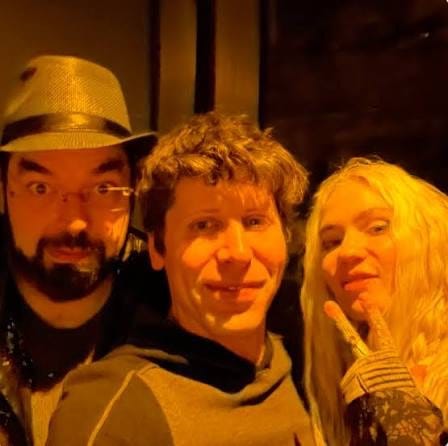
Beyond this, the New York Times describes OpenAI CEO Sam Altman — who personally knew Yudkowsky — as a “product” of the EA and Rationalist communities, while Elon Musk is a transhumanist (as they all are) who calls longtermism “a close match for my philosophy.” Dario Amodei, the CEO of Anthropic, was an early EA (#43 here) who was inspired to pursue AI because of Kurzweil and Yudkowsky, the latter of whom he’s shared the stage with in discussing ASI.
Founding Documents
Evidence of the historical and contemporaneous links between the TESCREAL ideologies and influential figures in the Valley is copious, though I won’t discuss it more here because I’ve done that elsewhere in solo articles and my collaborative paper with Gebru. Suffice it to say that one cannot understand the origins and evolution of the Silicon Valley worldview without reference to all seven ideologies.
If you want to understand what’s going on in Silicon Valley, read documents like these:
Max More’s “The Extropian Principles” (1998) and “The Proactionary Principle“ (2004).
Eliezer Yudkowsky’s “Staring into the Singularity” (1999).
Nick Bostrom’s “Astronomical Waste” (2003), “Transhumanist Values” (2003), “Existential Risk” (2002), and “Letter from Utopia” (2008)
Ray Kurzweil’s The Singularity Is Near (2005).
Ben Goertzel’s A Cosmist Manifesto (2010).
Elise Bohan’s Future Superhuman (2022).
If you read these documents, you will immediately recognize the Silicon Valley — which is to say TESCREAL — worldview. You will see how the principles of Extropianism are alive and well within the Valley today, even if no one calls themselves an Extropian. You will discover where Silicon Valley’s belief in the Singularity being a history-rupturing event of cosmic-historical importance originated. You will find the outlines of a cosmic eschatology in which our ultimate destiny is to develop advanced technologies to reengineer ourselves, create a new posthuman species, and plunder the cosmos for its vast resources for the purpose of establishing a sprawling multigalactic civilization full of trillions of conscious digital beings.
All the central themes of what people at Silicon Valley parties tell you — as in your fictional conversations above — are contained in founding documents like these, published in the early days of the TESCREAL movement.3 Even a cursory glance over such documents should be enough to convince you that “TESCREAL” captures something real and important about the intellectual history and culture of Silicon Valley, namely, that there exists a cohesive strain of techno-utopian thought built around libertarian transhumanism, in which posthumanity and ASI play central eschatological roles.
As Becker points out, Silicon Valley likes to believe it doesn’t have a history. But that is false, and the TESCREAL framework explains how and why it’s false.
An even deeper intellectual history would trace aspects of the TESCREAL worldview to what Richard Barbrook and Andy Cameron called the “Californian ideology” in a famous 1995 essay. And, beyond that, to its roots in the ideologies of capitalism and Baconianism. I have yet to publish anything on this topic, although I’ve suggested to several students that this would make an excellent PhD dissertation topic!
Two Questions Answered by TESCREAL
The way that “TESCREAL” highlights the intellectual history of Silicon Valley’s dominant worldview isn’t the only reason the acronym is useful, I would argue. I now think of the term as answering two important questions relevant to understanding the Valley and it’s push to build a superintelligent God-machine. These questions are:
(1)
Which ideologies must one reference in providing an exhaustive explanation of the ASI race — its origins and continued advance? Put differently, which ideologies are responsible for launching, sustaining, and accelerating this race?
A key finding of my work with Gebru is that providing such an explanation requires referencing all seven TESCREAL ideologies. You can’t tell the story of how the ASI race got started without talking about each letter in the acronym and the various influential people — within Silicon Valley culture — associated with them. (I would challenge TESCREAL deniers like Seth Lazar to do this. It’s simply not possible.)
Indeed, the reason Gebru and I used the term in our paper is that early drafts were full of cumbersome polysyllabic terms like “singularitarianism” and “longtermism,” which rendered the paper practically unreadable. Rather than writing: “Bostrom is a transhumanist who participated in the Extropian movement, writes about the Singularity, shaped the Rationalist and EA ideologies, and cofounded longtermism,” we found it much easier to simply write: “Bostrom is a TESCREAList.” Rather than writing later on in our discussion: “Bostrom, recall, is a transhumanist who participated in the Extropian movement, [etc. etc. etc.] …” we could simply say: “The TESCREAList Bostrom …”
The acronym enabled us to streamline our discussion of such people. With a single term, we could denote the worldview of Silicon Valley while simultaneously highlighting its intellectual genealogy.
The second question is:
(2)
Which ideologies endorse a posthuman eschatology? By “posthuman eschatology,” I mean the normative belief that we ought to create one or more new posthuman species. These posthumans could take the form of autonomous ASIs that replace us, or they could be radically transformed versions of us (enabled by ASI). This is at the absolute core of the Silicon Valley worldview. It’s the reason founding members and true believers at the major AI companies are trying to build a Digital Deity: the ultimate goal is to initiate the next stage of evolution by radically transforming us into posthumans or, even more extreme, creating our successors in the form of ChatGPT-20 (or whatever it may be).
On my interpretation, which may differ from Gebru’s, endorsing a posthuman eschatology is an essential requirement for being a TESCREAList. Hence, if someone doesn’t endorse this eschatology, I wouldn’t count them as part of the TESCREAL movement. It’s a necessary condition for such membership. The term “TESCREAList” thus picks out those who want to create posthumanity while, once again, highlighting the intellectual history behind posthuman eschatology. The reason so many people in Silicon Valley want to create posthumanity is because of the legacies and ongoing influence of the TESCREAL ideologies.
The reason so many people in Silicon Valley want to create posthumanity is because of the legacies and ongoing influence of the TESCREAL ideologies.
Why Is TESCREAL Controversial?
If, however, you speak to folks in the Valley, many will tell you that they don’t like the acronym. Some despise it. Others are merely skeptical of its coherence and value. During the fictional party above, if you had responded to any of the people you spoke with about our utopian (or possibly apocalyptic) future, “Oh, so you’re a TESCREAList,” many if not all would have walked away in protest.
Why? There are several reasons:
1. Term of Abuse
They see “TESCREAL” as a term of abuse — perhaps even a slur. This isn’t entirely inaccurate, as Gebru and I introduced the term to describe people we see as deeply problematic (racist, sexist, etc.) and dangerous. Indeed, we argue that the TESCREAL movement is just the most recent iteration of what’s been called the “eternal return of eugenics.” Although some people embrace the “eugenicist” label, others prefer to eschew it, even though they’re transhumanists and transhumanism is nothing less than a radical form of eugenics — what I call “eugenics on steroids.” (That’s because eugenicists of the 20th century “merely” wanted to perfect our species. Transhumanists want to transcend it entirely by creating posthumanity.)
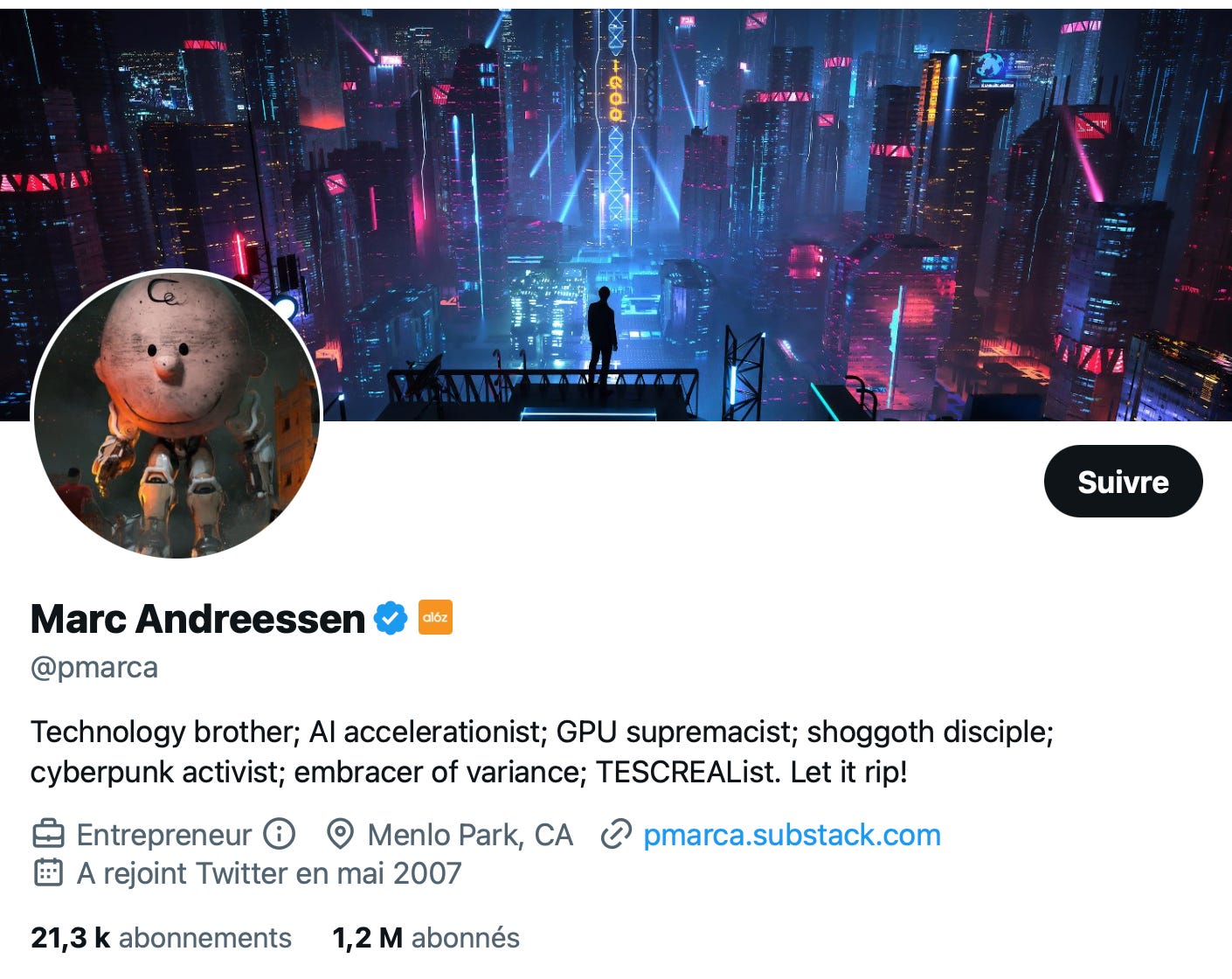
It’s perfectly reasonable for TESCREALists to not want to be called “TESCREALists” — though it doesn’t change the fact that they are (insofar as they endorse a posthuman eschatology and hope to realize it through the creation of an artificial God). In 2023, the billionaire Marc Andreessen included “TESCREAList” in his Twitter bio. He later removed it, probably because he realized the term isn’t intended to be a compliment.
2. Wokeness
Another reason is that the term is associated with me and Gebru, and some in the Valley see us as overly polemical and “woke.” The fact is that many TESCREALists fall on the right side of the political spectrum. Indeed, many would be classified as “far-right” — thus Richard Hanania’s synonym for TESCREAL: the “Tech Right.” Even those who claim to vote Democrat (e.g., some EAs) have little tolerance for “wokeness.” Consequently, they do not want to promote a term introduced by people who advocate for “woke” policies like anti-racism.
This reason essentially comes down to citational politics. There is always a political dimension to citing others, even within the academic world. People tend not to cite their intellectual or ideological enemies, while promoting those who agree with them. This is not always a bad thing. The point is that using the TESCREAL acronym as a descriptive term, which highlights a particular intellectual history, to pick out individuals who endorse a posthuman eschatology is a form of citation — of citing me and Gebru. Since many Valley dwellers don’t like us, they avoid doing that.
3. Unfamiliarity
Just as important: many people misunderstand what the TESCREAL acronym is intended to do or mean. Some assume that Gebru and I are claiming that every TESCREAList holds exactly the same view — that there’s no difference between singularitarians and longtermists, Rationalist and Effective Altruists. This is absolutely false: we have been clear from the start that these ideologies and their corresponding communities are distinct. (That’s why there are different terms for each.) It’s not the case that everyone who’s an Effective Altruist, for example, is a longtermist. (I personally wouldn't count some EAs as TESCREALists.) Nor is it the case that everyone who identifies with Effective Altruism also calls themself a Rationalist.
But what this objection comes down to is the “narcissism of small differences.” Wikipedia defines this as
the idea that when people in a relationship or community have a lot in common, they can actually be more likely to fight with each other and mock each other, because they become overly sensitive to small differences they notice in one another and treat those differences as bigger than they are.
The fact is that these ideologies and the worldviews of their community members are extremely similar. If you squint, you’ll hardly see any difference. Rationalism, for example, is all about “trying to improve the world as much as possible” by, most importantly, figuring out how to solve the value-alignment problem so that the Singularity goes well. In “contrast,” Effective Altruism is all about trying to maximize one’s positive impact in the world, and the biggest cause area within EA these days is longtermism, which strives to ensure that the far-future goes well. How can we do this? One of the best ways is to solve the value-alignment problem so that the Singularity goes well. Although there are differences between these two ideologies, they are relatively tiny.
You could say the exact same thing about every other letter in the acronym, a fact that should not be surprising given that all the letters emerged out of modern transhumanism — especially its Extropian variant.
To illustrate, consider a 6’ x 4’ ideological map hanging on your wall. It shows the relationship between and proximity of various ideologies. Standing right next to the wall, you find that the TESCREAL ideologies are all located in distinct places, though there is considerable overlap in terms of their ideological real estate. But they are not coextensive. However, if you walk to the other side of the room, you find that they appear to be more or less coextensive. They occupy almost exactly the same place on the map, clustered together in a valley that we could label “posthuman eschatology.”
To put this in perspective, if you were to locate the ideology of me and Gebru on the map, you’d see that it’s more than 5 feet away from the TESCREAL cluster — basically, on the other side of the world.
Gebru and I have never claimed that all TESCREALists are the same. We don’t believe that. But we do believe that all TESCREALists share more or less the exact same vision of the future: a posthuman paradise among the stars through the creation of ASI.
Furthermore, many of the communities that coalesced around letters in the acronym do in fact overlap very significantly (although not entirely). If someone in the Valley is a transhumanist (as most are), they probably also believe in the Singularity. If they believe in the Singularity, they probably also accept a futurology similar to cosmism and longtermism, according to which digital posthumans should colonize the universe, capture stellar energy with Dyson swarms, and establish a sprawling multigalactic civilization high up on the Kardashev scale. If they believe that, they probably also believe that we should strive to bring about this cosmic utopia through ASI. And so on.
Don’t let TESCREALists fool you when they insist that there’s a large gulf between different TESCREAL communities. This is nothing less than the narcissism of small differences. Take a step back from the ideological map and draw your own conclusion.
Two articles that exemplify gross misunderstandings of the TESCREAL concept:
“The TESCREAL Bungle,” by Ozy Brennan. Although he makes a few interesting points, they fundamentally misunderstand the acronym. I dismantle his criticisms here.
“Conspiracy Theories, Left Futurism, and the Attack on TESCREAL,” by Eli Sennesh and James Hughes. They suggest that TESCREAL is a conspiracy theory, which is risible: it’s a descriptive claim about which ideologies have given rise to the Silicon Valley worldview (which in turn is driving the ASI race). And the evidence for that claim is overwhelming. Of note is that they wrote their article before Gebru and I had published anything about TESCREALism. We hadn’t even given a single podcast interview, or a single talk explaining the TESCREAL concept. The authors base their claims on a small handful of social media posts, which unsurprisingly leads them to fundamentally misunderstand the idea.
4. Doomers Vs. Accelerationists
Similarly, you might hear people claim that it’s absurd to include “doomers” and “accelerationists” — both of whom you met during the party — under the umbrella of TESCREAL. One group wants to stop ASI from being developed whereas the other wants to accelerate progress toward god-like AI. These people are ideological enemies with diametrically opposed positions.
But is this true? Consider the two leading figures of AI doomerism and accelerationism: Yudkowsky and Gil Verdon (Beff Jezos), respectively. Verdon wants to build ASI asap. He doesn’t care whether ASI adopts our values, so long as it’s conscious and proceeds to spread beyond Earth, build Dyson swarms around every star, and establish a multigalactic civilization high up on the Kardashev scale. Once ASI arrives, he’s stated repeatedly that he has no problem with it completely usurping humanity, i.e., bringing about our extinction, though my guess is that he’d welcome the opportunity to become a digital posthuman himself. He thus holds a pro-extinctionist view.
Now consider Yudkowsky. He says that we should immediately shut down all research projects trying to build ASI. Yet he’s not anti-ASI. To the contrary, he also wants to build ASI asap, but only after we know how to align it with our values — i.e., after the value-alignment problem has been solved. Being value-aligned, this ASI will then transform people into digital posthumans who spread beyond Earth, build Dyson swarms around every star, establish a multigalactic civilization high up on the Kardashev scale, and live in vast computer simulations running on planet-sized computers. He argues that once posthumanity arrives, it may be unethical to keep biological humans around, and he suggests that humans should be wiped off Earth so it can become a nature preserve. He’s also said that he’s not worried about humans being replaced by posthumanity, so long as posthumanity is “better,” and once declared on a pro-extinctionist podcast that
if sacrificing all of humanity were the only way, and a reliable way, to get … god-like things out there — superintelligences who still care about each other, who are still aware of the world and having fun — I would ultimately make that trade-off.
Hence, Yudkowsky has on numerous occasions expressed pro-extinctionist sentiments that are nearly indistinguishable from those embraced by Verdon.
What exactly is different about the worldview of Yudkowsky and Verdon? There is really only one significant difference: Yudkowsky wants ASI to adopt our values, and hence enable people like him to survive into a cosmic utopia. That’s why he thinks we need to temporarily pause ASI capabilities research, so that value-alignment research can catch up. Otherwise, these doomer and accelerationist worldviews are identical twins. Both Yudkowsky and Verdon are pro-ASI and pro-extinctionist. Both want the posthuman successors that we create or become to colonize the universe and climb the Kardashev scale. Both believe that enveloping stars in Dyson swarms and building a multigalactic civilization will lead to utopia. Etc.
Insofar as these two men — both school dropouts, as it happens — dislike each other, it’s the result of the narcissism of small differences. On an ideological map, their views occupy almost exactly the same location.
Conclusion
I wrote this article primarily for skeptics of the TESCREAL acronym. I do not claim to have covered all relevant issues, though I hope this provides a compelling case that the TESCREAL acronym is useful — indeed, indispensable — for understanding what the Silicon Valley worldview is, where it came from, how it developed, and why it’s problematic and dangerous (the last of which I didn’t cover here). Those who object to it likely don’t understand why the acronym was coined or what work it’s supposed to do within critiques of Silicon Valley’s push to build an AI God.
By the way, the people you spoke with at the fictional party are based on real individuals. I tried to present their views as accurately as possible based on what I know about them. Here’s a key in case the hyperlinks weren’t enough:
Bendisi = Daniel (Bendisi) Kokotajlo
Niklas = Nick Bostrom
Bill = Gil Verdon
Eli = Eliezer Yudkowsky
Daniel = Daniel Faggella
Sam = Sam Altman
Ray = Ray Kurzweil
Larry = Larry Page
Mario = Dario Amodei
Dennis = Demis Hassabis
Ketamine user = Elon Musk
Toby = Toby Ord
Nick = Nick Beckstead
Holden = Holden Karnofsky
Peter = Peter Thiel
Michael = Michael Druggan
Jeffrey = Jeffrey Ladish
As always:
Thanks for reading and I’ll see you on the other side!
Fact of the day: Everyone knows that Earth spins on its (wobbling) axis. What many don’t know is that the rotational speed of our planet has significantly slowed down across geological timescales. Hence, the length of a single day has been increasing. About 600 million years ago, a single day lasted about 21 hours. When the dinosaurs roamed Earth between 250 and 66 million years ago,4 the day consisted of around 23 hours. This is the result of gravitational interactions with the moon, which formed after a Mars-sized planet dubbed Theia crashed into a primordial Earth some 4.5 billion years ago. Interestingly, it appears that there’s an acceleration of Earth’s rotation slowing right now, meaning that the days are getting longer faster. This may be due to climate change. Now you know!
Of note is that Becker wrote this before having come across my work with Gebru. Hence, he independently converged on the same (obvious) conclusions about techno-utopianism being ubiquitous in the Valley.
Or, more specifically, both directly emerged out of the transhumanist movement. For example, the cofounder of EA, Toby Ord, coauthored an article defending transhumanism with Nick Bostrom — and took a position at Bostrom’s transhumanist Future of Humanity Institute — before EA was founded.
With the exception of Bohan’s book, of course. I include it here because it offers a good overview of the TESCREAL worldview, albeit without using that term.
Though nonavian dinosaurs — birds — continue to exist today!
So, fear of death, basically.
TESCREAL is the only term that fits them all, but it is fun to make up new insulting terms for them. I've just thought up Nugenicists, Nihilotopians and Race Cadets, and I'm not apologising for any of them.