

In my previous article, we discussed how Elon Musk once suggested, in 2016, that there would be people living on Mars by the end of 2025. We also noted that he claimed in 2024 that AGI would arrive by the end of this year. As the Danish proverb goes, “It is difficult to make predictions, especially about the future.”
Since the 2,025th year of the Common Era in the Gregorian calendar is nearly over, I thought it might be interesting — and amusing — to take a look at some of predictions people made about what would happen in, or by the end of, 2025. Some prognosticators got certain things more or less right, though most were as accurate as Pete Hegseth chucking an axe at a big red target live on Fox News:
The fact that people often got things so wrong underlines how rapidly, and unpredictably, our world is changing. We really have no idea how different our lives might be by the end of 2026 — to say nothing of 2030 or 2035. Nonetheless, I’ll make a few soft predictions of my own below, noting that, as an academic once said, there’s no easier way to make oneself look like a fool than to predict the future. (I can’t recall who said that, and I’m probably getting the words wrong a bit, but it’s been in my head for the past 10 years, since I first came across it! Sagacious words. :-)
AGI 2025
We start with the CEO of Anthropic, Dario Amodei, who predicted earlier this year that LLMs (large language models) would be “writing 90 percent of code” by September — three months ago. So, not even close, although there is a trend of AI taking over some coding tasks. Last year, OpenAI’s CEO, Sam Altman, was asked what he’s excited about in 2025. Echoing Musk’s remarks above, he said: “AGI.” One commenter responded to this rather hilariously by declaring: “I don’t believe it’s marketing gimmicks. I don’t think it’s hype. I don’t think it’s talk.” Why? Because, she says, “Sam Altman is extremely measured in the statements he shares on stage.” Lolz. Expect more bullshit from AI leaders in 2026.
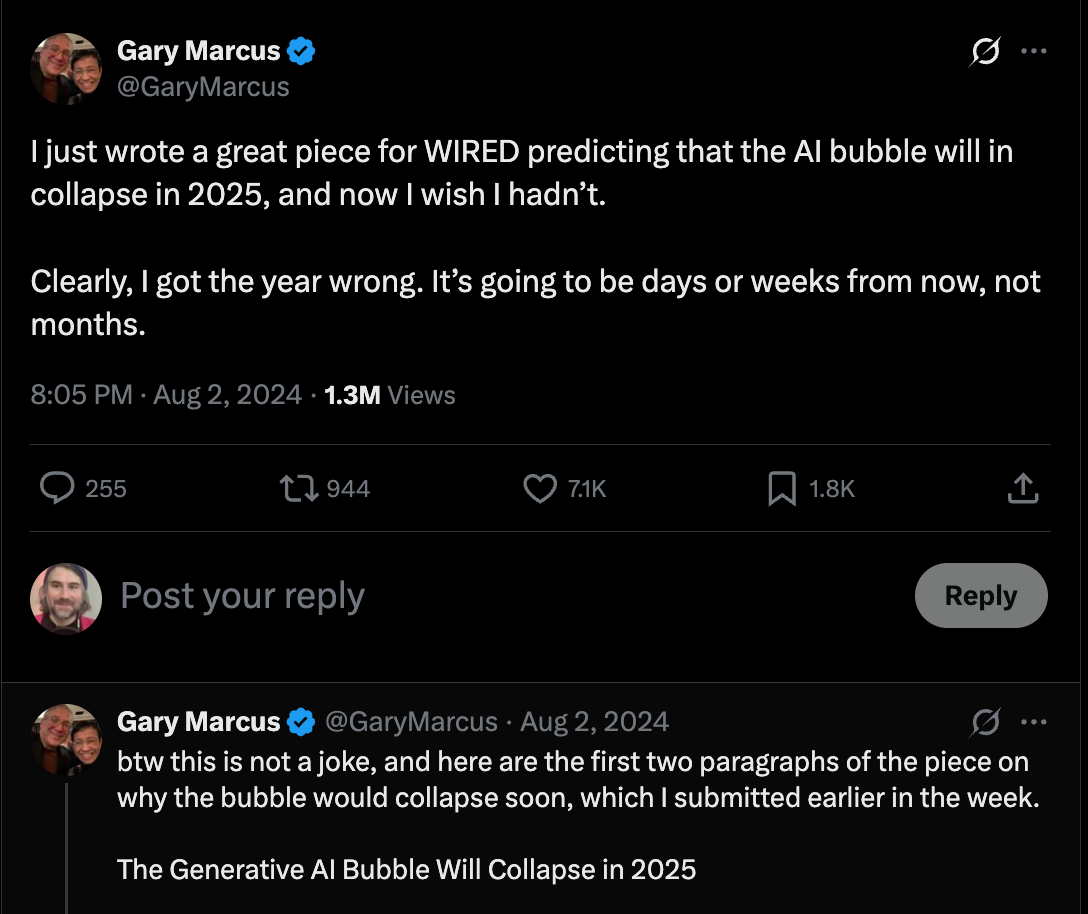
From AI evangelists to AI skeptics, Gary Marcus posted on X last year that he penned an article for Wired in which he argues the AI bubble will burst in 2025. But he then backtracked, claiming that the bubble would in fact pop before the end of 2024! Another swing and a miss, and I personally see no strong evidence for the bubble bursting in the very near future. I wouldn’t be surprised, though, if it happens before the end of 2026. (We’ll see how silly I look in a year! :-).
2024 Predictions in Forbes
Now consider an article in Forbes from last year, authored by Mark Minevich, whose personal website describes him as “a globally recognized AI strategist, investor, and UN advisor advancing AI innovation and AI-first digital transformation.” Here are some of his predictions for 2025:
(1) The U.S. equities index is expected to reach at least 6,500 by the close of 2025, representing a 9% increase in price from its present value and a 10% total return when factoring in dividends. A good deal of these gains will be courtesy of the AI firms.
The S&P 500 is currently around 6,887, and AI companies are largely responsible for the fact that we aren’t in an economic recession. So, this looks pretty accurate to me — but I’m not an economist. (Any economists want to chime in?)
(2) In households, inexpensive robotic appliances will prevail over conventional devices, providing greater protection, linking, and ease of use. In 2025, there will be confusion over what constitutes and does not constitute human effort, leading to profound debate over the topic of work, self, and meaning.
Roombas aside (which we’ve had for quite a while), the first sentence doesn’t hold up well. But the second might, depending on what one means by “human effort.” As The Conversation reports, it’s now true that “more than 50% of articles on the web are being generated by artificial intelligence,” though I don’t believe this study includes articles behind a paywall. Also, these “AI-generated articles consist largely of general-interest writing: news updates, now-to guides, lifestyle posts, reviews and product explainers,” where the “primary economic purpose of this content is to persuade or inform, not to express originality or creativity.”
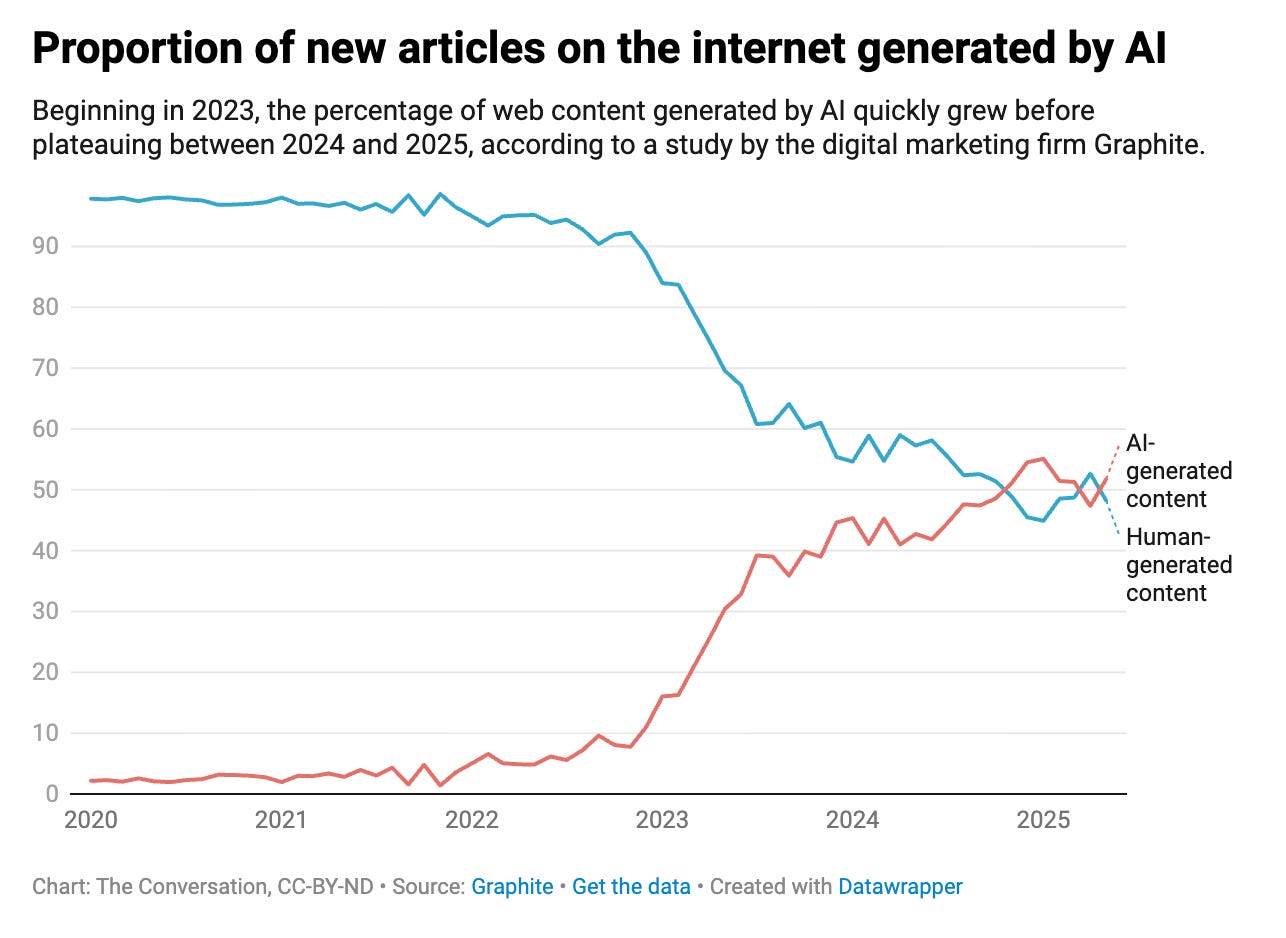
However, the blurring between people and AI goes far beyond this: even Sam Altman now suggests that the Dead Internet theory may be coming true — thanks to the very technology his company is building. Furthermore, apps like OpenAI’s Sora 2 have made it easy to create hyper-realistic videos, as demonstrated by this controversial AI-generated ad just released (and then withdrawn due to the backlash) by McDonald’s:
But Minevich also made a number of predictions in his Forbes piece that are egregiously off the mark. Here are a few examples:
(3) Asteroid mining will be a concept that turns into reality as firms such as AstroForge aim to launch a compact refinery into space, designed to extract minerals from asteroids and transport only the precious metals back to Earth.
(4) In 2025, humanity will continue experiments in deep space exploration and take a baby step toward the commercialization of outer space by forming permanent habitats on the moon through private business ventures and government initiatives. … 2025 will mark the key year when humanity will experience the change of its goals and dream to start a new life on a new planet and move from being an earth-bound species to a multi-planetary species.
(5) Anti-aging therapies that operate at the level of cells and genes will advance, and these technologies will become everyday practices.
Not quite! We’re nowhere close to mining asteroids, we haven’t established permanent colonies on the moon, and anti-aging therapies aren’t available at your local doctor’s office. If I had to guess, I’d say that progress in these areas will be more or less stagnant in 2026. Don’t expect any big breakthroughs — or so I’d argue!
2020 World Economic Forum Predictions
A more interesting set of predictions, in my opinion, comes from a 2020 article published by the World Economic Forum (WEF). Here are some of its claims:
(1) In 2025, carbon footprints will be viewed as socially unacceptable, much like drink driving is today. … Public attention will drive government policy and behavioural changes, with carbon footprints becoming a subject of worldwide scrutiny. … We’ll see a diversity of new technologies aimed at both reducing and removing the world’s emissions — unleashing a wave of innovation to compare with the industrial and digital Revolutions of the past.
Ummmmmmm … If anything, no one seems to care much about climate change anymore. Greta Thunberg is focusing on the Gaza genocide, Extinction Rebellion isn’t holding massive protests anymore (so far as I know), Just Stop Oil has vanished from the front page, and I see almost no one talking about climate change and the environmental crisis on social media — due in part to AGI anxieties largely eclipsing other apocalyptic worries.
This is despite the fact that we’ve crossed the 1.5C threshold identified by the Paris Climate Agreement, 2024 was the hottest year on record, and records relating to extreme weather continue to be broken around the world. In fact, 2025 will be either the second or third warmest year behind 2024. It’s been fascinating to see climate anxieties fade into the background while the global climatic predicament significantly worsens. Perhaps this is because, in addition to AGI capturing media attention, people feel helpless after Trump won the election last year?
Continuing with the WEF report:
(2) A scale up of negative emission technologies, such as carbon dioxide removal, will remove climate-relevant amounts of CO2 from the air. This will be necessary in order to limit global warming to 1.5°C. [Again, LOL.] While humanity will do everything possible to stop emitting more carbon into the atmosphere, it will also do everything it can in order to remove historic CO2 from the air permanently. By becoming widely accessible, the demand for CO2 removal will increase and costs will fall. CO2 removal will be scaled up to the gigaton-level, and will become the responsible option for removing unavoidable emissions from the air.
What a nice thought! But nope: we certainly aren’t doing “everything possible to stop emitting more carbon,” and CO2 removal hasn’t been “scaled up to the gigaton-level.” This prediction was way off target.
(3) By 2025, quantum computing will have outgrown its infancy, and a first generation of commercial devices will be able tackle meaningful, real-world problems. One major application of this new kind of computer will be the simulation of complex chemical reactions, a powerful tool that opens up new avenues in drug development.
I’ll write an article sometime in the next few weeks offering an introductory explainer of quantum computing, but overall I don’t think that quantum computers are being used as much as the WEF anticipated. No major breakthroughs in this area.
(3) Improvements in AI will finally put access to wealth creation within reach of the masses. … Artificial intelligence is improving at such a speed that the strategies employed by these financial advisors will be accessible via technology, and therefore affordable for the masses. Just like you don’t need to know how near-field communication works to use ApplePay, tens of millions of people won’t have to know modern portfolio theory to be able to have their money work for them.
Hmmm! Let’s say, no?
(4) One thing the current pandemic has shown us is how important technology is for maintaining and facilitating communication — not simply for work purposes, but for building real emotional connections. In the next few years we can expect to see this progress accelerate, with AI technology built to connect people at a human level and drive them closer to each other, even when physically they’re apart. The line between physical space and virtual will forever be blurred.
I mean, if one’s talking only about “emotional connections,” people have formed such connections with AI. Men now have AI girlfriends, and many folks consider ChatGPT to be their friend. AI has replaced human connection more than it’s enabled it. That said, Zoom remains a bit part of many people’s lives. Nearly all of my friendships right now are with people I speak to via the platform — I, like so many others, have almost no in-person friends. How strange!
So, the World Economic Forum got some claims right, while missing the mark by a wide margin in other cases.
2014 PEW Survey
Finally, let’s take a look at an old PEW survey from 2014, which asked 1,896 experts about “AI, robotics, and the future of jobs” through 2025. “The vast majority of respondents,” the article states, “anticipate that robotics and artificial intelligence will permeate wide segments of daily life by 2025, with huge implications for a range of industries such as health care, transport and logistics, customer service, and home maintenance.” It continues:
Half of these experts (48%) envision a future in which robots and digital agents have displaced significant numbers of both blue- and white-collar workers — with many expressing concern that this will lead to vast increases in income inequality, masses of people who are effectively unemployable, and breakdowns in the social order.
The other half of the experts who responded to this survey (52%) expect that technology will not displace more jobs than it creates by 2025. To be sure, this group anticipates that many jobs currently performed by humans will be substantially taken over by robots or digital agents by 2025. But they have faith that human ingenuity will create new jobs, industries, and ways to make a living, just as it has been doing since the dawn of the Industrial Revolution.
While some jobs are being replaced, AI hasn’t eliminated “significant numbers” of blue- and white-collar jobs. Furthermore, as MIT’s Media Lab reported last summer, 95% of generative AI pilots are failing, meaning that AI turns out to be much less useful than Sam Altman and other hypesters have led people to believe. Another study from this year found that, to quote CNN, there is now
an epidemic of nonsensical AI-generated work that “masquerades as productivity” and “lacks real substance.”
Workslop is drivel that looks like some sort of finished product from a white-collar job, but, in reality, it’s just gobbledygook.
Workslop, much like Shrimp Jesus or those big-eyed crying cats clogging your social feeds, has a patina of human craftsmanship. Think slick PowerPoints, official-looking reports with polysyllabic bits of jargon, lines of computer code that look like, well, usable code. But then humans who understand the actual work are left scratching their heads when the project “lacks the substance to meaningfully advance a given task.”
While some people are using AI tools to “polish good work,” others are using them to “create content that is actually unhelpful, incomplete, or missing crucial context about the project at hand,” the researchers wrote.
Naturally, that means more work for someone else to fix. Of the 1,150 US-based employees researchers surveyed across various industries, 40% report having received workslop in the last month.
I doubt this situation will change in 2026. Companies will continue to find that AI uses are extremely limited and such systems are nowhere close to completely replacing most people’s jobs.
The 2014 PEW report also includes a number of comically erroneous predictions made by particular people, as exemplified by this:
Stowe Boyd, lead researcher for GigaOM Research, predicted, “Pizzas will not be delivered by teenagers hoping for a tip. Food will be raised by robotic vehicles, even in small plot urban farms that will become the norm, since so many people will have lost their jobs to ‘bots. Your X-rays will be reviewed by a battery of Watson-grade AIs, and humans will only be pulled in when the machines disagree. Robotic sex partners will be a commonplace, although [a] source of scorn and division, the way that critics today bemoan selfies as an indicator of all that’s wrong with the world.”
Others made predictions that are pretty spot on, such as:
K.G. Schneider, a university librarian, wrote, “By 2025 AI, robotics, and ubiquitous computing will have snuck into parts of our lives without us understanding to what extent it has happened (much as I just went on a camping trip with a smartphone, laptop, and tablet).”
Additional Predictions
A few additional predictions concerning AI and tech are worth mentioning here. For example, the Turing Award-winner Geoffrey Hinton somewhat famously claimed in 2016 that “AI would be able to do all of the things radiologists can do within five years,” i.e., 2021. Not even close! That same year, SpaceX announced that it was “planning to send Dragon to Mars as soon as 2018.” Whoops!
Musk also said back in 2017 that “by 2021 his brain-computer interface company Neuralink would release a viable product for treating brain injuries.” Two years earlier, “he predicted that Tesla would eventually grow as big as Apple, a company that was then worth $700 billion” (quoting Futurism). An entire book could be written about the many, many failed predictions that Musk has confidently made over the past two decades. The guy deserves an award for being the biggest bullshitter on Earth right now, although Altman and some other AI CEOs are close behind.
As for when AGI will at long last debut, I recently noted that Daniel Kokotajlo, coauthor of the much-discussed “AI 2027” report, now says that AGI won’t arrive until 2030. I doubt this is the last time he’ll revise this prophecy (a prophecy of my own). Amodei, despite having been egregiously wrong about how AI writing code, says that we may have “powerful AI” — basically, his term for AGI — as soon as next year. Demis Hassabis is more conservative in his predictions, claiming that AGI will appear in the next 5-10 years. He adds that its arrival “could usher in an era of ‘incredible productivity’ and ‘radical abundance.’” Maybe for the rich!
Finally, in a just-published article for Forbes, Charles Towers-Clark makes a number of claims about how AI will develop and influence society in 2026 (note that I’m shortening some of his answers below, and skipping over a few of the less interesting claims):
There Is Unlikely To Be A Bursting Of The AI Investment Bubble: Achieving AGI, especially in today’s geo-political world, is an arms race. The exponential potential of AGI is so vast that no company or government with resources will step away from the transformative power and economic advantages it promises.
But AGI Won’t Just Come From Bigger Large Language Models: In 2026 we will see a greater exploration of other models than LLMs for the future of AI.
Job Displacement Will Become More Prevalent Due To AI Agents: As AI agents become better at completing tasks autonomously, more companies will implement them to reduce labor costs in 2026.
Adapting Humans To Automation, Not Automation To Humans: Companies that succeed in 2026 will rebuild their operations so that AI handles everything it can, while humans focus on oversight, creativity, and complex judgment
Stories Will Still Be Seen As Secondary To Facts: “You need the story first and then back it up with the data. Logic and data itself doesn’t sell” (quoting Benjamin Ball).
AI Detectors Become Commonplace: Future employees must learn to work effectively with AI tools, therefore institutions banning LLMs reflect outdated grading mentalities. Students should be evaluated on their thinking process with AI assistance, not their ability to work without it.
These aren’t exactly bold predictions. But it will be interesting to reexamine them at the end of next year.
What do you think 2026 has in store for us? Do you think LLM performance will dramatically rise as companies like OpenAI further upscale these systems? Do you think the AI bubble will burst and destroy the US economy? Will there be mass layoffs? Will 2026 witness unprecedented climate-related catastrophes? Will Trump start a war with Venezuela or, um, Canada? Will there finally be mass protests in the streets against Trump and ICE? Please leave your thoughts below — I’m genuinely curious what people think. :-)
As always, thanks so much for reading and I’ll see you on the other side!
Instead of predicting the future why not just build a better one?
Part 1: The Post Bullshit World:
https://kennetheharrell.substack.com/p/the-post-bullshit-world
Examines how technology has drifted away from the people who use it, shifting from empowering tools into systems that extract data, erode agency, and prioritize scale over human well-being. Through personal experience and cultural observation, it shows how many promises of modern tech convenience, connection, progress came with hidden costs that left users feeling watched, managed, and disconnected. The post argues for a return to technology built around trust, ownership, and human-centered design.
Part 2: Escaping Our Immaculate Dystopia:
https://kennetheharrell.substack.com/p/escaping-our-immaculate-dystopia
Explores how modern systems appear polished and efficient while quietly hollowing out autonomy, meaning, and social connection. It traces how market-driven innovation and techno-utopian narratives create frictionless surfaces that mask deeply extractive dynamics beneath. The post points toward escape not through rejection of technology, but through rebuilding smaller, local, and humane alternatives that restore agency and participation.
Part 3: A New Tomorrow:
https://kennetheharrell.substack.com/p/a-new-tomorrow
Articulates a forward-looking vision for technology that belongs to people again rather than managing them. It identifies the assumptions that must be discarded surveillance, lock-in, and infinite growth and replaces them with principles centered on ownership, transparency, and human-scale systems. The post concludes by outlining what this alternative future could look like in practice, emphasizing that it becomes possible when people deliberately choose to build and support it.
We guess a lot don't we?