

For an accessible introduction to the TESCREAL thesis, see this article. For an exploration of the pro-extinctionist implications of the TESCREAL worldview, read this.
Leftist Conspiracy Theories
On June 12, 2023, the democratic-socialist transhumanist James Hughes and then-graduate student Eli Sennesh posted an essay on Medium in which they argued that the TESCREAL thesis is little more than a leftist conspiracy theory.
This essay was written and posted before Timnit Gebru and I had published even one article on the TESCREAL concept, either together or individually. We hadn’t even given a single interview discussing the idea. Hughes and Sennesh’s entire piece was based on nothing more than a handful of tweets from me and Gebru. This would be like me writing a lengthy, detailed review of Hughes’ book, Citizen Cyborg, based solely on the title and a 200-word blurb.
Naturally, then, their critique completely misrepresents the TESCREAL thesis. Like an LLM, they hallucinated what they thought the TESCREAL thesis might be, and then launched a barrage of rhetorical missiles at the nonexistent target.
That said, the claim that TESCREAL is something of a conspiracy isn’t far off the mark. (This, however, is not what they argued.) It’s worth remembering here that not all conspiracies are conspiracy theories. In a section titled “Some Conspiracies Are Real” of her excellent book Doppelganger, Naomi Klein reminds us that the world has been shaped by “real conspiracies” hatched and executed by the socioeconomic and political elite. She writes:
The poisoned water system in Flint, Michigan, was covered up by state officials year after year. British Petroleum and Halliburton cut corners in the operation of the Deepwater Horizon offshore drilling rig, and the result was the largest accidental oil spill in history in the Gulf of Mexico, with the companies scrambling to cover up the full extent of the damage. Volkswagen ran a conspiracy for years to cover up how much polluting carbon its diesel vehicles were emitting (the cars were programmed to fool the testers). Most consequentially, Exxon and several other oil majors ran a conspiracy to spread doubt and confusion about the reality of climate change for decades, taking a page from the tobacco giants. These are just the barest of examples.
A Dish of Spaghetti Thrown at the Wall
The fact is that the TESCREAL movement is an incestuous tangle of researchers, activists, policymakers, wealthy donors, tech CEOs, think tanks, organizations, institutes, and AI companies all driven by a common eschatological belief system: we must build a Machine God, create a new posthuman species, colonize the universe, and establish a sprawling multigalactic civilization high up on the Kardashev scale.
There is a sense in which this is a conspiracy. The people sharing this belief system all know each other. They’ve all hung out at conferences and private parties. They’ve exchanged ideas on the same email lists. They run the major AI companies, as well as the “AI safety” organizations trying to stop those AI companies.
Even those in the community who appear to dislike each other, such as Eliezer Yudkowsky and Dario Amodei, have extensive personal histories, and despite their disagreements about ASI existential risk, both Yudkowsky and Amodei are trying to realize the very same cosmic “utopia” through the creation of artificial superintelligence (ASI).
To make this more concrete, let’s zoom in on a tiny segment of the social network that comprises the TESCREAL movement, focusing on names like:
Shane Legg
Ben Goertzel
Eliezer Yudkowsky
Demis Hassabis
Dario Amodei
Leopold von Aschenbrenner
Holden Karnofsky
William MacAskill
Nick Bostrom
Ray Kurzweil
Elon Musk, and
Jaan Tallinn
This will get messy, but the messiness is part of the point. I feel confident in saying that you’ll want to read this entire section carefully, maybe twice. It gets more outrageous the further along you read.
***
We begin with Shane Legg, whose 2008 PhD dissertation was titled “Machine Super Intelligence.” For this, he received a $10,000 award from the Canadian Singularity Institute for Artificial Intelligence. That’s the (now-defunct) Canadian branch of Eliezer Yudkowsky’s Singularity Institute, founded in 2000 and later rebranded as the Machine Intelligence Research Institute (MIRI).
From 1999 to 2001, Legg worked for Ben Goertzel’s company WebMind. In the mid-2000s, Goertzel co-edited a book about human-level AI that included a contribution from Yudkowsky, among others. The original title was Real AI, but Goertzel wanted something better. So he asked around for suggestions, and Legg proposed “artificial general intelligence” (AGI, the precursor of ASI). This is how the term “AGI” became part of our shared lexicon, although “ASI” has become more popular among AI hypesters over the past year or so.
Three years after Artificial General Intelligence (2007) was published, Legg cofounded DeepMind with Demis Hassabis, a fellow transhumanist and singularitarian. DeepMind’s explicit goal was the creation of a Machine God. Like many in the ASI race, Legg first became interested in superintelligence after reading one of Ray Kurzweil’s books, though he reports that Yudkowsky got him “obsessed” with ASI. He even exchanged emails with Yudkowsky via the SL4 mailing list, which Yudkowsky created in 2000 as “a refuge for discussion of advanced topics in transhumanism and the Singularity.”
Before founding SingularityNET, Goertzel was an active member of the Extropian movement of the 1990s, along with Yudkowsky, Kurzweil, and Nick Bostrom. At various Singularity Summit events, he shared the stage with these people as well as his former employee Legg and Legg’s DeepMind cofounder, Hassabis (more on this below). The Singularity Summit was an annual conference cofounded by Yudkowsky, Kurzweil, and Peter Thiel.
In 2008, Goertzel was hired as the “Director of Research” at Yudkowsky’s Singularity Institute (now MIRI). The following year, he convinced Jeffrey Epstein to donate $50k to the organization (this money being passed on to another research group, I believe). In fact, Epstein had been financially supporting Goertzel since 2001.1
Yudkowsky was one of the most prominent singularitarians of the early 2000s, alongside Kurzweil. He founded the Singularity Institute (MIRI) to accelerate the techno-rapture and what he frequently calls our “glorious transhumanist future.” He also participated heavily in the Extropian movement, founded Rationalism, and has been highly influential within the Effective Altruist (EA) and longtermist communities. (William MacAskill once described him as a “moral weirdo,” which is among the highest praise one could get from a leading EA.)
The Singularity Institute was initially funded by Thiel ($1,627,000). It also received money from Vitalik Buterin, Jaan Tallinn, OpenPhil (i.e., Open Philanthropy, now called Coefficient Giving), the last of which distributes money from Facebook cofounder Dustin Moskovitz, a hardcore EA-longtermist. OpenPhil has employed Nick Beckstead, Holden Karnofsky, and Luke Muehlhauser, who was previously the Executive Director of Yudkowsky’s MIRI and subsequently became a Board Member at Anthropic.
Beckstead, one of the earliest members of the EA movement,2 cofounded longtermism along with Nick Bostrom, and was a Research Fellow at Bostrom’s Future of Humanity Institute (FHI). After leaving OpenPhil, Beckstead became the CEO of Sam Bankman-Fried’s FTX Future Fund, co-run by Leopold Aschenbrenner, Amitav Balwit, and William MacAskill. (Note that Bankman-Fried was once the most prominent EA-longtermist in the world.3)
The FTX Future Fund had a close relationship with FHI, both sharing the same EA-longtermist ideology. As an article in Asterisk Magazine notes,
for a single, delirious summer, it seemed that every other person at Trajan House [where FHI was located], including FHI staff, was to-ing and fro-ing between Oxford and the Bahamas, where Sam Bankman-Fried was planning a barrage of longtermist philanthropy.
According to the New York Times, “Bankman-Fried and his colleagues had fed at least $500 million into Anthropic” (which we’ll get to in a moment), and the FTX Future Fund offered Nate Soares, a MIRI employee who coauthored a recent book with Yudkowsky, $6k for advice on regranting. Another Bankman-Fried run company, Alameda Research, donated over $113k to MIRI, as well as another $19k to an organization “housed” within MIRI called AI Impacts.
In addition to working with Beckstead at the FTX Future Fund, Aschenbrenner was also an intern at Bostrom’s FHI and its sibling organization at Oxford, the Global Priorities Institute, funded by OpenPhil and cofounded by William MacAskill — an EA-longtermist and transhumanist who was the moral “advisor” of Bankman-Fried.4 (Whoops!) Aschenbrenner subsequently worked at OpenAI as part of the “Superalignment” team, co-led by Ilya Sutskever.
The CEO of OpenAI, Sam Altman, has been pictured partying with Yudkowsky and, like Shane Legg, explicitly credits Yudkowsky with inspiring him to pursue ASI. The New York Times describes him in a profile as being a “product” of the EA (meaning, in this context, longtermist) and Rationalist movements.
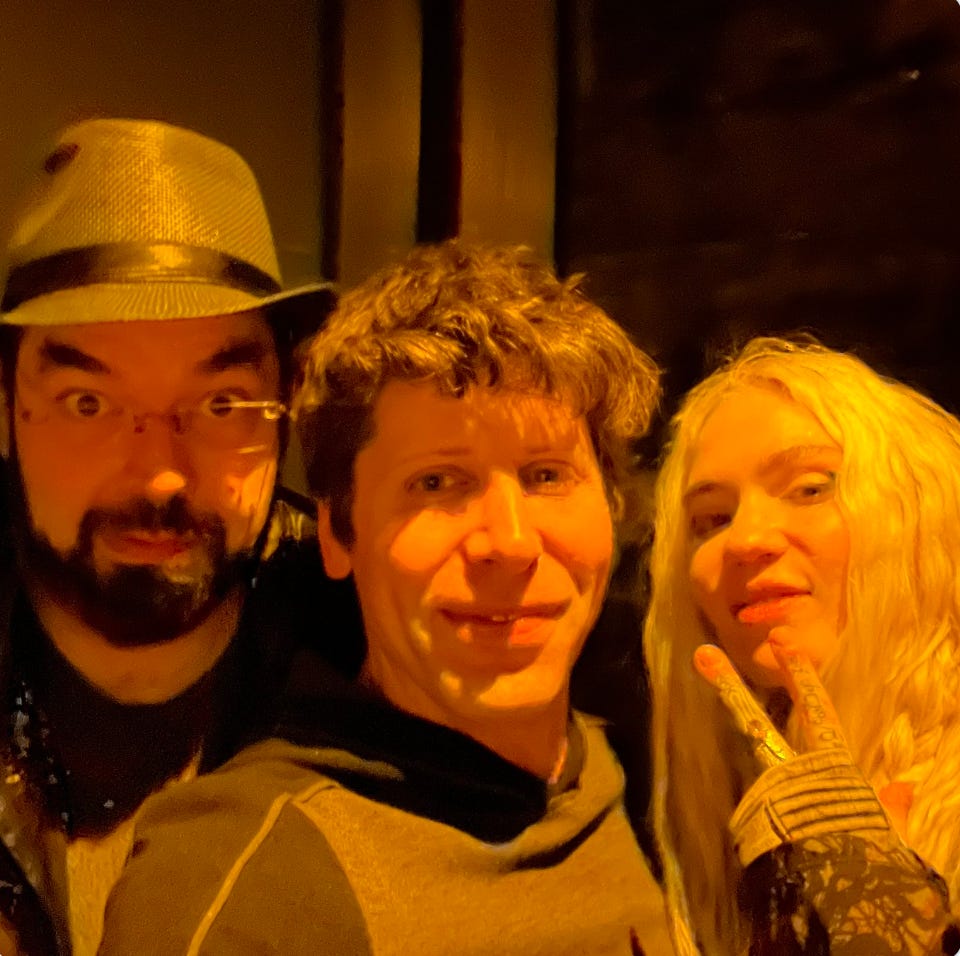
In 2024, OpenAI fired Aschenbrenner for sharing sensitive material from OpenAI with Holden Karnofsky, who left OpenPhil in 2024 (as Director of AI Strategy) and joined Anthropic in 2025. In his 2022 book on longtermism, MacAskill credits Karnofsky with having “a particularly profound impact on my broader thinking about longtermism.”
Following in the footsteps of Bankman-Fried, Aschenbrenner pursued the “earn to give” career path invented by EA. He started a hedge fund called Situational Awareness, which imploded this summer, losing $35 billion almost overnight.
This was just days before Aschenbrenner’s wedding to Avital Balwit, the former FTX Future Fund employee who, like her now-husband, previously worked at Bostrom’s FHI and is currently the Chief of Staff to Dario Amodei, Anthropic’s CEO. In attendance at the wedding were Amodei and “more than a dozen Anthropic employees … as well as MacAskill and others from the FTX Future Fund, plus effective altruists and the billionaires who had put their money into Situational Awareness.”
Alongside Beckstead and Karnofsky (who now works at Anthropic), Dario Amodei was one of the earliest members of the EA movement. According to the New York Times,
all of the major AI labs and safety research organizations contain some trace of effective altruism’s influence, and many count believers among their staff members. … No major AI lab embodies the EA ethos as fully as Anthropic. Many of the company’s early hires were effective altruists, and much of its start-up funding came from wealthy EA-affiliated tech executives.
Like Legg, Dario Amodei cites Kurzweil as having piqued his interest in ASI. He’s also shared the stage with Yudkowsky in discussing the promises and perils of ASI, and he spent years living with Karnofsky (they were roommates). Indeed, Karnofsky would later marry Dario’s sister, Daniella, who cofounded Anthropic with her brother after both quit working for OpenAI.
In addition to money from the FTX Future Fund, Anthropic has been funded by OpenPhil (where Karnofsky worked) and Jaan Tallinn (one of the most prolific funders of the TESCREAL movement).
Another noted figure at Anthropic is the utilitarian longtermist Amanda Askell, the former wife of William MacAskill, who was involved in the early EA movement and received her undergraduate degree at Oxford, where FHI and the Global Priorities Institute were based. (MacAskill changed his surname from “Crouch” upon marrying Amanda.)
In 2017, while still an employee at OpenAI, Dario Amodei joined a conference panel on ASI with Nate Soares (of MIRI, also Yudkowsky’s coauthor) and Shane Legg (of the Thiel-funded DeepMind). The conference was hosted by the Future of Life Institute (FLI), which was cofounded by Tallinn and Max Tegmark, the latter of whom has collaborated with Bostrom. Musk and Bostrom were both external advisors at FLI.
Also present at the conference — sponsored by Musk, Tallinn, and OpenPhil — was:
Musk (who has promoted the work of Bostrom and MacAskill, even calling longtermism “a close match for my philosophy”)
Eliezer Yudkowsky
Holden Karnofsky
Ray Kurzweil
William MacAskill
Nick Bostrom
Max Tegmark
Jaan Tallinn
Demis Hassabis
Sam Altman
Paul Christiano (who was also roommates with Karnofsky and Amodei)
Jason Matheny (a former FHI researcher who went on to run IARPA and is now the CEO of RAND Corporation)
Ilya Sutskever (a noted figure at OpenAI until he quit — Sutskever has parroted Yudkowsky in arguing that ASI could kill everyone on Earth. Recall that Aschenbrenner worked under Sutskever on the “Superalignment” team)
Helen Toner (a hardcore EA-longtermist who served on OpenAI’s board and voted to fire Altman in 2023)
Larry Page (a former close friend of Musk’s who personally hired Kurzweil to work at Google)
Eric Schmidt
Reid Hoffman
Vitalik Buterin (recipient of the Thiel Fellowship who donated $665 million to FLI and once participated in an FHI conference)
Going back in time a bit: Seven years before the FLI conference, Hassabis and Legg both gave talks at the 2010 Singularity Summit alongside Goertzel, Yudkowsky, and Kurzweil. (In fact, Legg and Yudkowsky were on the same panel.) Recall that Yudkowsky, Kurzweil, and Thiel founded the summit.
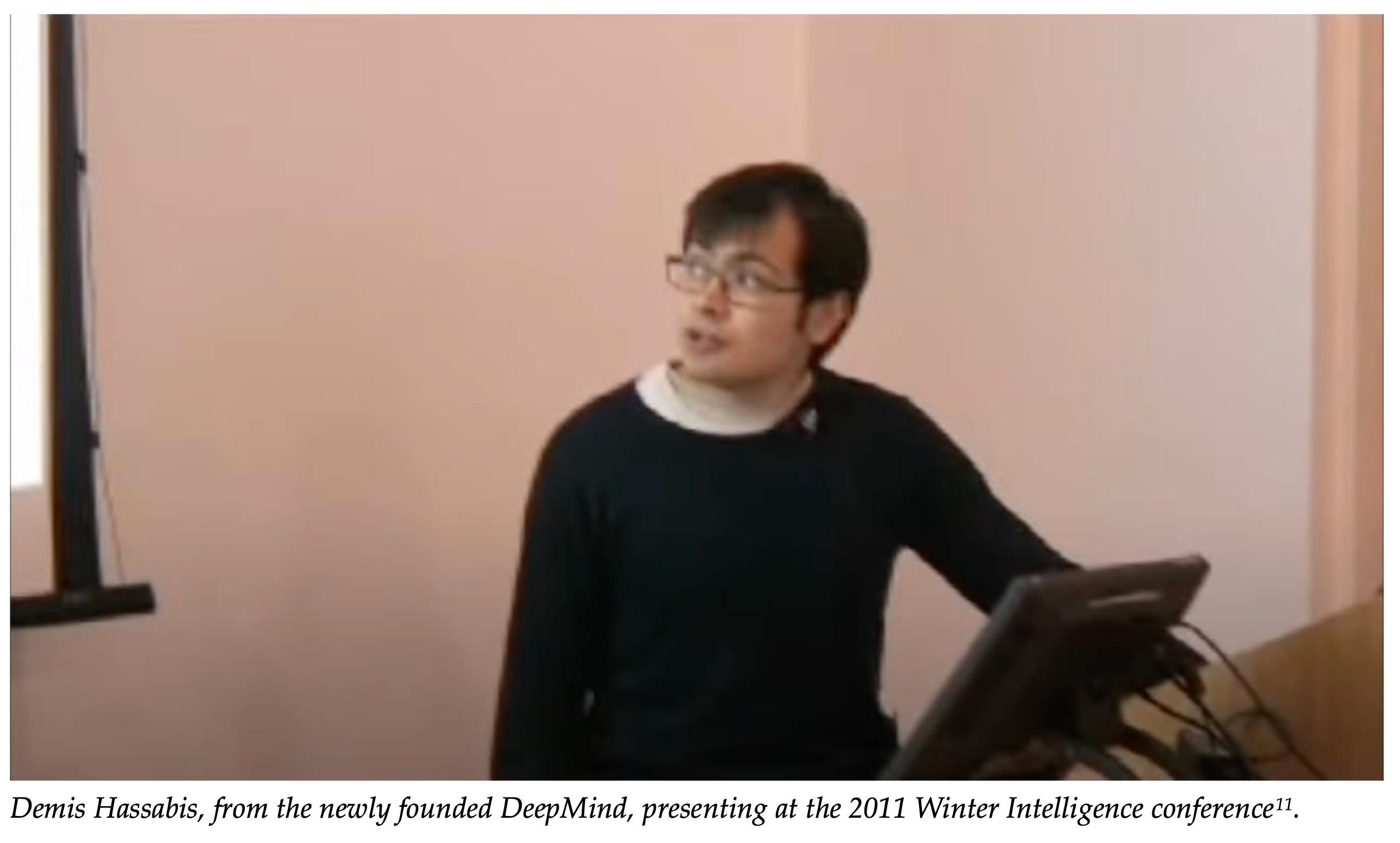
After the summit ended, Hassabis followed Thiel back to his mansion and asked for money to start DeepMind, which Thiel gave him. Hassabis later delivered a talk at the 2011 Winter Intelligence conference hosted by Bostrom’s FHI (image below), and hired Bostrom to be a member of DeepMind’s Ethics & Society research unit.
Taking a closer look at Bostrom, who constitutes a central node in the TESCREAL network: Alongside Yudkowsky, Goertzel, and Kurzweil, he was an early member of the Extropian movement, and he’s become one of the most influential transhumanists today. His 2014 book on the dangers of ASI was blurbed by Musk, and — as noted — he cofounded the longtermist ideology with Beckstead (of FHI, FTX, and OpenPhil).
Bostrom has also been a major figure in Yudkowsky’s Rationalist and MacAskill’s EA movements. He’s coauthored papers with Yudkowsky, and many of his “original” ideas about ASI came from the Rationalist founder. (As Goertzel once wrote, “scratch the surface of Bostrom, find Yudkowsky.”)
Before it was shut down — thanks in part to a racist email from Bostrom that I uncovered in late 2022 — FHI shared office space in Oxford’s Trajan House with the Centre for Effective Altruism, cofounded by MacAskill, who also worked for Bostrom at FHI and, once again, cofounded the Global Priorities Institute that hired Aschenbrenner. In 2015, Musk donated $10 million to FLI, which funneled some of these riches to FHI.
Recall that FHI had close connections with FTX, run by MacAskill’s advisee, Bankman-Fried, who’s now in federal prison. It also had connections with OpenAI. (Altman once described Bostrom’s 2014 book as “the best thing I’ve seen on this topic.”) In 2018, a group of FHI researchers coauthored a paper about AI risk with OpenAI.5 Notable names on the paper include Helen Toner, Dario Amodei (still at OpenAI, along with his sister, Karnofsky’s wife), and Carrick Flynn.
As it happens, Flynn was a former FHI researcher who ran for congress several years ago in Oregon. His campaign boasted of more than $10 million from Bankman-Fried, which “is considered an astronomical figure for a House Democratic primary.” His campaign manager? None other than Balwit, the former employee under Beckstead at the FTX Future Fund, who now works for Dario Amodei and is married to Aschenbrenner.
A Conspiratorial Afterimage
Believe me when I tell you that this is a tiny, tiny glimpse at how incestuous the ASI race — driven by the TESCREAL movement — is. An exhaustive account would require, I’d say, 100 pages of dense reading like that above.
If one were to compile such a document, you’d find the same people, think tanks, companies, etc. popping up over and over again. As mentioned earlier, these people all know each other. They’re all part of the same fringe eschatological movement (though that movement is hugely powerful in Silicon Valley, and hence the world more generally) with the shared goal of building a Digital Deity and conquering the cosmos as radically transformed digital space brains. Even a cursory glance at this network leaves a conspiratorial afterimage, like the floating dots of colors you see after looking at a bright object and then closing your eyes.
Indeed, it’s worth adding briefly that many notable media figures have connections to this movement, including Ezra Klein, Sam Harris, and Kelsey Piper. The last of these knew Bankman-Fried, is friends with Yudkowsky, and writes for the Vox vertical Future Perfect, which was funded by FTX. Even more striking is the fact that Ross Douthat, formerly of the New York Times and now a correspondent at CBS’s 60 Minutes, officiated Aschenbrenner’s wedding. (Side note: the New York Post reports that Aschenbrenner promised “his future wife he would someday buy her not a yacht or a mansion, but a galaxy.” Lolz.)
Here’s how Wikipedia defines a “conspiracy”:
[A] plan or agreement between people … for an unlawful or harmful purpose, such as murder, treason, or corruption, especially with a political motivation, while keeping their agreement secret from the public or from other people affected by it. In a political sense, conspiracy refers to a group of people united in the goal of subverting established political power structures. This can take the form of usurping or altering them, or even continually illegally profiteering from certain activities in a way that weakens the establishment with help from various political authorities.
I don’t think the TESCREAL movement, which admits of many minor variations, is cohesive enough to justify calling it a “conspiracy” without significant qualifications. But it is conspiracy-like. The difference between a real conspiracy and a conspiracy theory is, of course, epistemological: it depends on the totality of the available evidence. As Naomi Klein implies, there is ample evidence to justify describing Big Oil’s efforts to mislead the public about climate change as a conspiracy. But there isn’t any good evidence (!) to support the claim that commercial airplanes are spewing biological or chemical agents into the atmosphere, or that 9/11 was an inside job.
If one seriously examines the cluster-fuck of connections within the TESCREAL movement, and between the TESCREAL movement and the leading AI companies, it becomes clear that calling it “conspiracy-like” is epistemologically warranted. Or so I would argue.
But what do you think? What am I wrong about? As always:
Thanks for reading and I’ll see you on the other side!
For more on Epstein’s connections to the TESCREAL movement, see this article of mine.
He even helped name the movement “Effective Altruism.”
Recall that longtermism is just transhumanism plus space expansionism, built on totalist utilitarian foundations.
In fact, MacAskill also tried to convince Musk, in private text messages, to buy Twitter with Bankman-Fried.
Plus some researchers from other organizations.
Meh. That one is once again one of these where I think we are both better off if I actually write a proper reply because it's actually an interesting topic. But just in case my existential dread once again wins the upper hand over my work ethic:
I feel like the very charge you're defending against is the one that needs to be dismantled because it has been providing diminishing returns for a while now. The question whether there is or isn't a "conspiracy" is sort of a moot point. It's only relevant insofar it's a deciding factor in the question whether or not you're a conspiracy theorist.
And while "conspiracy theories" have been playing a major role in fascist thought, real conspiracies have been coasting on the easy side of the scrutiny spectrum for a while now by acting as if this all was just an authoritarian prompt. Of course there are conspiracies. The issue is with the stuff that has what German political theory calls a "Zentralsteuerungshypothese" (central directing hypothesis) which is the type of conspiracy you find for example in die-hard antisemitism (i.e. the Protocols etc.) and all the stuff that provides you with global explanatory theories that become unfalsifiable. (Every absence of proof becomes proof, for example, as this just shows how deep the conspiracy goes. Blah.)
That's not what we should be thinking about. We should be thinking about which things are a) plausible and b) worth thinking about.
A) will provide us with a bunch of actual conspiracies and B) will make sure we don't get lost in stuff that is ultimately a moot point because it really doesn't matter THAT much. (Do we REALLY care if something that is locked behind secret service archives NEEDS to be released? By which I mean, do we care ENOUGH to make this a main focus of our political lobbying or are there more important things to worry about?)
Have you read any of Robert Anton Wilson’s books?