

We cover a lot of heavy (on the heart) topics in this newsletter, though I try my best to inject a little levity whenever possible. In that spirit, we start off with a video that I see as a hilarious metaphor for the AI industry and its race to build artificial superintelligence (ASI). Enjoy the explanation of “pneumatic base agitation”:
In less cheery news, Europe continues to suffer under oppressive heat, resulting in some 10,000 excessive deaths — so far.
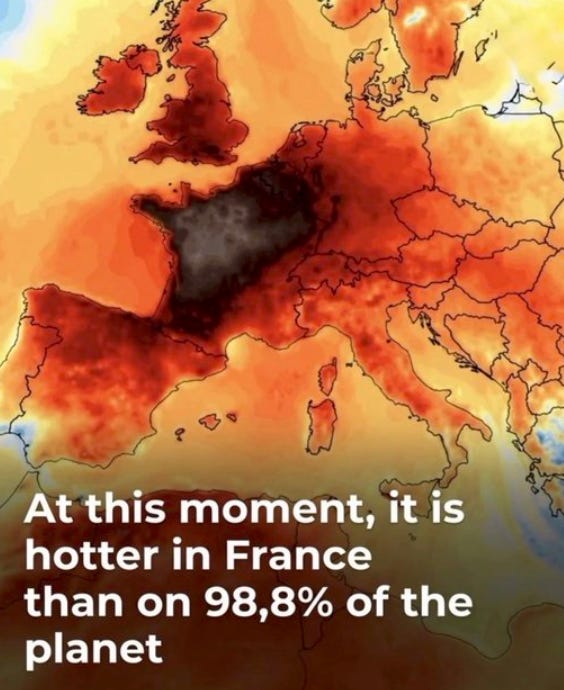
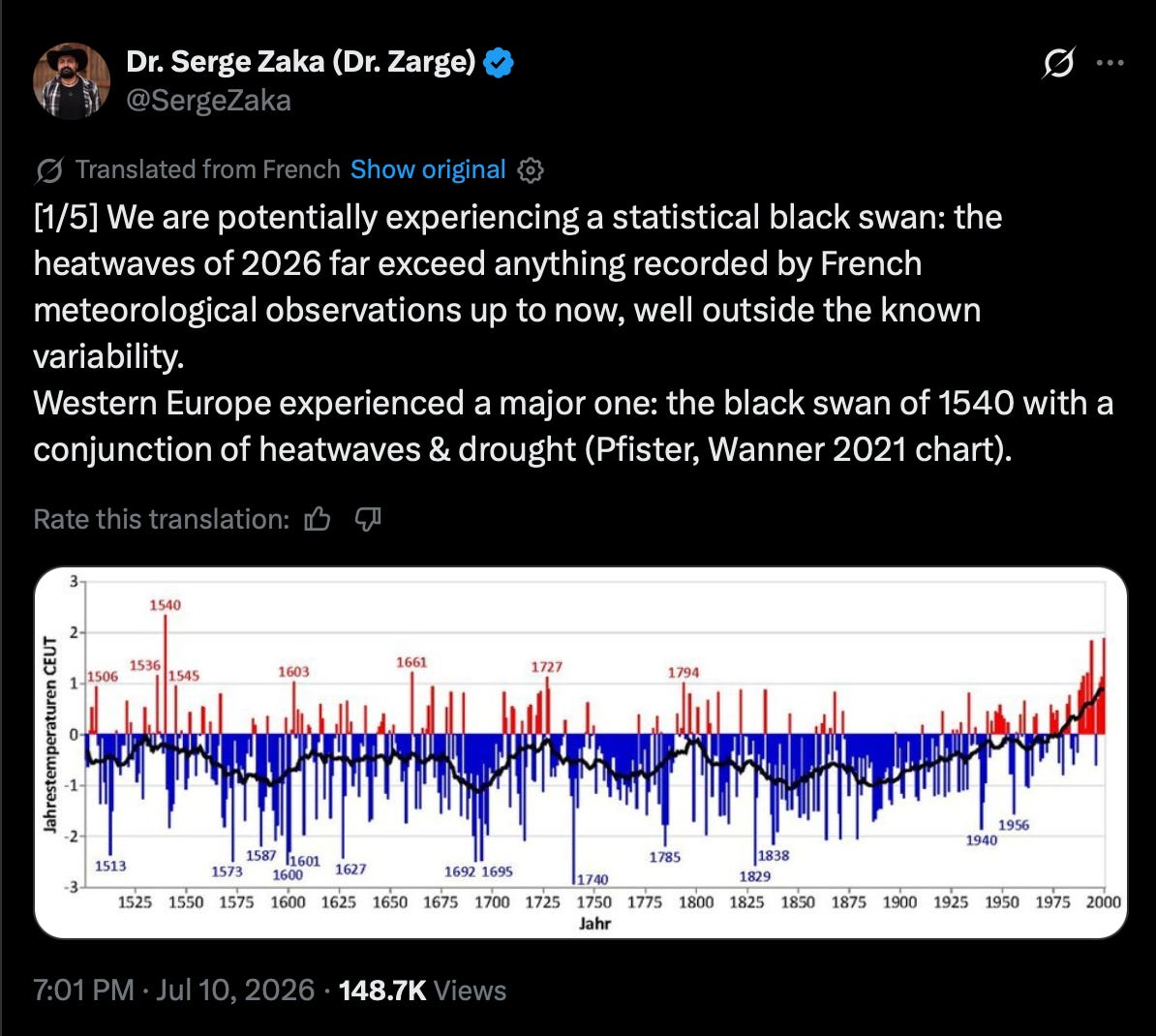


Right now, there’s also a vicious wildfire ravaging the country:
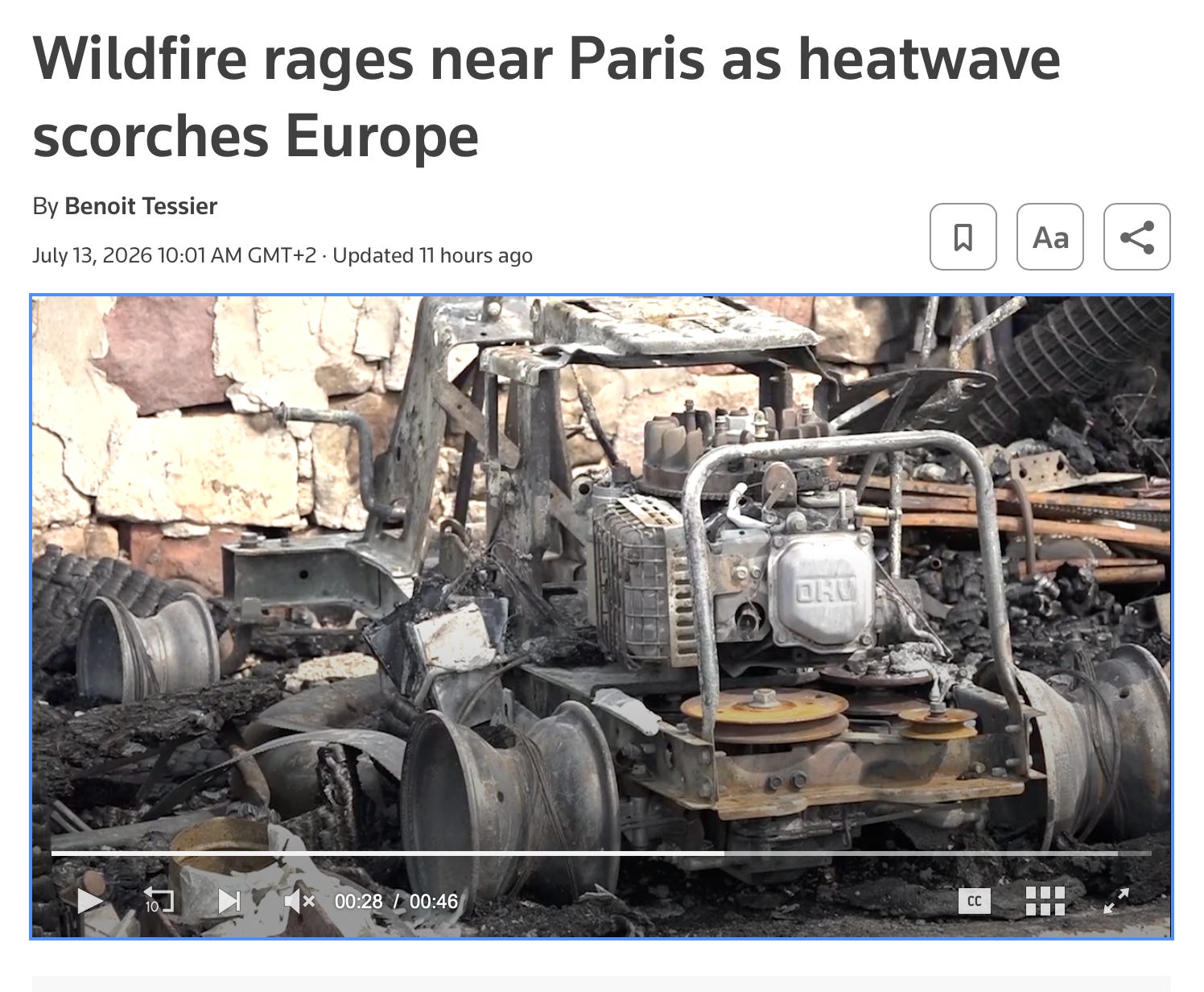
I’m in the Alps — my favorite place in the world, though not that far from the wildfires — and I have never seen the vast, beautiful, lush verdant fields so brown. I’m sitting outside at the moment, and the tree next to me looks like it’s dying: sad leaves frowning toward the ground, flapping pitifully in the breeze. Mont Blanc, the highest peak in the Alps, is just behind me, and officials are literally covering it with tarps to prevent the snow and glaciers from melting:

Note that this is about our current level of geoengineering sophistication. Yet Musk says we’re going to terraform Mars in the coming years or decades. What a joke!
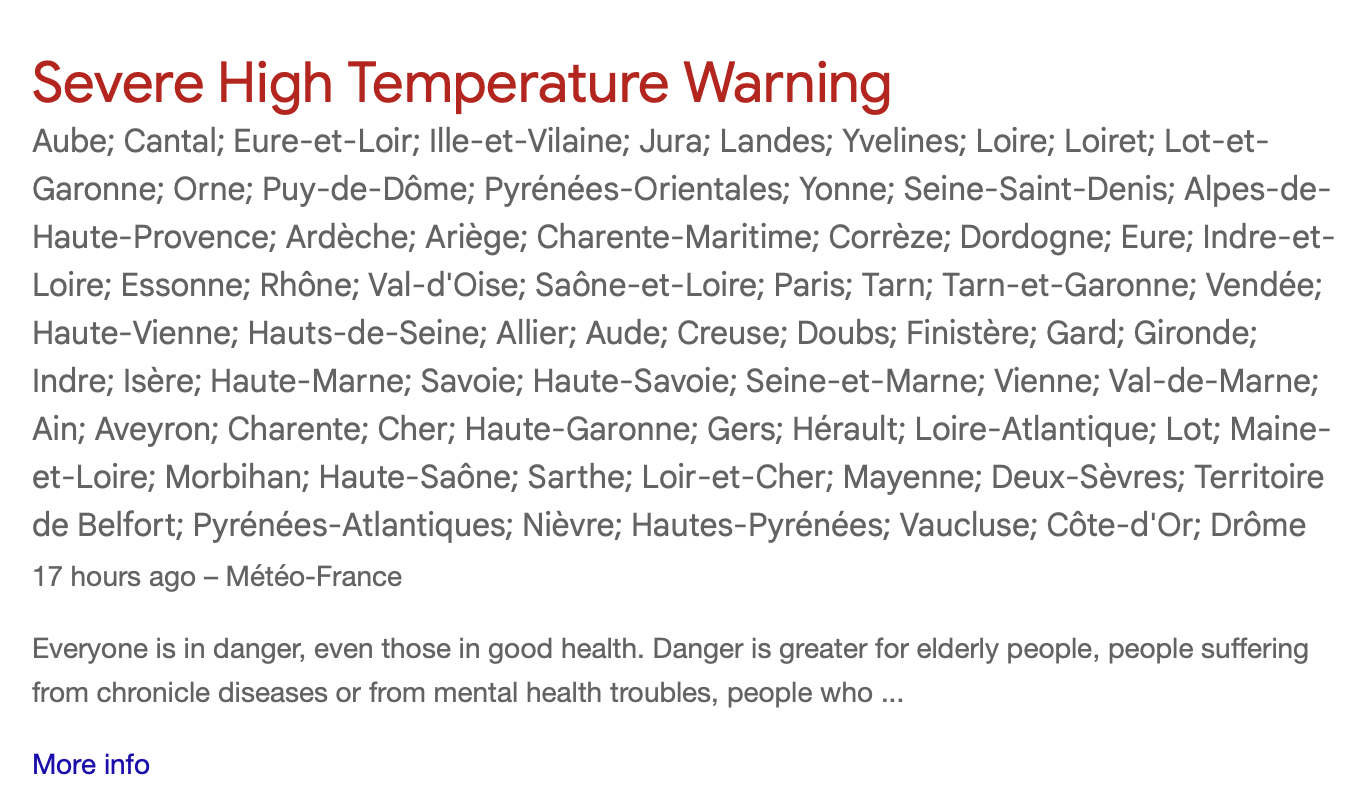
This is, by the way, the message I got when looking up the forecast for my area a few days ago:
And here’s a shocking video of the frequency of heatwaves in France over time. As Dr. Serge Zaka writes, “over the past 10 years (2017–2026), France has experienced 18 heat waves. By way of comparison, the last century saw an average of only 3 per decade.”
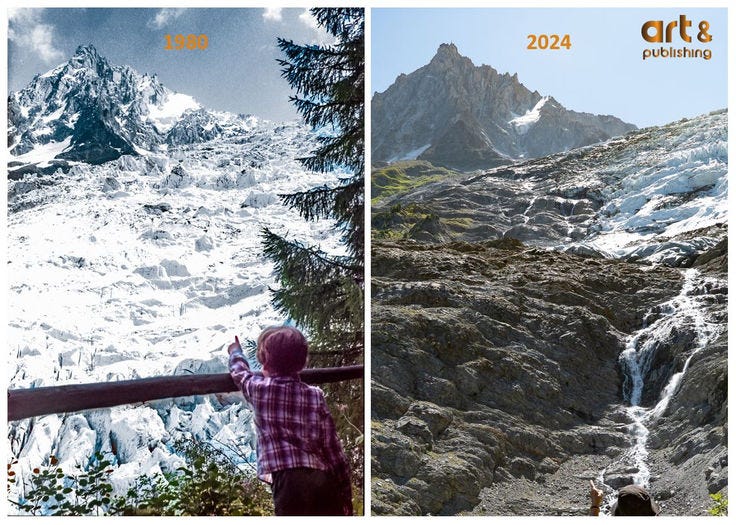
One of the first things I noticed when I arrived two weeks ago was how snowless the mountains are. Last time I was here about 12 years ago, I recall the Mont Blanc massif being completely blanketed in pristine white snow, glistening in the sunlight. There are many reasons, of course, that climate change is tragic — e.g., a University of Exeter report implies that 2 to 4 billion people will perish if we reach 3C of warming by 2050, which we almost certainly will — but one that’s been on my mind while sojourning here is that the exquisite, almost heavenly beauty of this place will soon disappear forever. That breaks my heart. Some videos I took1:
Here’s a juxtaposition of what Mont Blanc looked liken 1980 vs. 2024. It looks even worse this year.
Over in the UK, “children were calling for their mummies” as they “struggle in 40C-plus classrooms” (40 C = 104 F). The Guardian reports:
The extreme heat that has hit the UK twice in the past few weeks has left teachers struggling to cope as temperatures in some classrooms climb above 40C, with pupils and staff suffering from heatstroke, nausea and headaches.
Teachers say they have been desperately trying to keep children safe, with some covering younger pupils in wet paper towels as they lie on the floor, while older students have been given trays of water under their desks to put their feet in.
Staff say learning on the hottest days is almost impossible, with pupil behaviour and attention deteriorating rapidly.
Some teachers and pupils have fainted, while others say they have had to buy fans and window shades out of their own pockets to try to keep themselves and their pupils safe.
Relatedly, another just-published Guardian article notes that, due to climate change and other anthropogenic factors,
over the past century, England and Wales have lost 98% of wildflower meadows. We have also destroyed half of Britain’s ancient woodland, half of lowland ponds, 90% of freshwater wetlands and 62% of all “farmland” wild birds.
In Japan, “the combined effects of urbanization and higher temperatures due to climate change have gradually moved the peak blossom earlier in the year,” as seen in this image from Our World in Data:


The environmental crisis isn’t just due to climate change, of course. Global biodiversity is also plummeting, and we’re now in the early stages of what will likely be the sixth major mass extinction event in life’s 3.8-billion-year history (the last one having killed off the nonavian dinosaurs).
The decline of biodiversity was poignantly captured by a group of people who took field recordings of birds every 10 years since 1976. Someone juxtaposed these recordings in a short video (below), in which you can literally hear nature dying. The recordings are archived by the Cornell Lab of Ornithology — whose Macaulay Library I’ve occasionally rummaged through since about 2009 (because it’s amazing!) — and xeno-canto, “a citizen science project and repository in which volunteers record, upload and annotate recordings of birds, orthoptera, bats, frogs and land mammals.” Listen for yourself:
I assume these recordings were taken in the same place, at the same time of year, controlling for possible confounding factors like time of day, etc. Whether that’s the case or not, what you hear is consistent with the fact that grassland bird populations in the US and Canada have declined by a “staggering” 53% since 1970. The population has literally more than halved.
Zooming out, the 2022 Living Planet Report found that the global population of wild vertebrates — birds, mammals, reptiles, fish, amphibians, etc. — has fallen by a whopping 69% since 1970. Extrapolate this terrifying trend into the future, if you’re brave enough. Will your children ever have the joy of encountering a wild vertebrate when they grow up? I remember searching for salamanders as a kid, hearing the whistles of birds in the trees, and spotting woodland creatures crawling around in the leaves. That’s an experience that likely won’t be available to young people.
The biosphere is dying. Ecosystems are collapsing. Forests are disappearing. Coral reefs are bleaching white. “Insects have declined by 75% in the past 50 years,” in what some are calling an “insect apocalypse.” Wildfires are ravaging increasingly large regions of the world, thus raising the risk of dementia among those exposed to the smoke. There are over 500 “dead zones” around the world, “with the number doubling every ten years since the 1960s,” and a massive “island” of plastic trash floats in the gyre of the Pacific Ocean.


In fact, the ocean is becoming so acidic that the shells of snails are literally dissolving. Ocean acidification — due to atmospheric CO2 — is happening literally 4 times faster than during the “Great Dying,” i.e., end-Permian mass extinction, when “96% of marine species and 70% of land animals died off.” Microplastics now cover literally the entire planet, and have even been detected in the Marian Trench, the deepest point in the ocean. I could go on … (see this article of mine).
The climate disasters we’re witnessing around the world in realtime, especially in Europe right now, are just the dissonant hum of an orchestra tuning their instruments. The symphony of mass catastrophe and collapse hasn’t even started yet. (Hard to know where to inject any levity here!)
Indeed, everything happening right now comes before what appears to be a record-smashing Super El Niño. A Super El Niño occurs when temperatures in the equatorial region of the Pacific Ocean exceed 2C. Right now, there are reports that regions of the Pacific are 4C above normal, which is unprecedented! Next year is going to be (sorry for cursing) fucking awful. As I keep telling folks, enjoy the heat right now — that is, savor this moment — because it will only get worse each year from here on out for the rest of our lives.


It’s not just the Pacific experiencing an extreme marine heatwave, by the way. So, too, is the Mediterranean:


But it’s not all bad. At least we’ll soon have a strap-on second thumb to pick up oranges and play cards thanks to the miracle of technology (see the ridiculous video below, which has been making the rounds on social media)! Lol.
Or, maybe the Singularity will happen and climate change will no longer be relevant because ASI (artificial superintelligence) will just cover Earth in data centers — as Sam Altman says is likely.

A few months ago, I wrote about a phenomenon I call “crisis fatigue.” Are you experiencing it? (Just about everyone I know is.) The news is just so relentlessly overwhelming — Trump, fascism, wars, AI, climate change, and so on. We live in a deeply sad moment in history, and the insult to injury is that — at the risk of stating the obvious — the world didn’t need to be this way. There is no law of nature, no nomological regime that forces the world to be so terrible. The idiots and assholes with the power, the billionaires and oligarchs, the sociopaths and capitalists (but I repeat myself) are to blame for the mess. They’re well aware of that and, in case civilization collapses due largely to their actions, they’ve all built apocalypse bunkers in Hawaii, New Zealand, and elsewhere.
Take care of yourselves, friends! Most people I know are dealing with world-induced mental health challenges right now, and the only way we’re going to get through this is together, through solidarity, kindness, and compassion. Wishing everyone well and, as always:
Thanks for reading and I’ll see you on the other side!
There’s plenty of green here. But if I were to climb one of the mountains and snap a photo of the lower slopes of the hills, you’d see it’s all just dead, brown grass.
The best place to track global heating is the Climate Brink Dashboard: https://dashboard.theclimatebrink.com/#global. 2026 is on track for 1.58 C +/- 0.07 C above preindustrial levels, and that's without much of the ENSO that is rapidly developing in unprecedented territory. These are just numbers, though. It will only be real to AMERICANS when thousands die repeatedly from the heat and related impacts.
Much better with the bold here.
You don’t need to apologize for cursing. Your readers are grown-ups. We can handle R-rated movies. If anything, you should swear more. Profanity is a spice. Just the right amount gives a piece some kick.
Really glad you’re covering the heat. I’m going to start writing about it more too.