

History is best told as a story of organised crime. It is one group creating a monopoly on resources through the use of violence over a certain territory and population. — Dr. Luke Kemp
I just finished reading Luke Kemp’s recent book Goliath’s Curse, and I’d highly recommend it to readers of this newsletter. It’s a sprawling survey of societal collapse across the entire sweep of civilizational history, and his account of Paleolithic violence offers a devastating refutation of key claims made in Steven Pinker’s The Better Angels of Our Nature.
As it happens, I had a desk right next to Kemp’s when I was visiting the Centre for the Study of Existential Risk (CSER) in 2019. We hung out, chatted about global catastrophic risks over drinks, and kept in touch after I departed Cambridge (though we haven’t spoken much over the past few years). I knew him as an erudite scholar with an unusual talent for approaching complex topics in a neutral, objective manner.
To my pleasant surprise, Goliath’s Curse is even more erudite than I anticipated. It’s a work of superb scholarship, in my opinion, and constitutes a major contribution to the global catastrophic risk (GCR) literature. I changed my mind about a number of important issues while reading it.
There’s no way to summarize Kemp’s tome in a single article. What follows is a loosely organized survey of what stood out to me as key points, drawn mostly from memory and a few quotes I jotted down while reading. Please excuse the spaghetti tangle of thoughts that I’m about to throw at the wall!
“Hobbes’s Delusion”
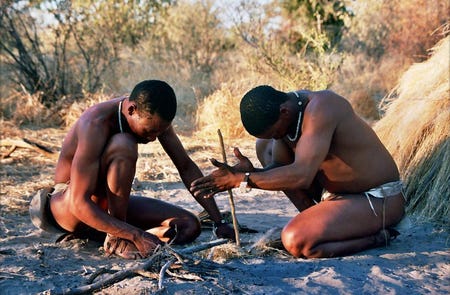
Kemp argues that life in the Paleolithic wasn’t “solitary, poor, nasty, brutish, and short,” as Thomas Hobbes famously claimed. For roughly 300,000 years, we lived in relatively small, highly egalitarian communities in which group decisions were made democratically. As he notes, “modern nomadic-egalitarian groups who have the lifestyles closest to our deep past are especially democratic.”
Violence wasn’t very common, and “Palaeolithic violence was probably highly personal. With little inequality, there would have been few material rewards for killing others.” Those who tried to dominate others were punished: expelled or, in extreme cases, killed — an example of “personal” violence. If you didn’t like the way your group was being run, you could “vote with your feet” by migrating to another group. There was, indeed, a constant interchange of individuals passing from one group to another.
People were also probably quite happy most of the time. Ethnographies of contemporary hunter-gatherers, Kemp points out, “are replete with reflections on how carefree and happy they are, with close-knit communities and a propensity to spontaneously burst into song and dance.”
With the rise of civilization, malnutrition became common and human health suffered, as reflected in the average height of agricultural populations falling for some 12,000 years (we didn’t regain our height until the 19th and 20th centuries). Higher levels of violence, along with oppression, slavery, patriarchy, and martial conflicts resulted. Life in the Paleolithic wasn’t perfect — infant mortality, for example, was much higher than it is today — but the Hobbesian assumption that life was terrible isn’t supported by the paleoanthropological data.1 Life actually got appreciably worse in many respects after the Neolithic revolution.
Civilization Is Domination
Kemp repeatedly emphasizes that people have an inherent aversion to being dominated. This is why those who tried to dominate others in our hunter-gatherer past were ostracized or executed. Yet domination is a core feature of what he calls “Goliaths,” as he explains:
The problem is that most of us are uncomfortable in recognizing the most common element of civilization: rule through domination. … A more apt label for these systems of violence is “Goliath.” A Goliath is a collection of hierarchies in which some individuals dominate others to control energy and labour.
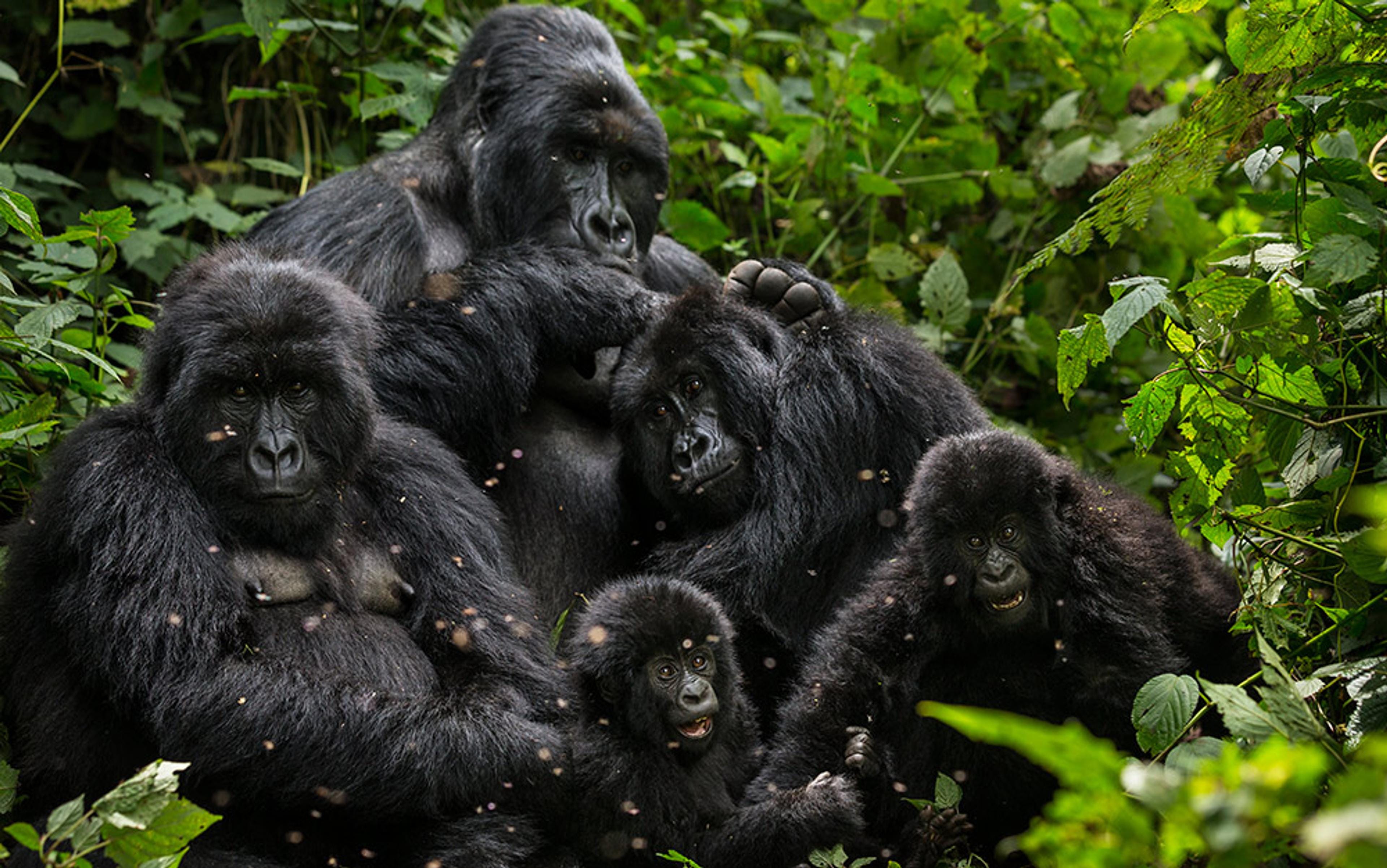
The emergence of Goliaths amounts to, in his phraseology, evolutionary backsliding. By subjecting people to oppressive hierarchies of dominance, it made us more like our evolutionary relatives, the gorillas and chimpanzees. In his words:
Rather than a stepladder of progress, this movement from civilization to Goliath is better described as evolutionary backsliding. Our egalitarianism and counter-dominance shaped our bodies and minds and supercharged our cultural evolution. They made us unique and helped us navigate the Palaeolithic. The move towards Goliath — whether it be through class or patriarchy — made us look more like the harems of patriarchal gorillas and the chimpanzee hierarchies built on violence and politicking.
Collapse and Inequality
A common denominator of collapse across history is wealth inequality. As a Guardian article about Kemp’s book puts it, “history shows that increasing wealth inequality consistently precedes collapse.”
I was aware of the literature on this, but was never convinced that inequality was a causally central factor in collapse. Kemp changed my mind: incompetence, corruption, wasted resources, overuse of resources, frivolous projects of self-aggrandizement (think of the Colossus of Rhodes or Trump’s proposed “Triumphal Arch”), the embrace of loyalists over experts, nepotism, foolish wars of conquest, etc. etc. follow the emergence of elites with excessive wealth and power.
Such phenomena make Goliaths more susceptible to threats that shock the system: famines, volcanic eruptions, earthquakes, disease outbreaks, incursions from foreign armies, ecological destruction, and so on. Whether these threats pose “existential” risks to society depends on how large the threat is, as well as how vulnerable and exposed the society is, as well as its ability to effectively respond once the threat materializes. As Kemp explains:
In the field of disaster risk, we refer to four determinants: threat, vulnerability, exposure, and response … Take the case of a tsunami. The tsunami (threat) is only dangerous if you lie in its way (exposure), and you lack robust shelter that could withstand the wave (vulnerability) or the ability to escape (response).
Consider the case of climate change. Most US citizens are worried about this. Parents fear that their children will inherit a planet much less livable than the one they grew up in. If there were a popular vote, the US would have taken action to mitigate the problem years ago.
But elites have lobbied the government not to act, while spreading climate propaganda to the masses. Curbing climate change would be bad for their personal wealth, power, status, and ambitions. Meanwhile, loyalists in the Trump administration reject the climatological consensus, with Trump himself calling it a “Chinese hoax.” Consequently, the US is doing nothing to mitigate the problem, and has failed to reduce its exposure and vulnerability to climate change’s increasingly harmful effects. This makes collapse much more likely — thanks to the incompetent, avaricious, power-hungry elites who rule the country.
Paleolithic Altruism
In the aforementioned Guardian article, Kemp says that
as elites extract more wealth from the people and the land, they make societies more fragile, leading to infighting, corruption, immiseration of the masses, less healthy people, overexpansion, environmental degradation and poor decision making by a small oligarchy. The hollowed-out shell of a society is eventually cracked asunder by shocks such as disease, war or climate change.
Indeed, Kemp notes that “the biggest predictor of resilience was how democratic or extractive the society was.” This is substantiated by considerable historical evidence, as he explains:
One study of the Late Antique Little Ice Age found that more inclusive societies had less famine, disease, and conflict, and less change in their rituals or how they were organized. Those results have been verified in another study of thirty-three societies covering twenty-two climate-related disasters over nine world regions, four continents, and a thousand years. More democratic groups tend to respond better to crises.
The question is, why? Local people could respond more quickly and effectively to new challenges than distant elites who were often buffered from threats such as a drought. This meant that more dramatic changes (such as collapse) were needed. A second benefit is that shared decision-making means that people in a community had more social connections, which created more effective collaboration (what academics usually call ‘social capital’) during times of stress. This holds true today: acts such as voting, deliberating, and being meaningfully involved in civic institutions (whether that be a sports club or a political group) foster closer and wider social ties. Those ties keep communities together when catastrophe strikes.
Kemp points out that during and in the aftermath of disasters, people tend to come together and help each other. Mass chaos, violence, and “anarchy” don’t usually take over. Rather, our Paleolithic tendencies toward cooperation and altruism often emerge. I’ve personally experienced a few emergency situations in my life, and it’s amazing how complete strangers suddenly become trusted friends.
Kemp continues:
A plethora of studies on modern disasters support the idea that more politically inclusive societies are more resilient ones. As one group of disaster-risk experts concluded, “there is near-unanimous agreement that people’s participation is essential to reducing the impacts of disasters on society.” One indicative study [analyzed] 150 countries over the period 1995-2009 found that more democratic countries, with more state capacity, had fewer fatalities and fewer people affected during disasters. This was true for a range of disasters, from floods to earthquakes. Strong states have more resources to deal with disasters, while democratic accountability ensures that aid is distributed wisely and not just concentrated on the rich and powerful. Inclusive political institutions create more flexibility, effective responses, and unified societies, and they prevent abuses of power.
Does Collapse Benefit the 99%?
Kemp argues that societal collapse has very often benefitted the 99%. It can actually open the door to more progress, innovation, creativity, art, and knowledge. It frequently makes life better for nearly everyone except the elites.
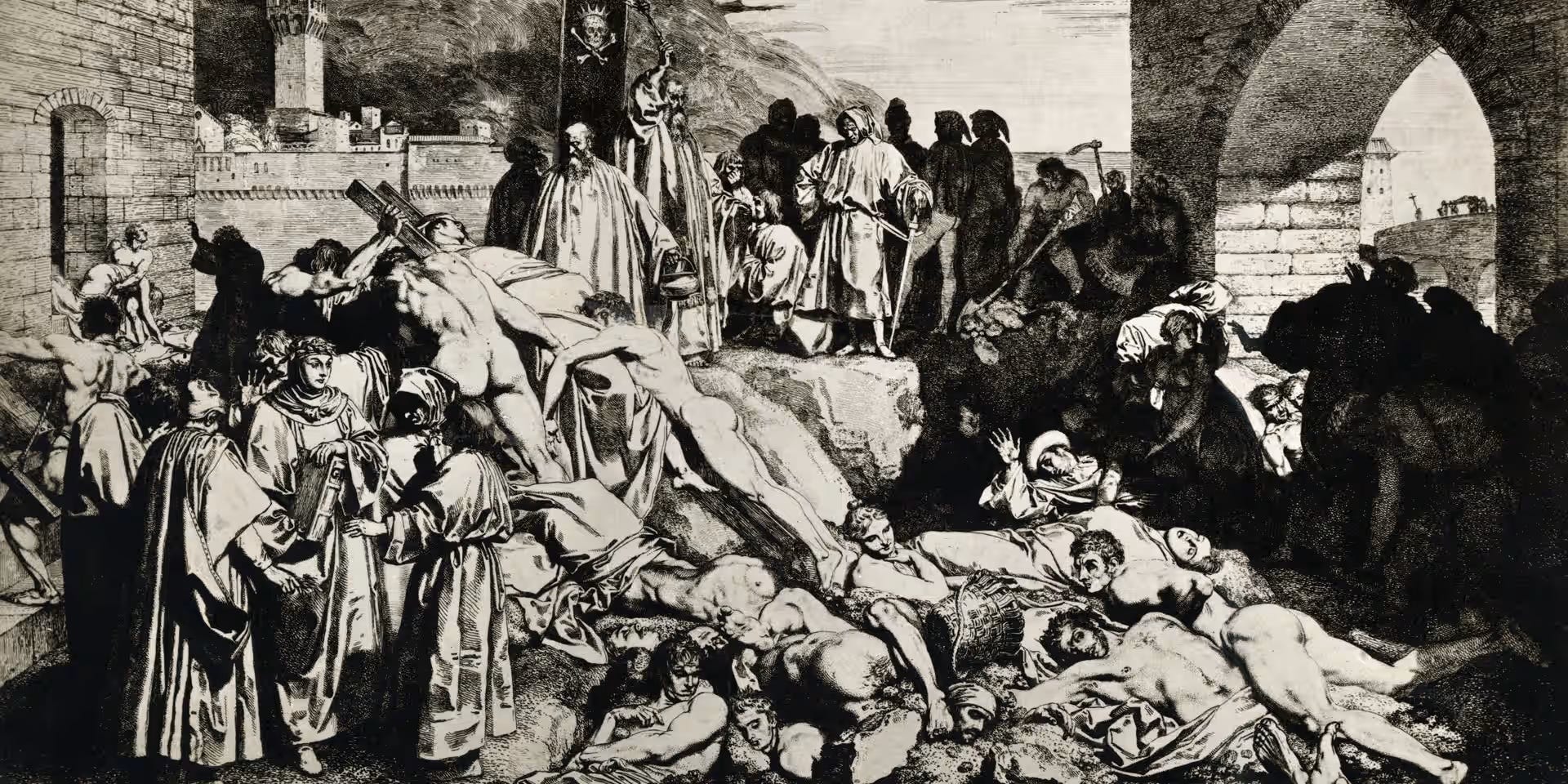
Two examples are the fall of Rome and the 14th-century Black Death. After Rome fell, “people actually got taller and healthier,” Kemp reports. After the bubonic plague swept across Europe, killing up to 50% of the population,
peasants were now valuable enough to force concessions out of the landlords and barons. Wages doubled or tripled in many regions, and the pay gap between men and women decreased. People grew taller and healthier. Life expectancy increased and heights grew from a low of 168cm during the Black Death to a high of around 174 cm.
However,
while the Black Death was a blessing for the survivors and their descendants, these positive effects were not evenly distributed. … Regions that already had inclusive institutions benefited in the long term from the Black Death, while those without them did not.
He adds:
The fall of Rome and the Black Death not only give us an insight into the surprising relationship between collapse and prosperity, but they can also help us to understand how petty European kingdoms became colonial conquerors.
What’s More Deadly than Collapse?
Indeed, some of the worst events in all of human history were the result not of the fall of Goliaths but their emergence and expansion. He writes:
The emergence of these colonial Goliaths was one of the most violent processes of human history. The colonization of the Americas itself may have claimed up to 10-11 per cent of the world’s people at the time. While the numbers are highly uncertain, only one other event seems to come close to this: the waves of the Black Death in the fourteenth century … We can think of these as “global decimations.”
The cause was, of course, the brutal mass murder of Indigenous peoples by the “more civilized” Europeans. It was also due to the Columbian Exchange, namely, “the widespread transfer of plants, people, pathogens, and culture across the Atlantic Ocean.”
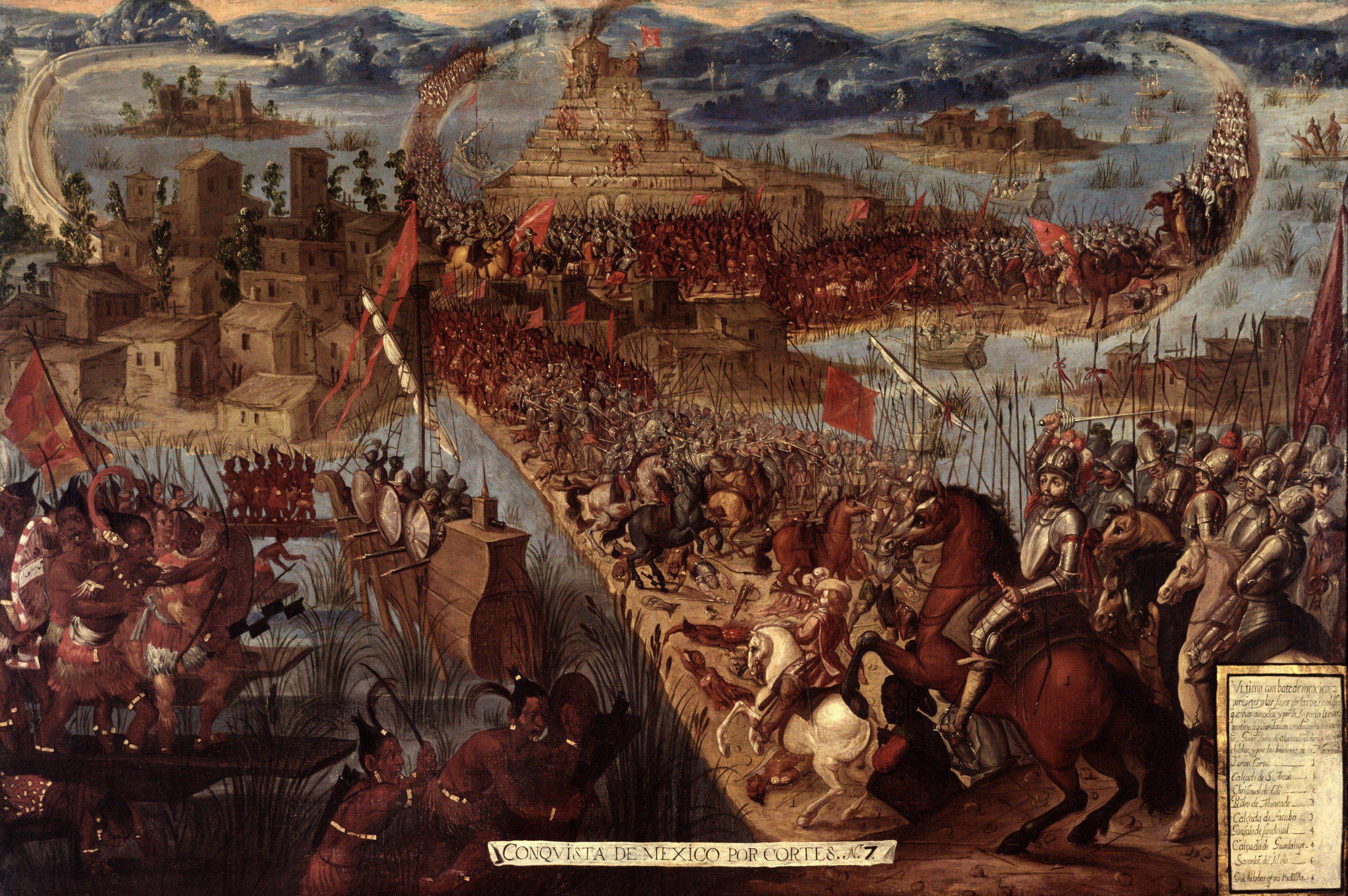

But “there is another critical reason,” Kemp writes, that “colonization efforts succeeded: indigenous allies.” Consider the Aztecs. They were a militaristic Goliath that sought territorial expansion and oppressed the peoples they conquered. He explains:
Those who resisted the imperial expansion of the Aztecs faced higher taxes and harsher working conditions. Many of the conquered territories resented such domination, while unconquered neighbours such as the Tlaxcalans (a confederation of four oligarchic republics) were in a state of near perpetual war with the Aztecs.
The Tlaxcalans thus offered the Spaniards a deal: join us to overthrow the Aztec Empire, to which “the Spanish wisely agreed.” That’s how the Spaniards managed to defeat the Aztecs: it was actually Indigenous peoples rebelling against their neighboring Goliath, because no one wants to be dominated.
What’s Civilized About Civilization?
The key point, however, is that most people looking at history get things exactly backwards: it’s not the disintegration of Goliaths that tend to inflict mass suffering on the 99%, but their very existence. Dominance hierarchies are the real villains of history.
This flips the script that Pinker wants us to believe. Over and over again, Goliaths have inflicted unimaginable horrors on people. “Civilization” seems to imply “civilized,” yet is there anything civilized about the way hierarchies oppress, subjugate, exploit, dominate, and control people through the perpetual threat of violence? As Kemp writes at the very beginning of his book:
[C]ivilization seems to be a wholly inappropriate term for what we see in Cahokia and Rome. It is derived from the Latin civilitas, which implies restraint, moderation, and good political conduct. Slavery, war, patriarchy, sacrificing teenage girls as the priests of Cahokia did, punishing slaves with crucifixion as in Rome, or dropping atomic bombs on cities as the US did less than a century ago, are not what most of us would consider civilized conduct. Orchestrating mass sacrifices or building bombs that vaporize cities does not require altruism, civility, or democracy. It requires top-down obedience enforced through the threat of violence.
In a memorable passage nearly 400 pages later, Kemp says this about states and companies:
States and companies (and perhaps now algorithms) are not just amplifiers of power and decision-making; they also inflate the worst in us: the darker angels of our nature. Think of a modern state, such as the US or Russia, embodied as a single person stalking the streets. Imagine what they are like. Overwhelmingly self-obsessed and self-interested, constantly boasting of their achievements, continuously suspicious of their neighbours, persistently posturing and hoarding guns and knives, and greedy to the extent of never giving even just 1 per cent of their earnings to those in need. That state person, if it took a psychiatry test, would rate disturbingly high on the dark triad (psychopathy, narcissism, and Machiavellianism).
I’d never thought about it this way, but it’s so true! States behave exactly like narcissistic, Machiavellian psychopaths.
The World Is Different Now
Interestingly, Goliaths have actually become more resilient over time. We don’t see the same sorts of collapse in recent history that we did long ago, especially within the Global North. States may “fail,” as happened with the Soviet Union and Yugoslavia, but the basic infrastructure and cultures that comprise those states have persisted. This, however, shouldn’t make us too confident that a genuine, catastrophic collapse doesn’t lie in our future. As Kemp writes:
The world appears to be growing both increasingly robust and more fragile. I call this the “Death-Star Syndrome,” after the space-weapon in the film Star Wars: A New Hope that can annihilate entire planets but can itself be destroyed by a single well-placed blow. Our world is incredibly powerful and robust, yet surprisingly fragile if hit hard enough in the right place.
First, we no longer live in isolated Goliaths that could rise and fall without affecting their neighbors. When Rome fell, other civilizations elsewhere in the world hardly noticed. That’s no longer the case: globalized modernity is so vastly interconnected that a collapse in one place could have profound consequences for all other regions. (As the saying goes, “when the US catches a cold, the rest of the world comes down with pneumonia.”)
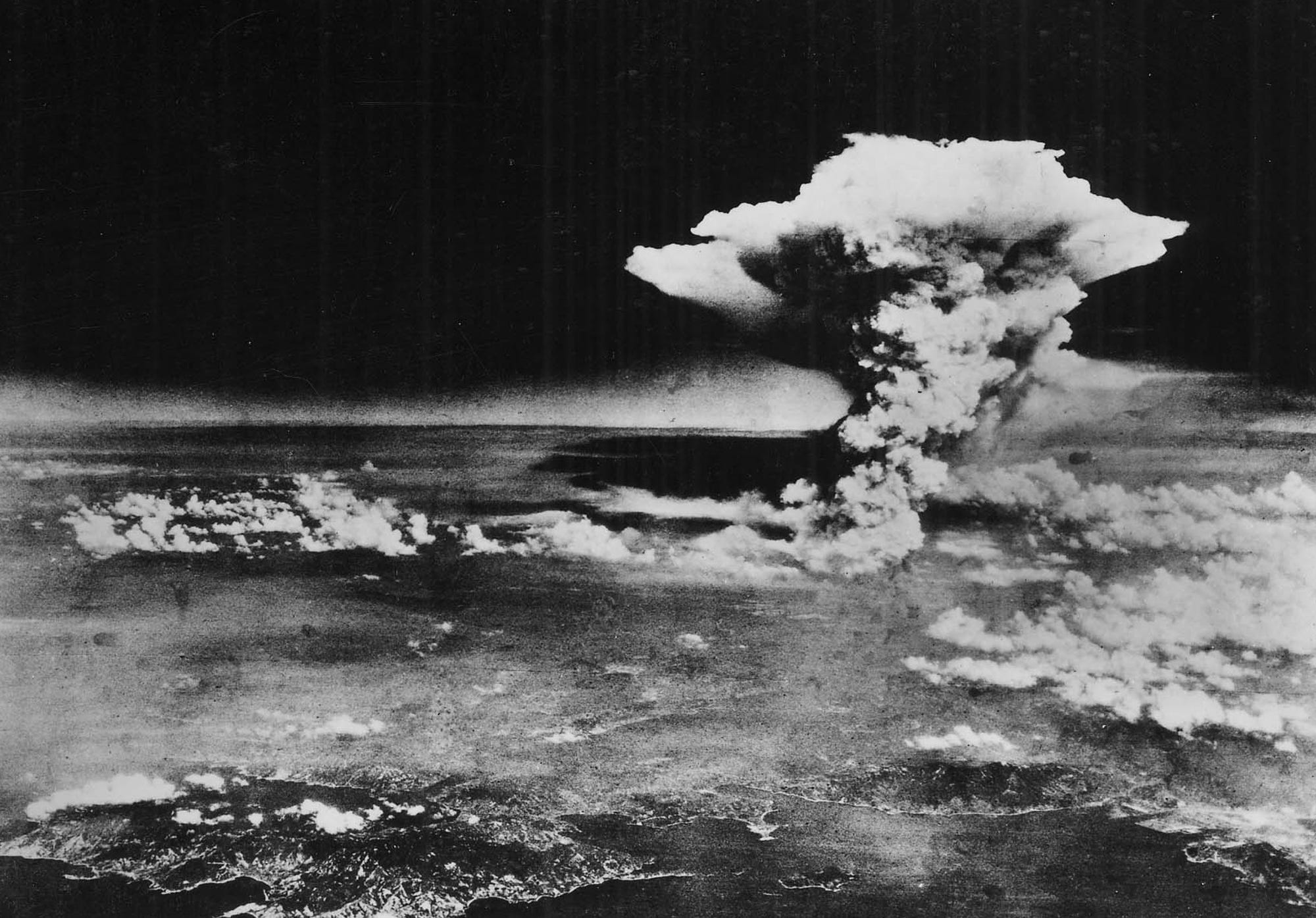
Second, we’re now facing threats on a planetary scale. Even a regional nuclear war between India and Pakistan could cause global temperatures to plummet by a staggering 4 C. A nuclear war between the US and Russia could kill over 5 billion people — and a relatively sudden loss of 5 billion people would have truly devastating consequences for the global economy, agriculture, geopolitical stability, and so on. As Kemp observes, the power to decide whether or not to initiate a nuclear war lies in the shaky hands of a select few Dark-Triad madmen: Donald Trump, Vladimir Putin, etc. This is a terrifying concentration of destructive power in people we wouldn’t trust to babysit our children.
There are also global-scale threats from climate change, engineered pandemics, artificial superintelligence, and killer robots, to name a few. While certain risks have declined over the centuries, Kemp notes that “fat-tailed” risks associated with such phenomena have notably increased. Consider this curve:
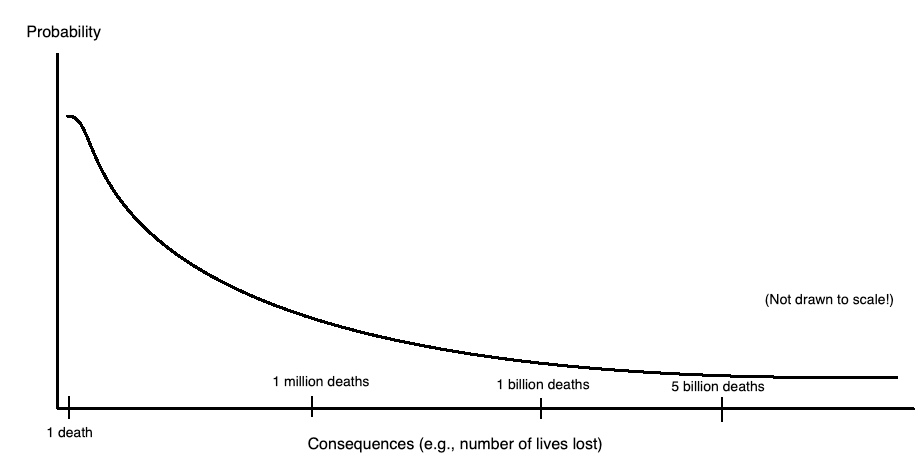
This shows that low-impact risks (on the left) have a higher probability of occurring than high-impact risks (on the right). However, the “fat-tail” on the right means that some very low-probability risks would result in widespread, global-scale harms. You can think of it like this: most people who will ever die in pandemics will die in the absolute worst pandemics. Those pandemics — falling on the far right of the graph — will take so many people that they’ll overwhelm the numbers of people who’ve died from far more common localized outbreaks and epidemics. Here’s how Kemp puts it:
You are about twice as likely to take your own life than to be murdered. You are more likely to die from cancer than from any infectious disease. Unfortunately, this does not mean that we live in the safest of times or are on the cusp of defeating disease. Far from it.
Deaths from disease and violence follow a “fat-tailed distribution.” They are marked by a few outsized events, such as the Spanish flu, the Black Death, and the Columbian Exchange. This makes observing an average from one year, or even ten, essentially meaningless. The average will be brutally skewed by these “tail events.” The extremes, not the average, are the main source of risk. Importantly, these tails are becoming fatter and longer over time. Even if the world on average seems safer and healthier, the extremes are growing in likelihood and severity.
Advanced AI, synthetic biology, climate change, biodiversity loss, and perhaps future nanotechnology carry fat-tailed risks such that, if a low-probability worst-case outcome were to occur, it would decimate the world.
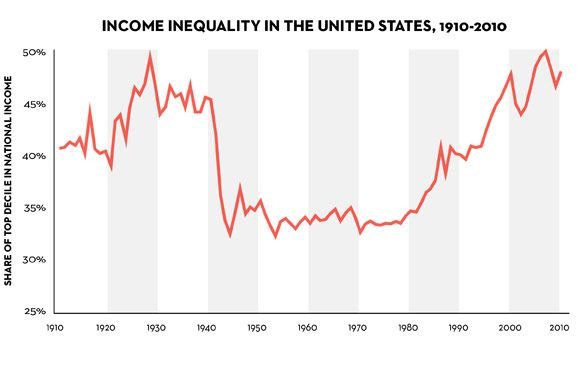
Making matters worse, wealth inequality has skyrocketed. The catastrophe of World War II leveled things off a bit, but disparities have risen since the 1970s. This harbinger of collapse has probably never been more salient, certainly not on the global stage. The world is run by people who are actively destroying it, while those same people prepare for the coming collapse by building apocalypse bunkers in Hawaii and New Zealand.
Here’s how Kemp explains the unsettling uniqueness of this perilous period in the Guardian:
He cites three reasons why the collapse of the global Goliath would be far worse than previous events. First is that collapses are accompanied by surges in violence as elites try to reassert their dominance. “In the past, those battles were waged with swords or muskets. Today we have nuclear weapons,” he says.
Second, people in the past were not heavily reliant on empires or states for services and, unlike today, could easily go back to farming or hunting and gathering. “Today, most of us are specialised, and we’re dependent upon global infrastructure. If that falls away, we too will fall,” he says.
“Last but not least is that, unfortunately, all the threats we face today are far worse than in the past,” he says. Past climatic changes that precipitated collapses, for example, usually involved a temperature change of 1C at a regional level. Today, we face 3C globally. There are also about 10,000 nuclear weapons, technologies such as artificial intelligence and killer robots and engineered pandemics, all sources of catastrophic global risk.
Yikes.
Those Damn Agents of Doom
All of this “existential risk” — a term I don’t like, although Kemp isn’t using it the way as TESCREALists do — comes from a small group of elite actors that he calls “Agents of Doom.” This refers to the Big Oil fossil fuel companies, the Big Tech AI companies trying to build superintelligence, and military-industrial complexes (“a collection of militaries and the arms manufacturers they tend to contract to”). It’s these companies, run by assholes who likely score high on the Dark Triad traits, that are responsible for pushing civilization toward disaster.
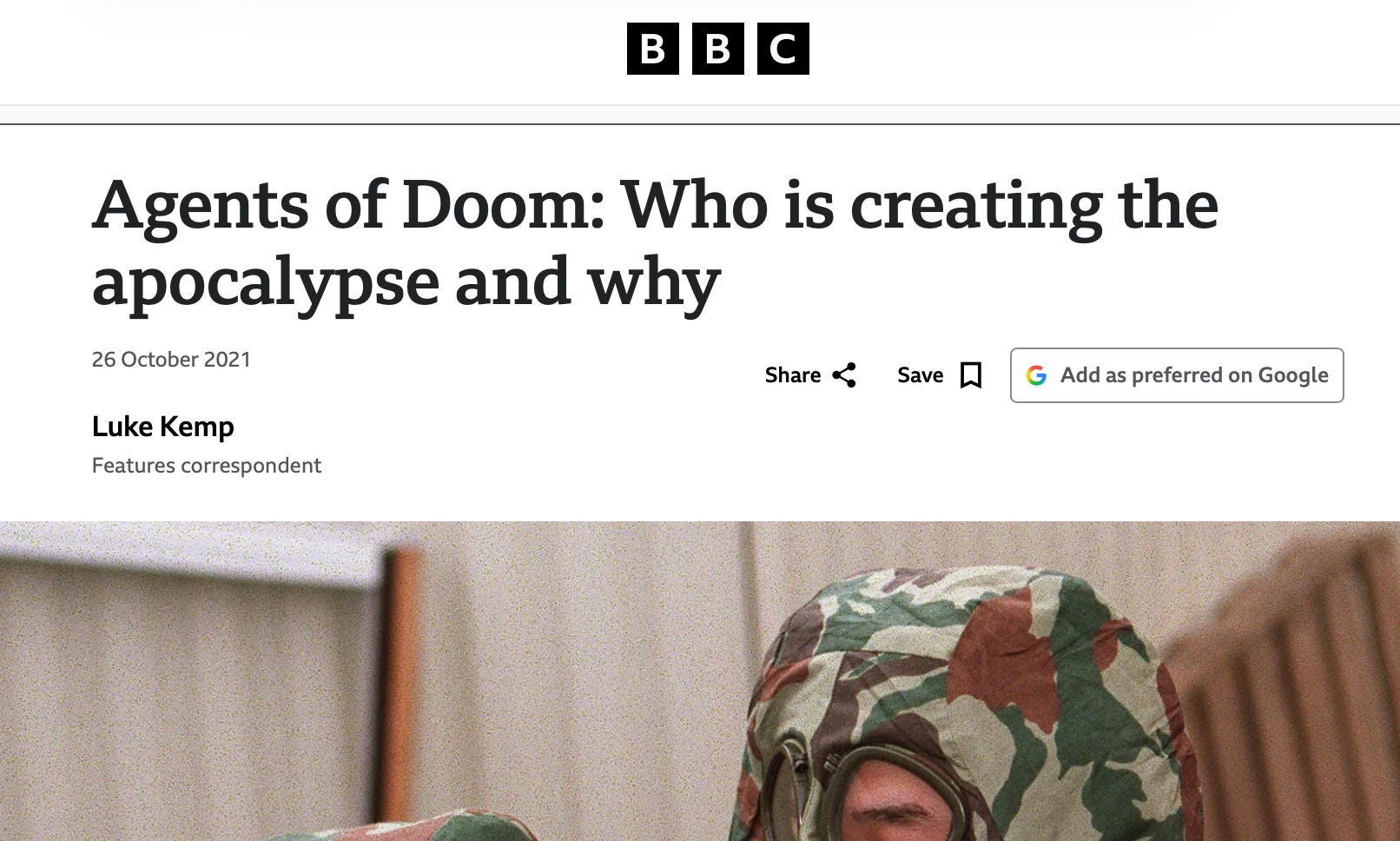
I sometimes hear radical environmentalists say, “So what if humanity goes extinct due to climate change? We deserve extinction given how we’ve trashed the biosphere.” My response points out the obvious: “This misdiagnosis the problem. It’s a tiny elite of endlessly avaricious capitalists with a fetish for the accumulation of infinite wealth and power who are responsible for our predicament. If climate change were to take only them out, there might be a degree of justice served. But the 99.9% don’t deserve to die for the actions of a tiny few.” This response generalizes to superintelligence, bioweapons research, nuclear proliferation, and so on. If our global Goliath collapses, blame the Agents of Doom.
What, then, can we do?
Termination, Chains, or Overthrow
Kemp argues that we have three options before us:
Looking at both the long-run trajectory of Goliath and current trends, our Global Goliath appears destined to hurtle down one of three paths. The first, and most likely, is self-termination. The second is a world in chains. The third is a world in which we somehow manage to shackle and control it.
Kemp argues that we must revive aspects of our Paleolithic lifeways, namely, governance through democratic means. He writes:
Open democracy and inclusive institutions are essentially harnessing these better angels of our Palaeolithic psychology. They are using the best of us to make better decisions and closer communities: to harness our collective intelligence and impulses to help each other. They are moving closer to our past as equals in a web of sharing, constantly moving communities: a fluid civilization. Our Palaeolithic emotions are not a curse. The curse is the institutions and arrangements which bring out the worst in us.
We must therefore empower the people, utilize the wisdom of crowds, and strive to develop novel forms of democratic control to collectively guide the ship of civilization through the unprecedentedly dangerous 21st century. “If we start to properly fund experiments in democracy,” Kemp writes, “and reward them like we reward start-ups in tech, then who knows in what profound new ways we’ll be able to harness the wisdom of crowds.”
Insurmountable?
Unfortunately, Kemp notes that “reversing inequality and establishing deep democracy in a lasting fashion has … been a rarity throughout history.” But it’s precisely because this “is a highly unlikely outcome” that
makes it worth fighting for even more desperately. While throughout history the collapse of a Goliath was usually temporary and a liberation, in the future it threatens to be permanent and take us and much of the planet with it. We are passengers on a journey that looks likely to end in chains or evolutionary suicide. Our Global Goliath will die explosively unless we kill it first.
Indeed, this points to a disheartening fact about future collapse scenarios: not only could they take the entire global system down, but the world left behind would be far less welcoming than the world was after past collapses. As Kemp writes, “it will be trickier in the future for a population to bounce back post-collapse.”
Climate change will, as alluded to above, render large portions of the planet subject to extreme weather events and unsurvivable heatwaves (exceeding the 95 F wet-bulb temperature), while global biodiversity loss and the sixth major mass extinction event will leave ecosystems far more impoverished than they otherwise would be. Consider that the global population of wild vertebrates — mammals, fish, reptiles, birds, amphibians, etc. — has declined by a staggering 69% since 1970. Extrapolate this trend into the future, and then imagine your children or grandchildren trying to survive by hunting, gathering, and fishing.
Extinction Vs. Collapse
An interesting point that Kemp brings up, which I’ve made on numerous occasions over the years, is that total human extinction is “far-fetched,” at least within the foreseeable future. He writes that
even an extreme collapse with extensive infrastructure damage, temporary climate change, and a population loss of 99.99 per cent would have only a 0.1-0.3 per cent chance of causing extinction. There would still be 810,000 survivors, who would have a “grace period” of easy access to remaining supplies (canned goods and produce) and equipment. That might buy them enough time to learn the necessary survival skills such as basic foraging and agriculture. Killing off every single human is an incredibly high bar.
I agree with this.2 I’ve argued that the probability of extinction is very low, though I’d quickly add that the probability of collapse this century looks exceptionally high — on the order of >90%. In other words, I would be very surprised if civilization survives beyond the next 74 years or so. If we could overthrow the oligarchy and put everything under democratic control, as Kemp advocates, then I’d say we have a pretty good chance of making it through. But that also seems quite unlikely — “it’s easier to imagine the end of the world than the end of Goliath,” to quote Kemp. However, he adds that this
is because we are still stuck in Goliath traps: status races, arms races, and races to the bottom (where firms or states try to outcompete each other by exploiting people and environments more intensely). Decreasing nuclear stockpiles, slashing carbon emissions, and making our societies more democratic are all completely feasible, and doing so in the long term will mean escaping these traps and digging up the root causes of existential risk.
Some Criticisms
I have many friendly criticisms of Kemp’s magisterial book. One of the most pressing is that he doesn’t go far enough in talking about how certain Agents of Doom, namely, the AI companies, are trying to bring about a version of human extinction in which our species is replaced by a successor species of posthumans. If the TESCREAL worldview were successfully realized, the result wouldn’t be collapse — yet the extinction of our species would almost certainly result. See my “Pro-Human Manifesto” for all the gory details.
The usual way of thinking about the relation between extinction and collapse within GCR studies is this: extinction would entail collapse, but collapse need not entail extinction. That’s true if one’s talking about final human extinction, but not terminal without final extinction. And it’s precisely terminal without final extinction that many TESCREALists would hope to realize, if they’re successful. Because avoiding final extinction would by definition mean that we have successors, our “civilization” could persist even if our species were to completely die out.
Terminal extinction: our species disappears entirely and forever, full stop.
Final extinction: our species disappears entirely and forever without leaving behind any (worthy) successors to take our place.
I wish Kemp had spent a bit more time on this extremely important issue, though as someone who spent years writing a book of comparable length, I understand how utterly exhausting it is to try to mention everything that could or should be mentioned. The lacuna is completely understandable. Perhaps he’ll address this when a second edition comes out!
As always:
Thanks for reading and I’ll see you on the other side!
Fact of the day: The number 1 is exactly the same as 0.99999… . Those are just two ways of writing the very same quantity. You can see this by noting that 1/3 = 0.33333… . Now, 1/3 x 3 = 1, while 0.33333… x 3 = 0.99999… . Hence, the two numbers are identical. Now you know!
Amusing side note: Kemp observes that the terms Stone Age (Paleolithic), Bronze Age, and Iron Age are misleading. He writes:
There is an unfortunate penchant for labelling historical periods after metals (such as bronze and iron) that tend to characterize elite life in cities. If we are to name periods after the most used and vital resource, then most of human history should be called the wood age.
I got a kick out of the term “The Wood Age”!
With once exception: if the AI Agents of Doom succeed in building a “misaligned” ASI (artificial superintelligence), then I see no reason our species would survive. Fortunately, I don’t think we’re on the verge of building an ASI, and climate change might just destroy society before technical advancements render ASI feasible.
Emile, I’m an old (73) environmentalist, biologist, and natural born Luddite-sympathizer… I always read yr stuff. It always seems right on. Always make me feel shitty. But I enjoy it anyway. Kemp’s book sounds quite good and I thank you for reviewing it. So much of this entire mess was foreseeable, and foreseen by many of my heroes… which is somehow a comfort. It’s really amazing we’ve gotten this far. I was sure it was all about to collapse when I read McPhee’s The Curve of Binding Energy in… 1975? I suppose it’s all kind of exciting…
Wonderful shout-out and critique, thank you. Goliath's Curse is a deep and astonishing read (astonishing because it skillfully demolishes canonical ideas of civilization and progress through the use of tons of historical data and carefully thought-out arguments).
One key feature of "Goliaths" that's also well worth mentioning imo is the emergence of lootable resources (stored surpluses of seeds, lifestock, metals, etc.) as a result of humanity transitioning to agriculture and then industrialization. Today's global economic system is almost entirely built around incidental and engineered scarcity of such resources to maintain harmful hierarchies based on status and power.
Reclaiming these resources with more direct forms of democracy (such as citizen councils and selection of individuals via sortition rather than elections, which gobble up a lot of resources and only fuel cult of personalities and partisan politics) is the way to go.