

I was going to publish an article outlining the evolution of the TESCREAL movement over the past 30 years, drawing from my forthcoming entry for the Oxford Research Encyclopedia of Science, Technology, and Society. But my god it’s been hard to focus on that with all the atrocious news screaming at me (and everyone else) all day.
So, I thought I’d publish something a bit more topical: my thoughts on whether the Doomsday Clock will be moved ahead once again in two weeks (on January 27).
What Is the Doomsday Clock?
The Doomsday Clock was created in 1947 to metaphorically convey our collective proximity to doom, annihilation, or collapse. It’s maintained by the Bulletin of the Atomic Scientists, a venerable institute founded by physicists who had previously worked on the Manhattan Project, which designed and built the first atomic weapons. Since 1947, the minute hand of the clock has been moved closer to and further away from midnight — i.e., doom — depending on world affairs.
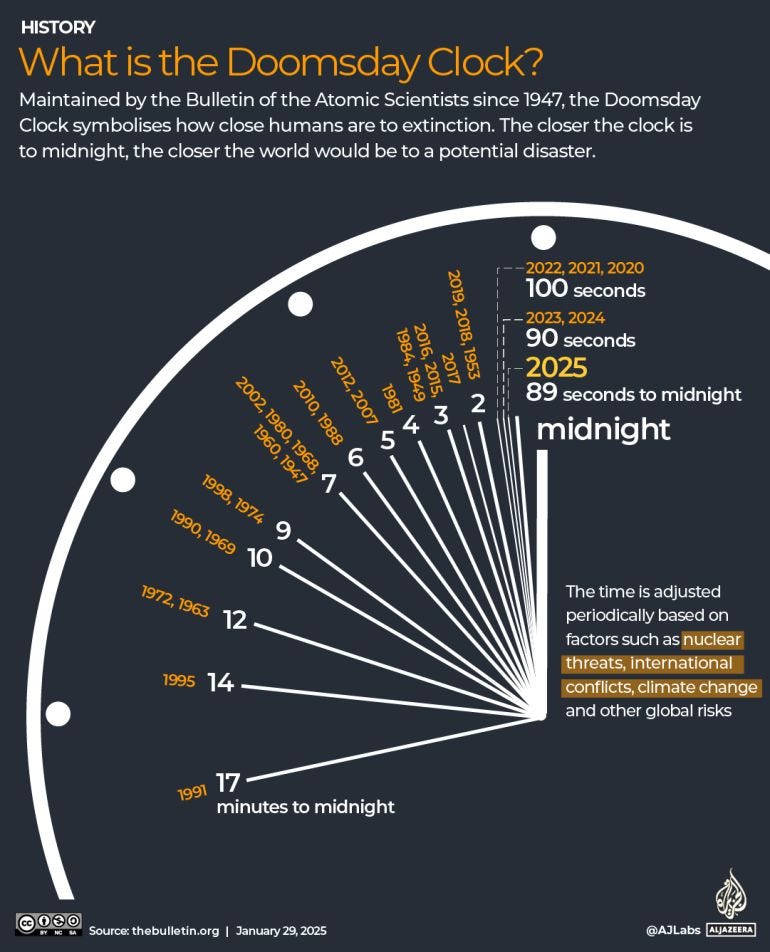
It started off at 7 minutes before midnight, but inched forward to 2 minutes in 1953 after the first thermonuclear (or hydrogen) weapons were built by the US one year earlier. Thermonuclear weapons employ nuclear fission and fusion (the splitting and fusing of atoms) to create explosions far greater than atomic weapons, which use only fission (the splitting of atoms).
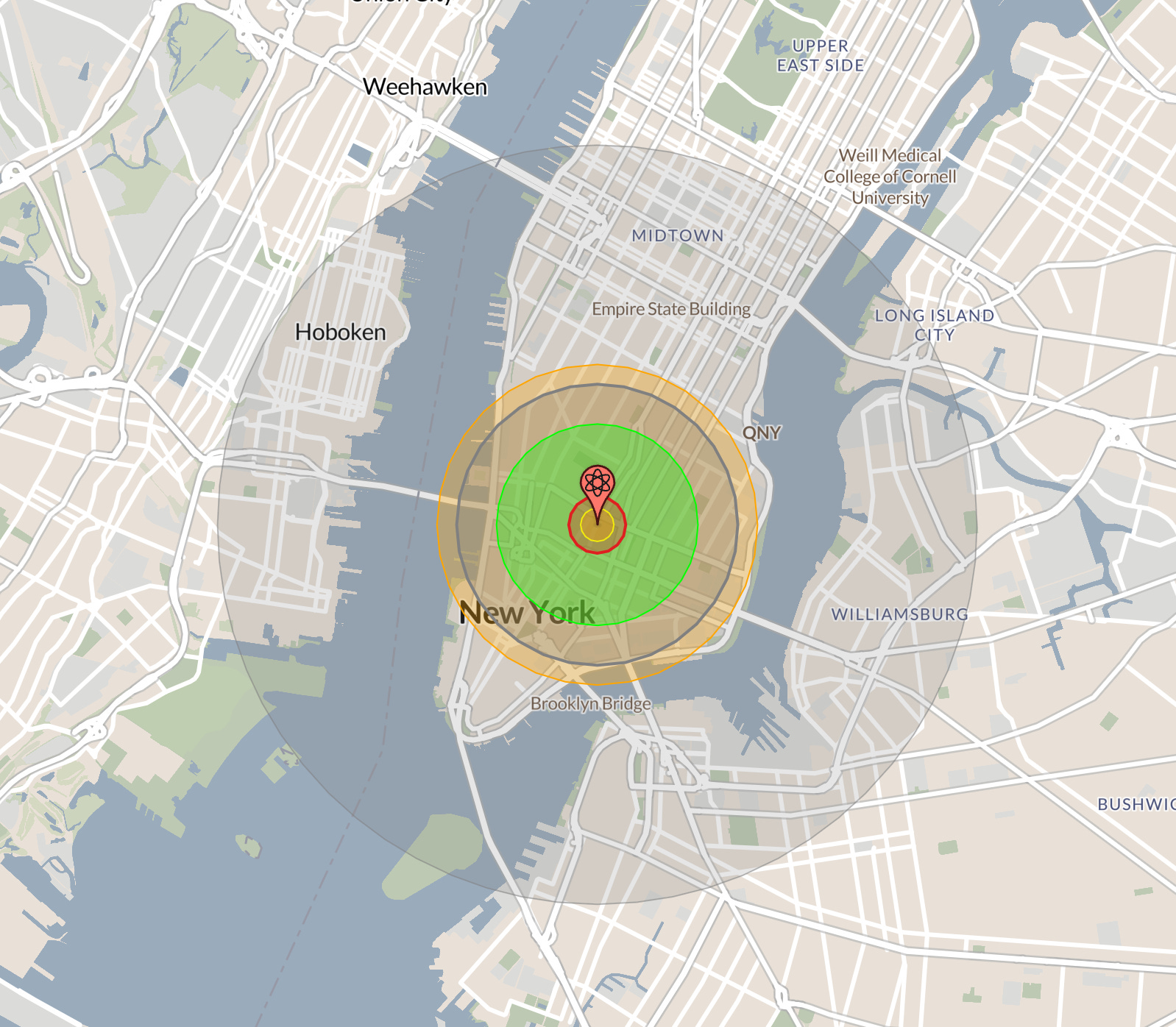
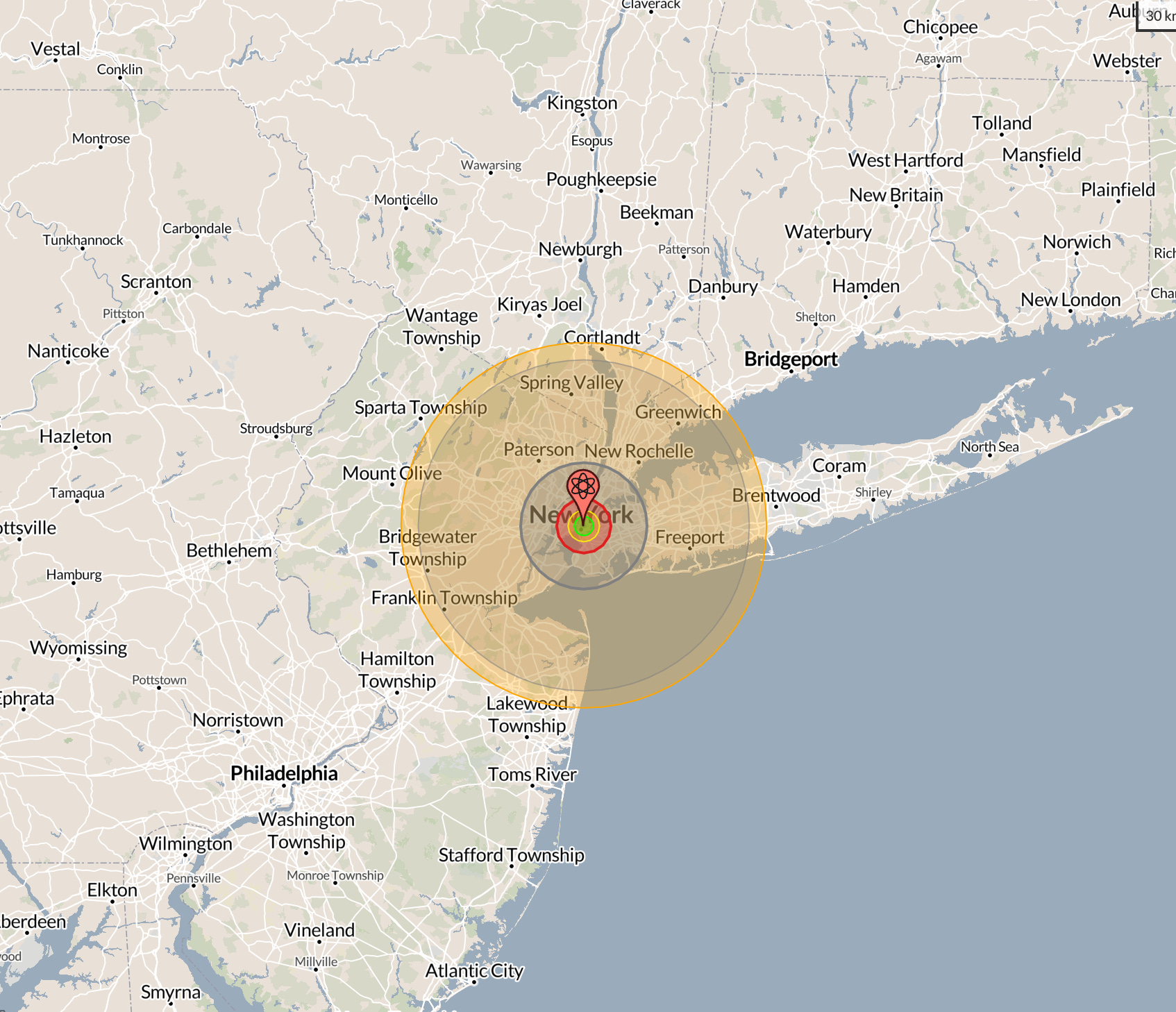
To illustrate the difference in explosive yield, the first image below (from nukemap) shows the damage that a Hiroshima-sized bomb would cause to New York City. The second shows the damage inflicted by the largest thermonuclear weapon ever detonated, call the Tsar Bomba. Note that the Tsar Bomba was half as powerful as it could have been; Soviet scientists reduced the explosive yield because they worried about radioactive fallout.
We’ll return to nukes momentarily.
With the official end of the Cold War in 1991, the Doomsday Clock was reset to a reassuring 17 minutes before midnight. The risk of thermonuclear annihilation — which still hangs over humanity like the sword of Damocles — was greatly reduced. Humanity took a step back from the precipice of universal destruction.
An Ominous Trend
However, since then, the minute hand has steadily crept forward, as our political leaders have egregiously failed to take steps toward establishing world peace and mitigating the myriad threats facing our species.
Sixteen years ago, in 2010, the Bulletin added non-nuclear threats like climate change to its list of worries. More recent assessments by the organization have also taken into consideration emerging technologies like AI. In 2017, the clock was set to 2.5 minutes before doom, approaching the proximity record set in 1953, due almost entirely to Trump having been elected the previous year.
One year later, the Doomsday Clock ticked forward to 2 minutes before doom, and in 2020 it surpassed this ominous milestone to reach a mere 100 seconds before doom. It was then moved to 90 seconds and 89 seconds in 2023 and 2025, respectively.
The Bulletin’s Science and Security Board is responsible for setting the clock, where this board includes many distinguished scientists “with a specific focus on nuclear risk, climate change, and disruptive technologies.” I was once invited to attend one of the high-profile Doomsday Clock announcements in Washington DC, where I met former secretary-general of the United Nations, Kofi Annan (!). I’ve also published numerous articles with the Bulletin, including a critique of longtermism that triggered some of the threats and harassment that I discuss here.
I can attest that it’s an excellent organization run by very serious people; the process of setting the Doomsday Clock is highly rigorous. While the clock metaphor is flawed in many ways — e.g., clocks don’t run backwards! — I take their evaluation of the global predicament of humanity quite seriously, and think others should, too. (If you don’t, may I ask why? Genuinely curious!)
Will the Minute Hand Lunge Forward?
The question is: will the Bulletin move the minute hand forward in two weeks? In 2024, I guessed that they would leave it at 90 seconds, the same setting as 2023 — and I happened to be right. I also suspected that they would move it ahead in January 2025, after Trump was reelected — and that was on the mark, too.
This year, I can’t imagine them not setting the clock even closer to doom. Here are five reasons I think the clock will end up at 88 seconds (an appropriate number, I suppose, given that “88” is code for “Heil Hitler,” as “h” is the 8th number in many European Latin alphabets!).
#1
Immediately after his 2024 inauguration, Trump withdrew the US from the Paris Climate agreement for the second time. (He also withdrew the US during his first term, but Joe Biden reversed this.) Then, just days ago, Trump withdrew the US from the United Nations Framework Convention on Climate Change.
Established in 1992 and having entered force in 1994, the Convention aims “to financially support climate change activities in developing countries,” with the “ultimate objective” of stabilizing “greenhouse gas concentrations in the atmosphere at a level that would prevent dangerous anthropogenic interference with the climate system.” It is “the underlying treaty for the landmark Paris climate agreement.” As the person below notes, the US now “stands alone in dismissing the problem of climate change.” Pretty astonishing.


This is, of course, bad news for the planet. Last year was the second hottest on record, surpassed only by 2024. In fact, the 20 hottest years on record all happened within the past 22 years.
Since at least the 1980s, climate scientists have been warning that unchecked anthropogenic global warming could result in a host of devastating consequences, including:
more extreme weather events,
uncontrollable wildfires,
devastating heatwaves (some exceeding the 95-degree-F wet-bulb threshold for human survivability; see the video below),
megadroughts,
food supply disruptions,
rising sea levels,
coastal flooding,
biodiversity loss,
ecological collapse,
ocean acidification,
the spread of infectious disease,
mass migrations,
political instability,
social upheaval,
economic collapse,
inter- and intra-state conflicts, and even more
According to one recent study published by the University of Exeter, if we exceed 2C of warming by 2050, we should expect more than 2 billion premature deaths. If we exceed 3C of warming, we should expect over double that — amounting to roughly half the human population right now.
Here I’m reminded that 12 years ago, the former US secretary of defense Chuck Hagel described climate change as a “threat multiplier,” adding that it “has the potential to exacerbate many of the challenges we are dealing with today — from infectious disease to terrorism.” Even the Department of Defense noted in a 2015 report that “global climate change will aggravate problems such as poverty, social tensions, environmental degradation, ineffectual leadership and weak political institutions that threaten stability in a number of countries.”
What a giant step backwards we’ve taken! At exactly the moment we most need someone to address the climate crisis — given that the window for meaningful action to mitigate the problem is rapidly closing — the American public made the catastrophically unwise decision to put a twice-impeached convicted felon and climate denier back in the Oval Office.
Climate change will affect the livability of our planet for the next ~10,000 years — a longer period of time than human civilization has so far existed. It’s hard to overstate what a devastating blow Trump administration’s dismissal of climate change is.
#2
Relatedly, Trump has vowed that US oil companies will invest billions into Venezuela to revamp its dilapidated oil infrastructure and greatly increase its oil output (though the Exxon Mobile CEO responded that the country is “uninvestible” in its current condition). Venezuela has the largest oil reserves of any country in the world, although production slowed during Hugo Chavez’s presidency.
Even more, the type of oil buried under Venezuelan ground — called “heavy sour crude” oil — “is among the dirtiest in the world.” It contains a much “higher concentration of planet-heating carbon than lighter oils,” like that found in the US. As CNN reports:
Its consistency means heavy oil is generally harder and more energy-intensive to extract. “The oil does not flow from the well as a liquid. It has to be heated, usually by pumping steam into the reservoir,” said Lorne Stockman, research co-director at the environmental non-profit Oil Change International. This requires large amounts of energy, primarily produced from planet-heating natural gas.
Impacts continue beyond extraction. The oil’s high sulfur content also makes it harder and more expensive to refine into useful products like gasoline and diesel. It requires specialized equipment and more energy-intensive processes, further increasing climate pollution.
Again, at exactly the moment when reducing our collective carbon footprint is vital for the survival and wellbeing of humanity, Trump plans on pumping even more pollution into the atmosphere.
#3
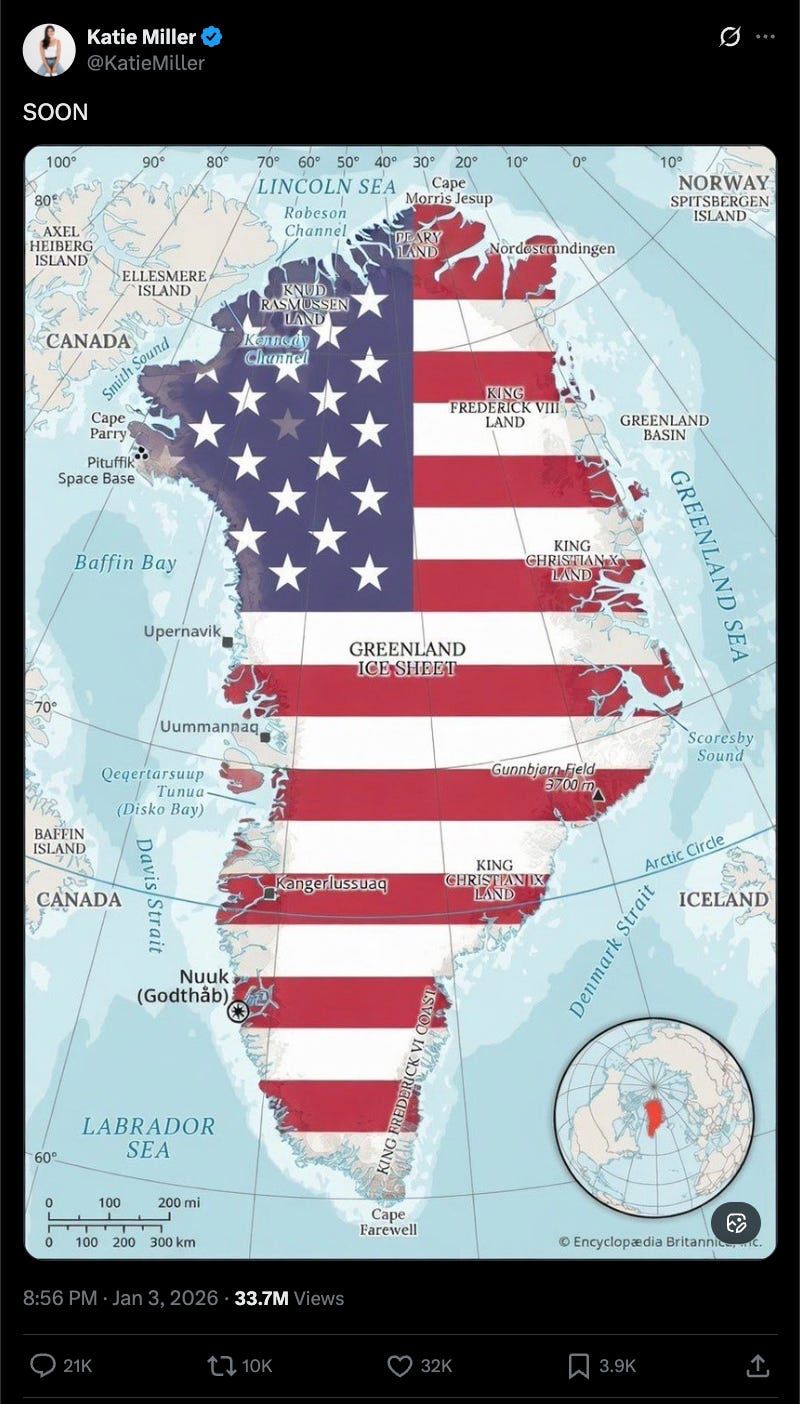
The US attack on Venezuela, whereby Venezuelan president Nicolas Maduro was kidnapped in violation of US constitutional and international law, was quickly followed by US threats targeting Columbia, Cuba, Iran, Mexico, and Greenland — not to mention Trump’s repeated threat to annex Canada and make it the 51st state.
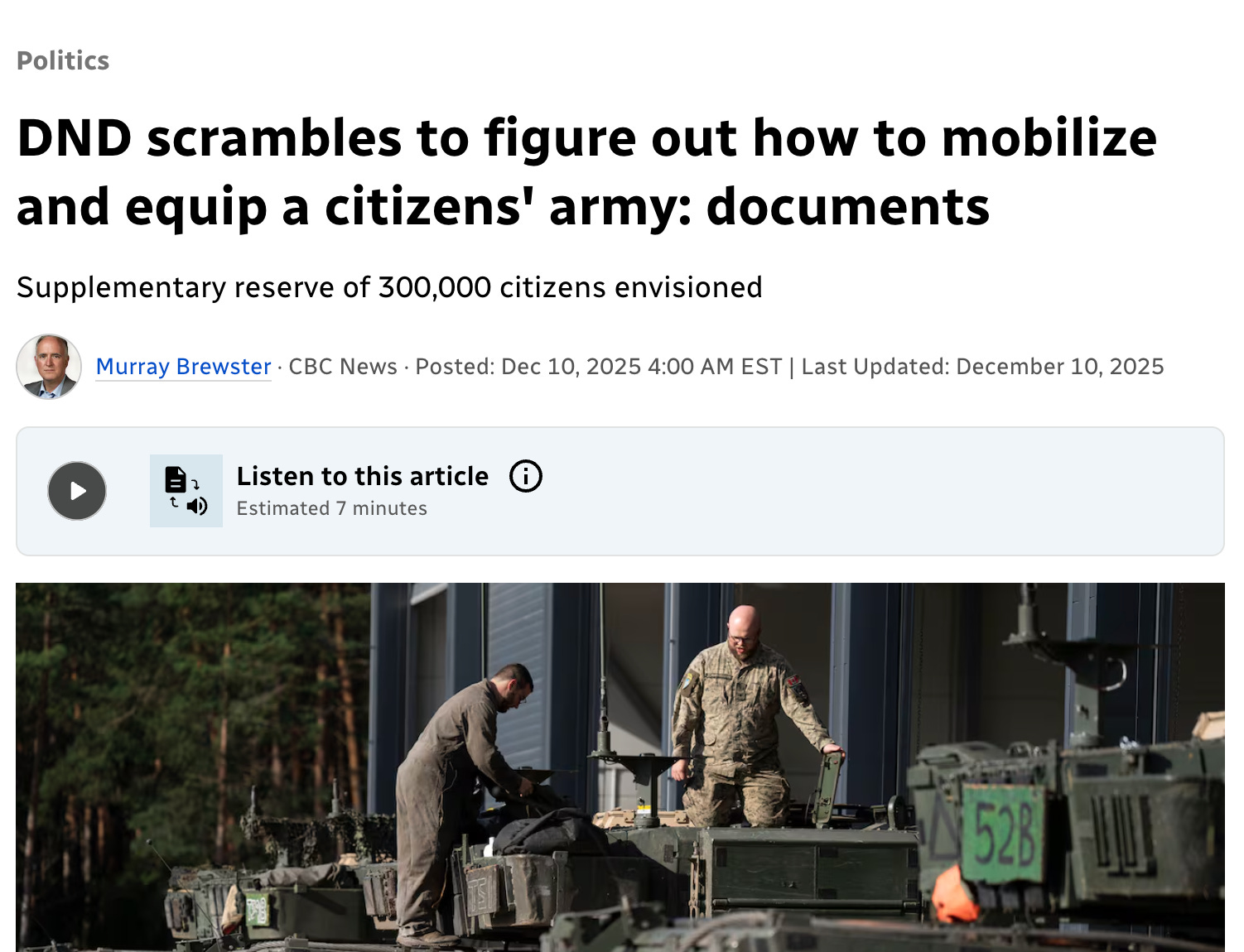
In fact, the CBC reports that Canada is quite literally taking steps to prepare for war with the US. The same goes for Denmark and Greenland: the Danish Defense Minister and Deputy Prime Minister, Lund Poulsen, announced just last Tuesday that his country would invest $13.8 billion in “rearming Greenland, given ‘the serious security situation we find ourselves in.’” (It’s hard to believe this is reality.)
The trampling of international law and jingoistic-imperialist foreign policy that Trump is now implementing will greatly destabilize the post-WWII world order. As Trump himself noted on social media (in all caps), “Russia and China have zero fear of NATO without the United States,” given that the US is the greatest military power within NATO by far. Since it seems only a matter of time before the US takes Greenland, the NATO alliance that’s played an integral role in keeping the “Long Peace” (no great-power wars) since WWII will likely soon dissolve, leaving Europe more vulnerable to Russian incursions and acts of aggression.
Although I doubt that NATO would go to war with the US once Trump annexes Greenland, it’s not entirely implausible, in my opinion. Canada is part of NATO, and would become even more fearful of the US if its geographical neighbor, Greenland, were to become US property — as Stephen Miller’s wife suggested it will in a social media post the same day the US illegally kidnapped Maduro. This is very bad and not at all good!
#4
Another reason the Bulletin will probably move the Doomsday Clock forward is nuclear proliferation. Trump announced recently that “the United States intends to resume nuclear testing.” Furthermore, “new programs and accelerated funding would sharply raise Pentagon spending on nuclear forces to $62 billion under the Trump administration’s fiscal year 2026 defense budget request.”
In 2018, Trump proposed a “nuclear-capable sea-launched cruise missile program,” which was subsequently opposed by the Biden administration; moving forward with this “would add $1.9 billion in R&D funding to the modernization program in fiscal 2026.” Just one week after being sworn in last year, Trump ordered the US Armed Forces to build a multi-layer missile defense system, the “Golden Dome,” far more extensive than what we currently have, with the capability of destroying cruise, hypersonic, and ballistic missiles before they strike the US. The war machine is rumbling.
Meanwhile, “China expanded its nuclear arsenal from approximately 250 to probably 600 nuclear weapons in the last five years, while Russia has been explicitly and implicitly threatening to use nuclear weapons since its invasion of Ukraine.”
Indeed, Russia just “launched an Oreshnik missile into Ukraine … for the second time” since 2024, “in a strike that Kyiv and its allies say is meant as a warning for the West.” The warning is that this intermediate-range hypersonic ballistic missile, which could potentially strike over 3,000 miles away from the launch site, can carry a nuclear payload. It’s a nuclear-capable missile that had previously been “banned for decades” by the Intermediate-Range Nuclear Forces Treaty — which Trump unilaterally withdrew from in 2019.
As a report from the Stockholm International Peace Research Institute reported in June of last year, the “world’s nuclear arsenals [are] being enlarged and upgraded,” with “nearly all of the nine nuclear-armed states — the United States, Russia, the United Kingdom, France, China, India, Pakistan, the Democratic People’s Republic of Korea (North Korea) and Israel — continued intensive nuclear modernization programmes in 2024, upgrading existing weapons and adding newer versions.”
Since the Cold War concluded, the nuclear arsenals of the US and Russia have declined by 80%. But now, it appears that the nuclear arsenals of the countries mentioned above are actually growing, with 0.3% more nuclear warheads in 2025 than 2024. This is why the Stockholm Research Institute concludes that “nuclear risks grow as new arms race looms.” A very ominous sign.
It’s worth also noting the message that invading Venezuela, and Iraq before it, sends to the rest of the world: if you have nuclear weapons, the US won’t invade you. This provides an even stronger incentive for countries like Iran to develop nuclear weapons.
#5
Then, of course, there are the ongoing threats posed by global pandemics, social media, and artificial intelligence (AI). The CDC recently changed the recommended vaccine schedule for children by removing vaccines like those for hepatitis A and B and meningitis (!). Measles is making a comeback in the US, with 49 outbreaks in 2025. Some regions have tried to criminalize wearing face masks to protect against Covid-19 and other communicable diseases.
I can’t imagine the Bulletin not taking seriously the dangers of social media and AI, too. The latter has made it possible for anyone to generate hyper-realistic deepfakes, such as those spread on TikTok of Venezuelans celebrating the abduction of their president, or those unmasking the ICE agent who murdered Renee Good in Minneapolis. Social media provides a potent means of disseminating this “fake news” to the masses, most of whom who lack the media literacy skills to discern what’s real and what’s AI-generated.
It’s difficult to overemphasize the synergistic calamity of these two technologies merging. George Orwell famously wrote in 1984: “The Party told you to reject the evidence of your eyes and ears. It was their final, most essential command.” We’re seeing this play out in realtime with the heartless murder of Good. But what happens when you and I can no longer even trust our eyes and ears due to AI slop, disinformation, and deepfakes polluting our information ecosystem?
Furthermore, it’s worth noting that, as one person wrote on X:


This matters because it threatens US democracy and domestic stability, and US stability has implications for the entire world. As the saying goes: “When America sneezes, the world catches a cold.”
Americans now live in a plutocratic oligarchy — rule by a select view super-wealthy individuals — with unambiguously imperialist and fascist commitments. This situation is unsustainable, and if/when it catastrophically implodes, the ensuing chaos will endanger the entire planet.
Add to this the fact that the AI bubble is currently propping up the US economy, which would likely be in a recession right now because of Trump’s tariffs. As Ruchir Sharma, a fund manager and former Morgan Stanley investor, recently observed, the entire “US economy has more or less become ‘one big bet on AI.’”
Conclusion
My guess is that the Bulletin will only move the minute hand forward by one second. However, I also wouldn’t be surprised if they chose to push it several seconds closer to midnight. The global predicament of humanity is dire — even worse than during the height of the Cold War, according to the Bulletin. We now face a rapidly growing multiplicity of unprecedented global threats and a deteriorating international security situation, thanks in large part to Donald Trump.
I suspect that this is the least crazy the world will be for the rest of our lives, if only because of climate change and all the disastrous sequelae that comes with it. So, buckle up! Things are going to get even bumpier.
On that happy note!
Thanks for reading and I’ll see you on the other side!
Nah Émile, you’re wrong. The Doomsday Clock will NOT move because Trump will post on Truth Social saying:
“THE BULLETIN OF ATOMIC SCIENTISTS WILL NOT BE MOVING THE DOOMSDAY CLOCK!!! I HAVE SPOKEN TO ALL OF THEM AND THEY ALL NOW AGREE THEY WERE SUFFERING FROM TDS, AND WILL NOW MOVE IT TO 1 BILLION YEARS TO MIDNIGHT. ANYONE WHO SAYS OTHERWISE IS SPREADING FAKE NEWS AND IS ALSO PROBABLY A LIBERAL. GOD BLESS AMERICA!!!
Come on Émile, get your head in the game. You’ve been in Europe for far too long.
/s!!!
Thanks Emile. Your analysis appears to me spot on. Regardless of the Doomsday clock or what the Bulletin does with it, we, the world, are living in very dire times. I was a Cold Warrior, when cloaked hostilities between the USSR were at their peak and the prospect of global nuclear war was always on our minds. Since the early 90's that prospect had largely retreated. Until now. Trump is a deranged megalomaniac being fed a constant stream of batshit crazy megalomaniacal lunacy from an equally deranged Steven Miller. And we are only a year into this nightmare. I do not see how this ends well, for anyone.