

It’s not dark yet / But it’s getting there. — Bob Dylan
The (Existential) Mood of the Times
Back in ~2017, I was speaking to a friend of mine — a famous senior political scientist at Johns Hopkins — and I asked how he was doing. His response has haunted me ever since: “Every day feels like a funeral.”
The global predicament — or what the Club of Rome called the “world problematique” — has only worsened since then, and the slide appears to be accelerating. In my 2024 book Human Extinction: A History of the Science and Ethics of Annihilation, I introduced the idea of an “existential mood.” This is a kind of public mood — a “mood of the times” — that arises from a specific set of assumed answers to questions like:
Is human extinction possible? Or is humanity fundamentally indestructible?
If possible, how probable is it?
Is this probability increasing or decreasing?
Could extinction happen in the near term? Or are we safe for the time being?
Is our extinction inevitable in the long run?
How could our extinction happen? What are the various “kill mechanisms” that could catapult us into the eternal grave?
Have we discovered all possible kill mechanisms? Will we create new kill mechanisms in the future?
And so on.
A Brief History of Thinking About Human Extinction
For nearly all of Western history, virtually everyone believed that humanity is indestructible(!). Even those who affirmed that human extinction could happen also believed that humanity cannot be destroyed. How does that make sense?
Well, they accepted a version of extinction that I call “demographic extinction,” whereby our species disappears entirely — but not necessarily forever.
“Terminal extinction” refers to our species disappearing entirely and forever, while “final extinction” refers to our species disappearing entirely and forever without leaving behind any (worthy) successors. Mentioning these because I’ve referenced them in numerous newsletter articles!
For example, the Ancient Greek philosopher Xenophanes propounded a cyclical cosmology according to which at some point in the future all humans will disappear from the earth. However, as the cycle proceeds, we will inevitably return — until we disappear again. He thus accepted a kind of human extinction while nonetheless affirming the indestructibility of our species.
Once Christianity became widespread in the West during the 4th and 5th centuries (boosted by the 313 CE Edict of Milan and 380 CE Edict of Thessalonica), even the most elementary conception of our extinction — demographic extinction — became more or less unthinkable. It simply wasn’t part of God’s plan for the universe, for balancing the cosmic scales of justice at the end of time. Yes, the world as we know it will end, but humanity will endure through the cataclysmic paroxysms of the eschaton to join God in heaven on Earth forever.1
The point is that naturalistic extinction (think: dodos and dinosaurs) is rendered impossible by the eschatological narrative of Christianity and its metaphysical assertion that all humans possess immortal souls, which implies that humanity itself is immortal.
It wasn’t until the 19th century, as Christianity began to retreat, that people — for the first time in all of Western history — started to accept that humanity might not be fundamentally indestructible.
You find, for example, Lord Byron’s 1816 poem Darkness — inspired by the Year Without a Summer caused by the Mount Tambora eruption in Indonesia — which depicts the world completely bereft of all humans. Around the same time, the “last man” motif became widespread, known today mostly because of a book by Byron’s friend, Mary Shelley, titled The Last Man (1826).
Then, in the early 1850s, something devastating happened: physicists discovered the second law of thermodynamics (“Second Law”). They immediately recognized the apocalyptic implications: that Earth — if not the entire universe — will someday become uninhabitable. One scientist wrote of “the terroristic nimbus of the second law,” which he described as “a destructive principle of all life in the universe” (at the time — surprisingly — most reputable scientists believed in extraterrestrial civilizations). Another reported that
species after species of animals and plants will first degenerate and then become extinct, as the worsening conditions of life render it impossible for them to continue the struggle for existence; a few scattered families of degraded human beings living perhaps in snowhuts near the equator, very much as Esquimaux [dated language] live now near the pole, will represent the last wave of the receding tide of human existence before its final extinction; until at last a frozen earth incapable of cultivation is left without energy to produce a living particle of any sort and so death itself is dead.
Wild stuff!
Not long after, Bertrand Russell penned his famous 1903 essay “A Free Man’s Worship” — which basically plagiarized another article from Arthur Balfour (yes, that Balfour2). In it, he poetically lamented that
all the labors of the ages, all the devotion, all the inspiration, all the noonday brightness of human genius, are destined to extinction in the vast death of the solar system, and that the whole temple of Man’s achievement must inevitably be buried beneath the debris of a universe in ruins.
This gestures at what I mean by an “existential mood” — a vague sense of, in this case, inevitable doom that pervaded intellectual culture, if not society more generally. (Indeed, H. G. Wells brought this mood to those outside of academia with his 1895 The Time Machine, which depicts the end of earthly life.)
Many people at the time felt this mood in their bones. It lingered in the background. It cast a shadow on the present. It mumbled faintly in the back of people’s minds. The terrible realization that, in the end, all will be lost, and not even a trace of humanity having once existed will remain, framed people’s thinking about the cosmically hopeless human situation. Russell even describes it as a kind of “unyielding despair.”
Four Shifts in Mood
In the book, I argue that there have been exactly four well-defined shifts in existential mood, driven by four sudden changes in how people answered the various questions listed above. These are:
The first shift happened in the 1850s, due to the Second Law. It caused a double psycho-cultural trauma: not only is human extinction really possible, but it’s inevitable in the long run.
The second in 1954, due to the Castle Bravo debacle. Almost no one was talking about human extinction from nuclear war between 1945 and 1954. Immediately after Castle Bravo, though, it was on the minds of many leading scientists, who conveyed their horror to the public through letters like the Russell-Einstein manifesto and Mainau Declaration.
The third in the early 1990s, when scientists realized that global-scale natural catastrophes can happen; see the Alvarez hypothesis. (Scientists didn’t believe in natural global catastrophes prior to this because nearly everyone in the Earth sciences accepted a paradigm called “uniformitarianism,” which says that natural catastrophes are always localized. A new paradigm sometimes called “neo-catastrophism” took its place, which is our current reigning paradigm.)
And the fourth began in the early 2000s, when (a) a consensus about climate change first arose, and (b) people — in particular, early TESCREALists — began to speculate about how 21st-century technologies will introduce novel, unprecedented threats to human survival far more terrifying than the risks faced during the 20th century. The opening act of this mood was exemplified by Bill Joy’s 2000 Wired article, “Why the Future Doesn’t Need Us.”
The existential mood that resulted from the fourth shift — our current mood — is marked, I argue, by a haunting sense that however perilous the previous century was — with its nightmarish chemical, biological, and nuclear weapons, along with the giant hemoclysm of the two world wars — the present century will be far more perilous.
An Astonishing Transformation
In the book, I highlight how advanced AI would reinforce the new existential mood — and, insofar as this was a prediction, it happens to have been spot on.
To be clear, I distinguish between when a new existential mood is initiated and when it solidifies. Sometimes there’s a multi-year gap between when one can identify the emergence of a new mood and when this mood spreads beyond some group to pervade society more broadly. The fifth mood (resulting from the fourth shift) first appeared in the early 2000s — perhaps even the 1990s — and is fully solidifying in realtime. Indeed …
Can you feel this existential mood? I bet you can! Just this week, a former Anthropic employee named Jacob Coxon has been appearing on major news outlets like CNN, MSNBC, and Fox News because he quit Anthropic and declared on X that “the people building AI earnestly believe that it could kill us all by the end of the decade.” As of this writing, his tweet has 119,000 likes and has been viewed 24.3 million times.
The current lead researcher of Alignment Science at Anthropic, Evan Hubinger, quote-tweeted Coxon’s post saying:


This also went mega-viral, as you can see.
It’s hard to overstate how astonishing this transformation is. Just ~two centuries ago — perhaps 7-8 generations in the past — nearly everyone would have claimed that humanity is fundamentally indestructible. Human extinction is not something to worry about, because it quite literally can’t happen. God wouldn’t allow it!
Even atheists during the 19th-century Enlightenment didn’t believe that we could disappear forever — or even temporarily. The French encyclopedist Diderot, arguably the first atheist in our modern sense, speculated that someday humanity might indeed vanish, but that surely we would re-emerge on Earth. He was channeling a secular version of the old way of thinking: it’s just not plausible to think that our species could disappear forever.3
Meanwhile — as you know — virtually every notable figure in the ASI (artificial superintelligence) race has expressed existential concerns similar to those of Coxon. Dario Amodei says the probability of extinction in the near future is 25%. Musk puts it at 20%. Demis Hassabis says the likelihood is “definitely non-zero and it’s probably non-negligible. So that in itself is pretty sobering.” Sam Altman says that “probably AI will kill us all,” and argues that the only way to “survive” the advent of ASI is to become digital posthumans by “merging” with machines (in other words, we will need to undergo terminal extinction). Shane Legg puts the probability of doom at 5-50%. Geoffrey Hinton says it’s at least 10%.
I don’t think that ASI is about to kill everyone on Earth. I see absolutely no reason to believe this. Just today, I read a RAND report from last year arguing that it’s extremely implausible that a rogue ASI could murder literally every last person — and I think they’re right.
But that’s not the point. The point concerns the public mood that now pervades Western society. This mood is undeniably reinforced by the growing proclamations from prominent researchers (many of whom are affiliated with the TESCREAL movement) of imminent doom.
Even if one rejects such proclamations, it’s still hard to avoid feeling the existential mood that’s now percolating into every corner of society. Just three days ago, two people wrote me — in the midst of Coxon’s media blitz — to ask whether this is it for humanity. One person is an old friend who I hadn’t spoken to for some 10 years. Meanwhile, university students are despairing; people are spending their retirement savings because they don’t believe there will be a future. And so on, and so forth.
***
It’s not just AI, as noted above. Another major cause of the current existential mood is of course climate change. Thanks to the record-shattering Super El Niño brewing in the Pacific, on top of all the warming that’s happened so far, 2027 is now projected to be 1.8C above pre-industrial levels.


Ecosystems are collapsing; the ocean is acidifying 4.1 times faster than it did during the Great Dying, the worst extinction event in Earth’s history; we’ve crossed 7 of 9 planetary boundaries; catastrophic, irreversible (on human timescales) tipping points are looming; the entire planet is covered in microplastics (even found in the Mariana Trench); and human activity (mostly in the Global North) has initiated the sixth major mass extinction event in life’s 3.8-billion-year history on Earth.
Entire regions of the planet will be — and are being — subject to heatwaves exceeding the 95-degree wet bulb temperature, meaning that you’d die even if you were naked, in the shade, standing in front of a giant fan. And one study from the University of Exeter estimates 4 billion premature deaths if we reach 3C of warming by 2050, and 2 billion if we exceed 2C.
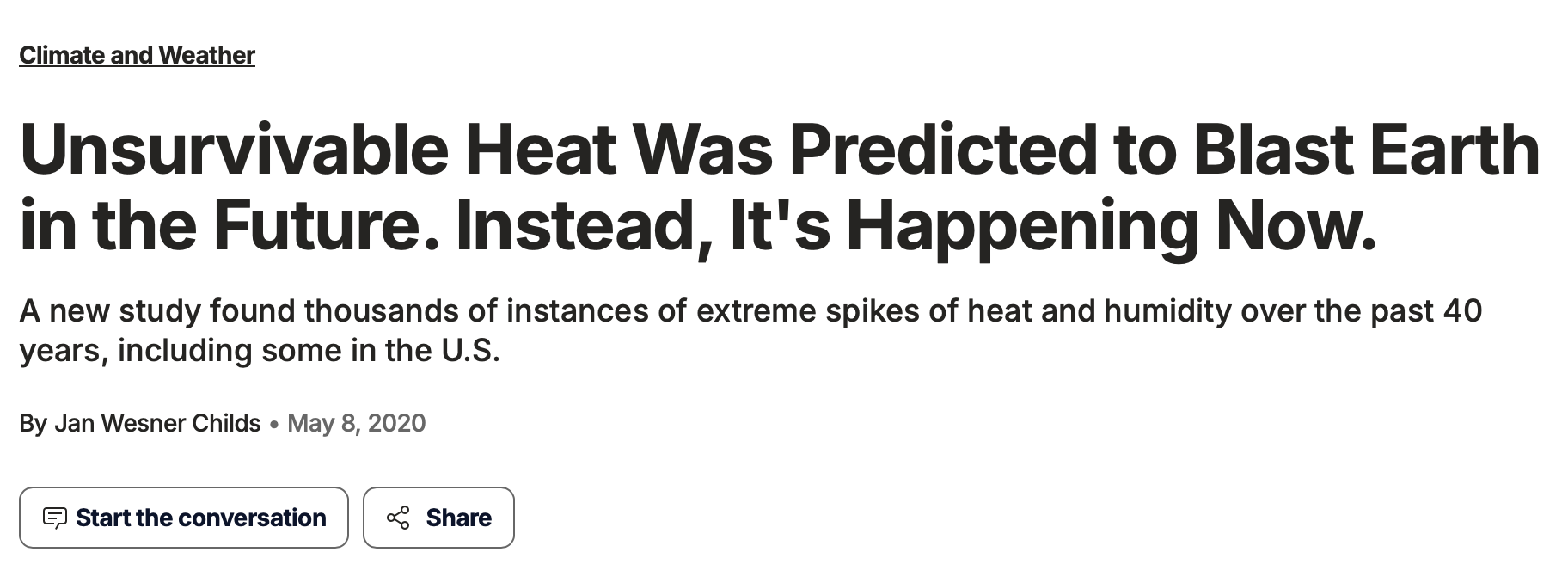
Humanity won’t die out because of catastrophic climate change, either — unless there’s a runaway greenhouse effect, though climatologists believe the probability of this is very low. But many people don’t clearly distinguish between civilizational collapse and human extinction (in fact, these have been conflated by people going back at least to the early 1900s), and hence climate change is also intimately connected to the current existential mood, according to which the probability of extinction is unprecedentedly high and almost certainly rising.
Additional factors include:
The continued risk of nuclear conflict, which appears to have risen due to the Russia-Ukraine war. Iran is also likely, I think, to pursue nuclear weapons even more vigorously given Trump’s dumb decision to start a war with them. The “hardliners” in Iran were essentially proven right by the US’s fatuous actions.
The possibility of the US-Iran and Russia-Ukraine wars expanding.
The possibility of engineered pandemics, perhaps enabled by AI. (Recall that scientists just created brand new viruses using AI.)
The possibility of mirror life, which could potentially destroy most life on the planet.
And so on.
***
A somewhat useful indicator of the current existential mood is the Bulletin of the Atomic Scientists’ Doomsday Clock, which aims to track our collective proximity to total annihilation. The clock was created in 1947, and was originally set at 7 minutes before midnight (or doom). It inched closer in 1953 — reaching 2 minutes before doom — the year after the US built the first thermonuclear weapon (far more powerful than the atomic bombs dropped on the Japanese archipelago), and then was set to a reassuring 17 minutes in 1991, after the Cold War officially ended.
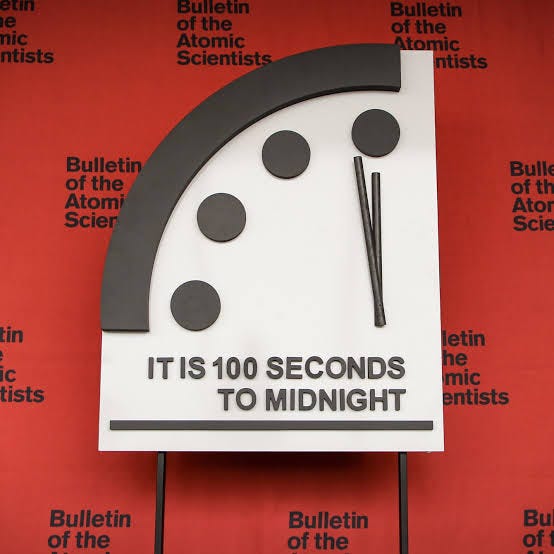
Over the past few years, it has ominously moved closer and closer to midnight:
In 2012, it moved to 5 minutes.
In 2015, it moved to 3 minutes.
In 2017, it moved to 2.5 minutes.
In 2018, it moved to 2 minutes, tying the record.
In 2020, it broke the record, being moved to 100 seconds.
In 2023, it moved to 90 seconds.
In 2025, it moved to 89 seconds, and …
In 2026, it was set at a mere 85 seconds before doom.
Why? Because of nuclear proliferation, wars, climate change, synthetic biology, Trump and fascism, and advanced AI.
To put this in perspective, prior to the 1950s, the only plausible kill mechanisms were natural: astroid and comet impacts, volcanic supereruptions, gamma ray bursts, etc. These are real dangers, but they are vanishingly improbable. An asteroid 12km wide, which is how big the asteroid that killed off the non-avian dinosaurs was, only strikes Earth once every 100 million years or so! (This is actually a higher estimate than what I’ve read elsewhere.)
Hence, if there had been a Doomsday Clock in, say, 1850, it would have been set at something like 0.5 seconds after midnight on the day of doom — i.e., roughly 24 hours before the clock ticks to the dreaded moment of annihilation. Think about how wild this is. Never before in our 300,000-year history has humanity been so at risk of global catastrophe.
Was This All a Mistake?
Again, I don’t believe that human extinction — total annihilation — is actually that probable. A full-on nuclear war, ASI takeover, engineered pandemic involving synthesized designer pathogens, and so on, very likely wouldn’t kill every last person on Earth.
But, at the same time, I do think that the probability of a major, horrific, global-scale catastrophe is higher now than ever before. In 1961, just before the Cuban missile crisis that the historian Arthur Schlesinger Jr. called arguably “the most dangerous moment in human history,” John F. Kennedy said this in an addressed to the UN General Assembly:
Today, every inhabitant of this planet must contemplate the day when this planet may no longer be habitable. Every man, woman, and child lives under a nuclear sword of Damocles, hanging by the slenderest of threads, capable of being cut at any moment by accident or miscalculation or by madness. The weapons of war must be abolished before they abolish us.
The “nuclear sword of Damocles” can be generalized to many other threats, of course — those listed above. Even if some humans survive (and they almost certainly will), we live amid unprecedented levels of global risk. Trump could literally wake up tomorrow and decide to launch a nuclear missile. Or, perhaps I’m wrong and one of the AI companies succeeds in triggering recursive self-improvement next year, resulting in an ASI that does somehow — perhaps in a way we cannot possibly imagine and hence anticipate — exterminate humanity or “merely” obliterate civilization.
All of this makes me wonder whether “civilization” has been worth it. In Goliath’s Curse, Luke Kemp — an old friend of mine — points out that many of the most horrendous events in human history have been the result not of natural catastrophes but the emergence and expansion of civilizations.
Furthermore, we once lived in (a) abundant environments, where food was relatively plentiful, everyone’s teeth were almost perfectly straight, and “diseases of civilization” like “acid reflux, acne, anxiety, asthma, certain cancers, depression, type 2 diabetes, flat feet, high blood pressure, irritable bowel syndrome, lower back pain and osteoporosis” were rare or non-existent, and (b) societies that were non-hierarchical and egalitarian. The hallmark of civilizations — which Kemp dubs “Goliath’s” — is dominance hierarchies, manifest in phenomena such as slavery, patriarchy, exploitation, etc.
Yes, infant mortality was much higher among hunter-gatherers, and they didn’t have “cool” things like TV and social media. But they also didn’t have doomscrolling, nor did they perpetually live under the nuclear/etc. sword of Damocles. The Doomsday Clock would have been set at something like 12:01 am, not 85 seconds before calamity later that day.
I know asking the question, “Was civilization worth it,” is opening a can of worms! I don’t have a settled answer, and I’m curious to know what you think. Perhaps I’ll dedicate an entire essay to it in the future. As always:
Thanks for reading and I’ll see you on the other side!
Albeit with transformed physical bodies, which you could argue is a kind of “extinction,” but this is a complicated conceptual and metaphysical issue that we don’t need to get into!
Balfour was also the brother-in-law of Henry Sidgwick, the famous utilitarian. Small world!
Wells actually addressed this in 1893 essay, “The Extinction of Man.” He writes that
it is part of the excessive egotism of the human animal that the bare idea of its extinction seems incredible to it. “A world without us!” it says, as a heady young Cephalaspis might have said it in the old Silurian sea. But since the Cephalaspis and the Coccosteus many a fine animal has increased and multiplied upon the earth, lorded it over land or sea without a rival, and passed at last into the night. Surely it is not so unreasonable to ask why man should be an exception to the rule. From the scientific standpoint at least any reason for such exception is hard to find.
In other words, there’s a certain narcissism of our species that prevents us from accepting that the universe really could exist without us. In fact, my preferred title for my book — which Routledge rejected — was The Universe Without Us: A History of the Science and Ethics of Human Extinction.
Great read! I hadn't seen the problem posed in the terms before and it reminded my of Álvaro Vieira Pinto's philosophy of technology from the 1970s, where he puts that the dominant classes can't dominate the future, so they have to dominate the ideas of the future in the present. This leads me to think about the political implications of the "mood of our times" - a lot of food for thought. Thank you!
As an 80s kid; I saw Apocalypse obsession in America ALL THE TIME. In the 80s it was widespread belief Cold war would end in Nuclear extinction. I was raised on TV; and The religious right megapastors ran informercials Sunday mornings spotlighting the imminent doom. I was taught the 4 horsemen, all this in brochures and more if u call now! Call now and learn how YOU can avoid all this by being raptured away! And my MAGA mom told me it was all true and dragged us to Orthodox church. Which is diametrically opposed to all that bullshit but Greek American Boomers swallowed all wackadoo Religious right theology.
90s - Y2K was the shadow. 9/11 supercharged extinction fears. The Great Recession brought more gloom. The Left panics over climate doom; the right cheers for a rapture. "Rapture Ready Index" websites have been predicting the world ending next week since 2002. Obama was the Antichrist. Blah blah blah.
In short, USA is just always obsessed with end of world. A very influential religious structure that swallows other Christian immigrant sects whole is always always preaching it. The secular side is terrified and exaggerating the threats. "You're actually going to have children with whats going on?" OverPopulation was an actual doomer obsession for a while; until very recently. I had visiting professors lecture and show videos about it: "zeropopulationgrowth" ZPG was an org of academics ngos and donors trying to bring contraception to 3rd world.
Color me exceptionally skeptical that AI chatbots will kill us all. Its just recycled Y2K; technological terror. Stock up on canned food, bottled water.
Great read though. I just feel younger people who didn't get fooled by 80s and 90s and 00s bullshit don't know that they WILL hear end of world panic the rest of their lives. By your 4th decade of living in America you gotta start getting skeptical. THIS time; its totally happening! No its not. America's various subgroups just love to obsess for different reasons about the Apocalypse.