

Pro-Extinctionism Isn’t Going Anywhere
A central theme of this newsletter over the past year has been the pro-extinctionist implications of the TESCREAL worldview. Many people in Silicon Valley want to create a new species of posthumans to replace us, and many see artificial superintelligence (ASI) as the key to doing this. Companies like Anthropic aren’t merely building a technology, they’re trying to realize a worldview.
However, as I note in Part 1 of my “Pro-Human Manifesto,” there are many different kinds of pro-extinctionism circulating in the Valley. The four main questions that these pro-extinctionists disagree about are:
Whether posthumans should be digital or biological. Most Valley dwellers claim that posthumanity should take the form of digital beings, a view that I call digital eschatology. However, a small minority of people, like Peter Thiel, embrace an eschatology of biological transhumanism, according to which some or all future posthumans should be biological.
Whether posthumans should be an evolutionary extension of our species or take the form of autonomous AI systems that are, as such, separate and distinct from us. In the first case, humanity (or some portion of humanity — the elites) would be transformed into posthumanity, which would then replace our species. In the second, we would essentially create a new evolutionary lineage de novo. These AIs would then supplant humanity like an invasive species let loose on an island. We can call this second option digital eugenics.
Whether posthumanity must embrace “our values” (whatever they are) or should adopt their own unique values, which may be wildly different from ours. Accelerationists like Gil Verdon (aka “Beff Jezos”) don’t seem to care one bit whether posthumanity embodies “our values.” As Daniel Faggella puts it, they want our “successors” to have values that are “alien, inhuman.” In contrast, the field of “AI safety” is founded on the idea that it matters greatly whether posthumanity is “aligned” with “our values” — hence, the value-alignment problem. If ASI isn’t value-aligned, then the future won’t contain human values, extended to the stars. The result would be an “existential catastrophe.”
Whether particular individuals alive today should have the opportunity to become one of these future (most likely digital) posthumans. Many TESCREALists — suffering from debilitating death anxiety — think it’s very important that they themselves get to join the ranks of posthumanity in a cosmic utopia someday. This is why people like Ray Kurzweil, Nick Bostrom, Eliezer Yudkowsky, and Sam Altman have arranged to have their brains cryogenically frozen or chemically preserved if they die — so they can be resurrected in posthuman form.1 Others would say that what ultimately matters is the creation of posthumanity — full stop — whether or not specific individuals survive the transition to a new posthuman era. This gets at a difference in emphasis between what theologians would call “personal eschatology” and “cosmic eschatology,” respectively.
These are the central points of disagreement among Silicon Valley pro-extinctionists, and sometimes those disagreements can be vicious (see the “narcissism of small differences”!). I’ve argued that we will witness increasingly public debates among the tech elite not about whether pro-extinctionism is bad, but about which type of pro-extinctionism is best. I think the Musk-Page debate is an example of this.
***
If you’d like some concrete examples of the different pro-extinctionist views that these disagreements yield, check out my “Pro-Human Manifesto.” Since publishing that, additional examples have popped up.
For instance, consider the following quote from Dean Ball, who was just recently hired by OpenAI “to lead a newly formed Strategic Futures team focused on shaping the company’s approach to frontier AI policy and governance.” Ball also has affiliations with the Foundation for American Innovation, the Heritage Foundation, and Yale University, and he was the Senior Policy Advisor for Artificial Intelligence and Emerging Technology for the Trump administration. In a recent interview, he says this:
Weirdly enough, if you think that this moment is — I don’t necessarily believe this — but a lot of people would say we’re living through this kind of eclipse of the human intellect, where we’re in the final days of humans being the primary actors on this planet. And that soon, machines will rise. There is this irony in that I think that whole transformation, I think humans … will actually go through a very “main-character energy” period of time, as that transformation occurs, even if it ultimately does mean that the machines ultimately become the primary actors, there’ll be this period. … In that sense, it’s a very beautiful time period to live through because in a Dionysian way, there’s a lot of ugliness and bad, but there’s a beauty in the ugliness … when a star dies, it grows super-big into the Red Giant, and it’s like that … as you watch this final flowering of humanity in the birthing of the machine intelligence, it’s like, you see this greatness in human effort. And I feel like we do see some of that going on in the world. I think we’ll see much more of it. I think it will be a heroic time period that we live through, basically, that’s what I’m saying. At least it could be — or villainous time period, but there’ll be a lot of opportunities for great people.
Put differently, we’re about to see the desperate last gasps of humanity as our digital progeny smother us to death. This is the “final flowering of humanity in the birthing of machine intelligence,” yielding a “heroic” — or “villainous” — period during which “great people” will have “a lot of opportunities.” The world as we know it will come to an end, and a new era of AI super-beings will commence. This is it, folks!
The arrogance, hubris, and tyranny of this vision is difficult to overstate. Sorry for cursing, but who the fuck are these people to decide for all of humanity when, how, and whether a Digital God arises, thus sentencing our species to extinction? I’m reminded of a quote from Sam Altman, who said in 2016: “We’re planning a way to allow wide swaths of the world to elect representatives to a new governance board. Because if I weren’t in on this I’d be, like, why do these fuckers get to decide what happens to me?”
Sounds good, right? Except that OpenAI didn’t follow through — they never allowed representatives of people around the world to participate on its governance board. Instead, they stacked the board with people like Quora CEO Adam D’Angelo, Facebook CTO and Salesforce co-CEO Bret Taylor, American attorney Nicole Seligman, and Altman himself. “Fuckers,” indeed.
***
Or, consider an OpenAI employee who goes by “roon” online (his real name appears to be Tarun Gogineni). In a recent exchange on X, someone said this:
humans are broken, rotting robots. transhumanists are correct to be disgusted with this situation.
Roon responded:
but [if] you were right[,] though, nothing human or even transhuman makes it out of the near future.
The original poster answered:
I want to survive, roon! just not as chopped unc,
where “unc” is slang for “uncle,” and is sometimes used “to imply that someone is old, getting old, or acting older than their age.” Roon then replied once more:
I think we can and will survive, just in a curtailed lightcone as enhanced pets to creatures of incomprehensible power if we let the technology evolve naturally2


But could “we” survive as “enhanced pets,” as roon claims? Depending on the nature of these “enhancements,” it probably wouldn’t be “us” who survives. Even if “we” do survive, why the hell would anyone want to be a “pet” owned and controlled by “creatures of incomprehensible power”? This utterly bleak future appears to be a good-case scenario from roon’s perspective. There really is no other word than “fuckers.”
***
It reminds me of Altman saying that the only way humans will survive the arrival of ASI is by “merging” with machines. In other words, to avoid extinction (annihilation), we will need to undergo a different form of extinction (“the merge”). The fact that Altman and his employees, like roon, are attempting to unilaterally impose this future on humanity without our consent or permission is utterly infuriating. Who do these “fuckers” think they are?!
Roon, by the way, previously declared on X that
things are accelerating. Pretty much nothing needs to change course to achieve AGI … Worrying about timelines is idle anxiety, outside your control. You should be anxious about stupid mortal things instead. Do your parents hate you? Does your wife love you?
As I wrote about this in Truthdig, he’s saying that
AGI is right around the corner and its development cannot be stopped. Once created, it will bring about the end of the world as we know it, perhaps by killing everyone on the planet. Hence, you should be thinking not so much about when exactly this might happen, but on more mundane things that are meaningful to us humans: Do we have our lives in order? Are we on good terms with our friends, family and partners?
He also once said this:

Make no mistake: these people are ideological extremists whose worldviews are intimately bound up with pro-extinctionist fantasies. They talk about “utopia,” but this utopia isn’t for us — it’s for the posthumans who replace us.
The Climate Crisis Heats Up
In 2008, when I was still a graduate student in neuroscience, The Guardian published an article about James Lovelock, originator of the Gaia hypothesis. He discusses climate change, and the article closes with this paragraph:
What would Lovelock do now, I ask, if he were me? He smiles and says: “Enjoy life while you can. Because if you’re lucky it’s going to be 20 years before it hits the fan.”
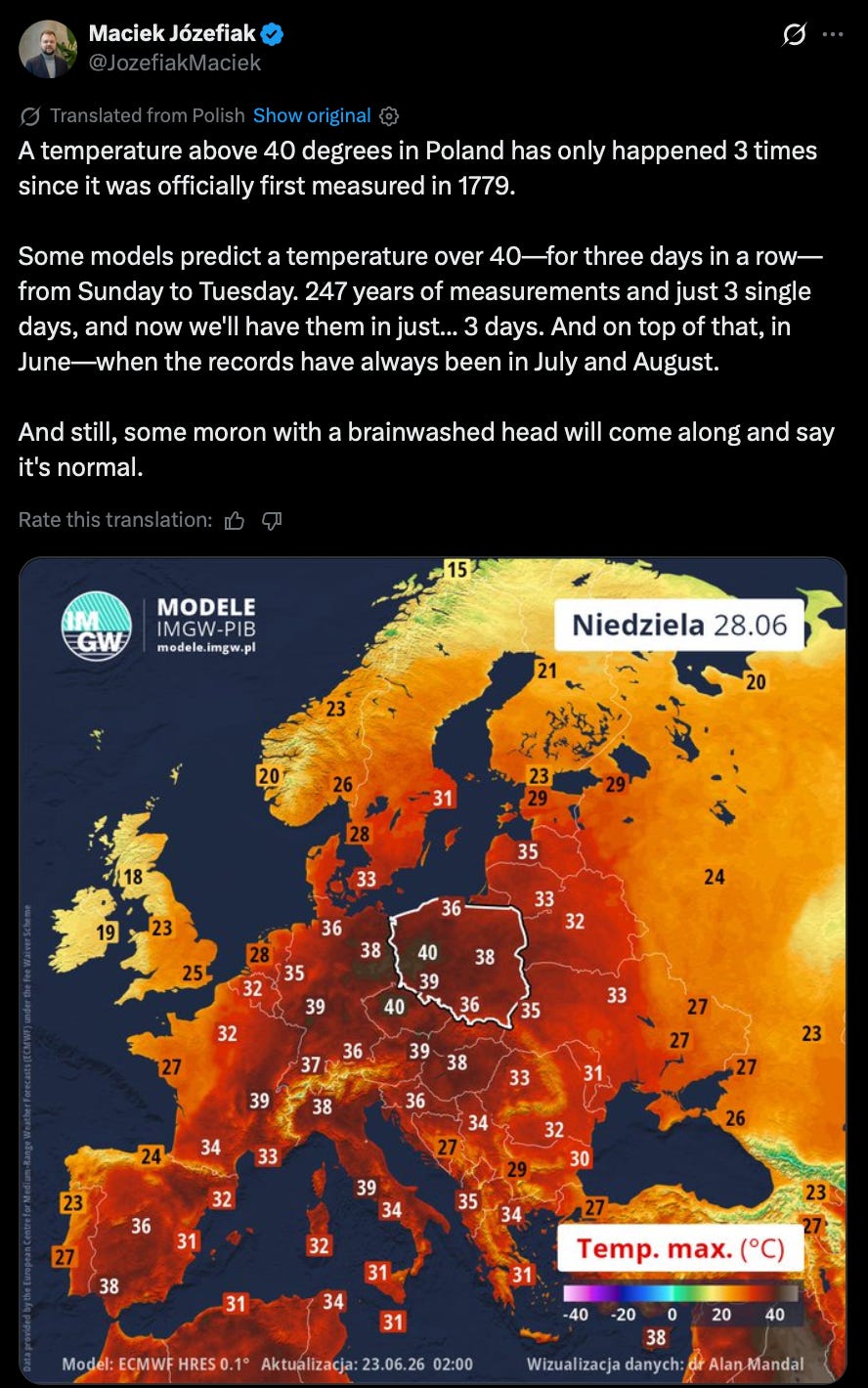
Not too bad in the prediction department! As you probably know, Europe is in the midst of a massive heatwave — the second of 2026 so far. Parts of France and Spain are melting in 111 F (44.4 C) temperatures, and records are being broken all over the place. Here are some screenshots of forecasts that I took a few days ago:
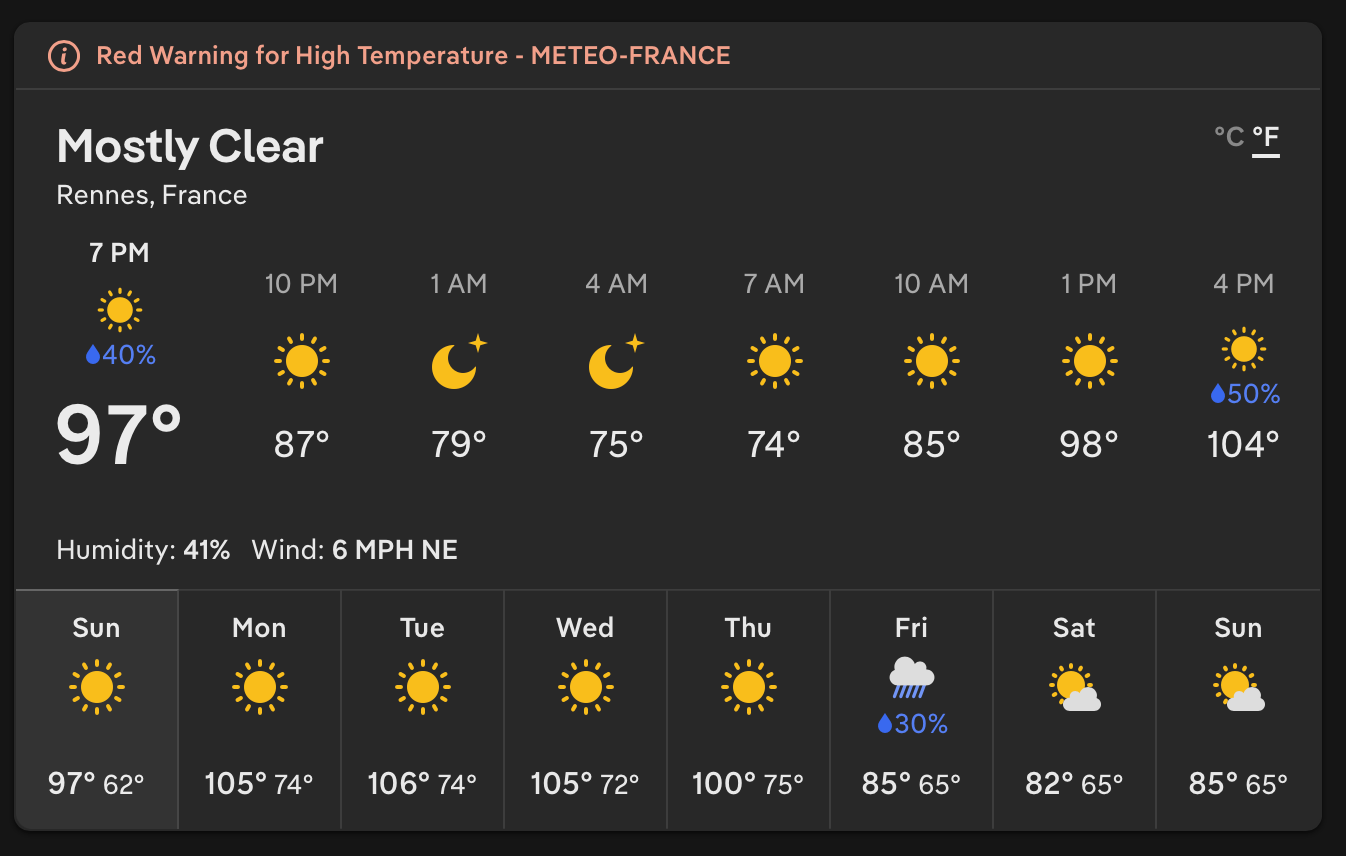
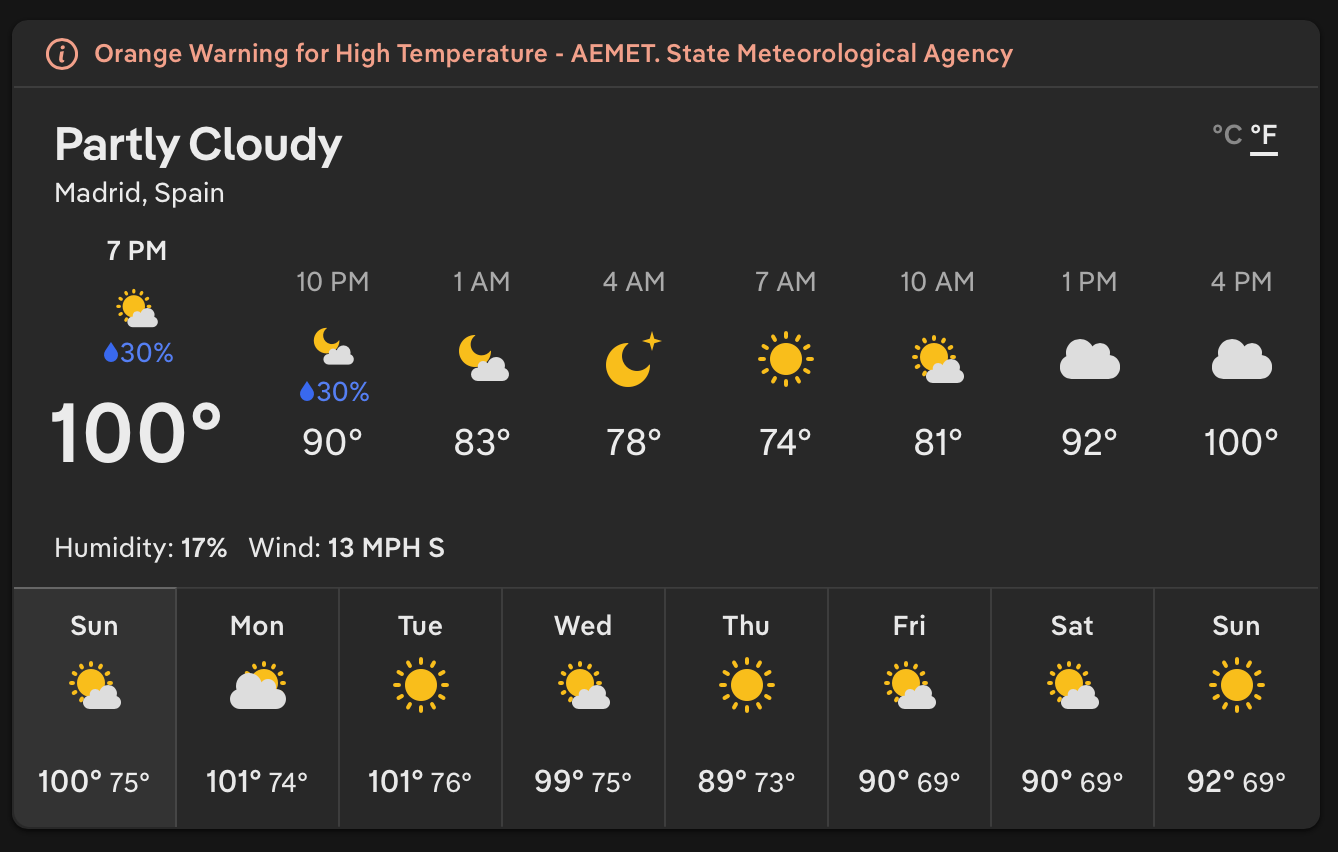
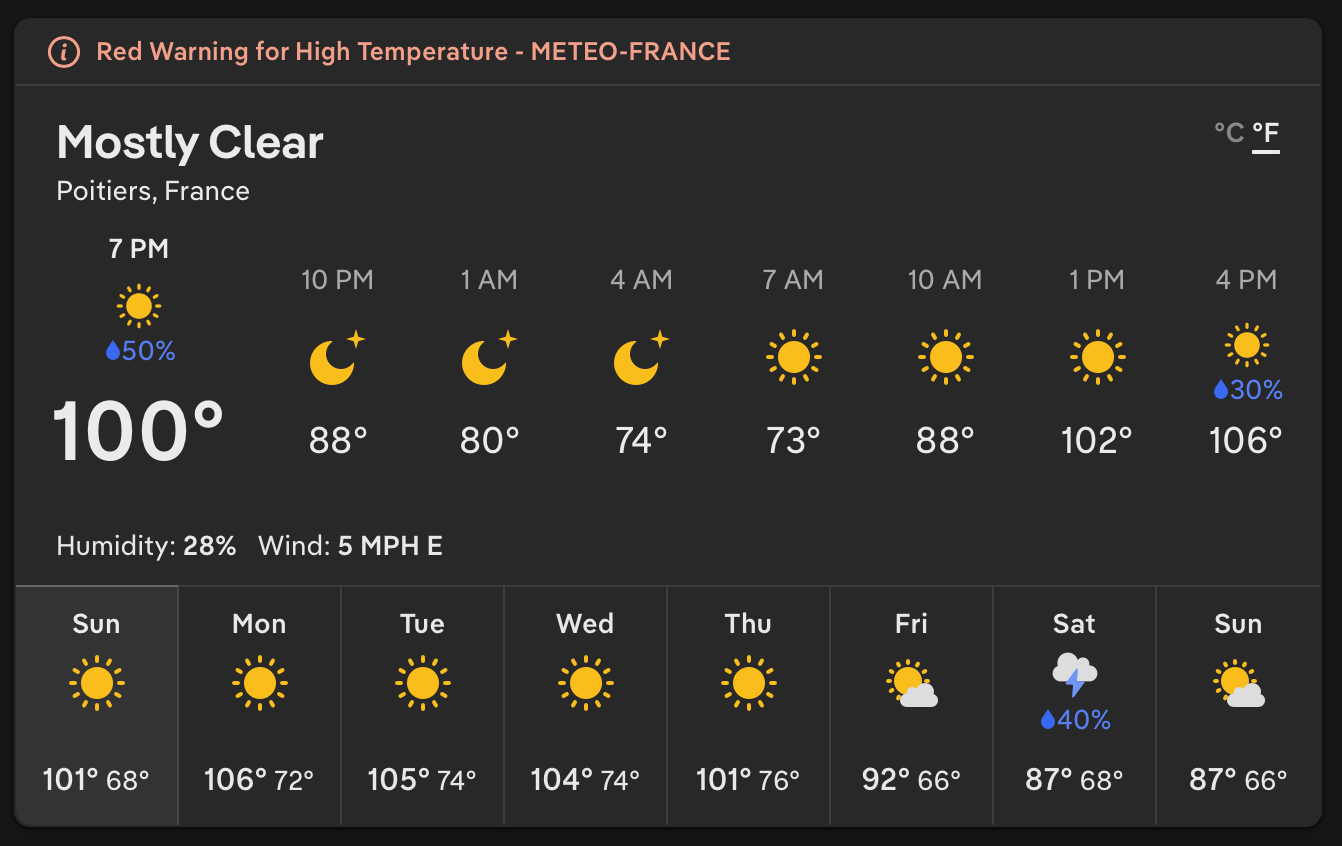
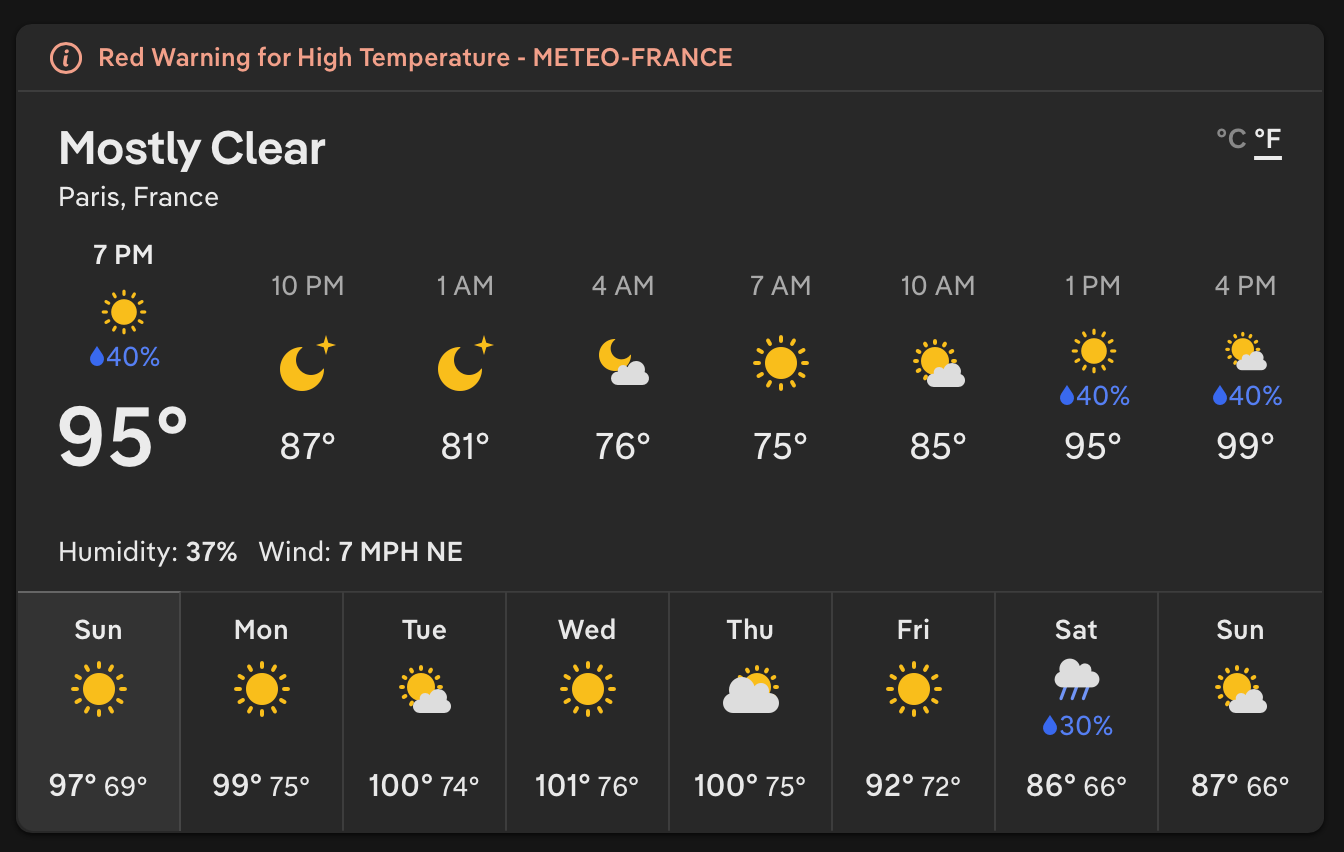
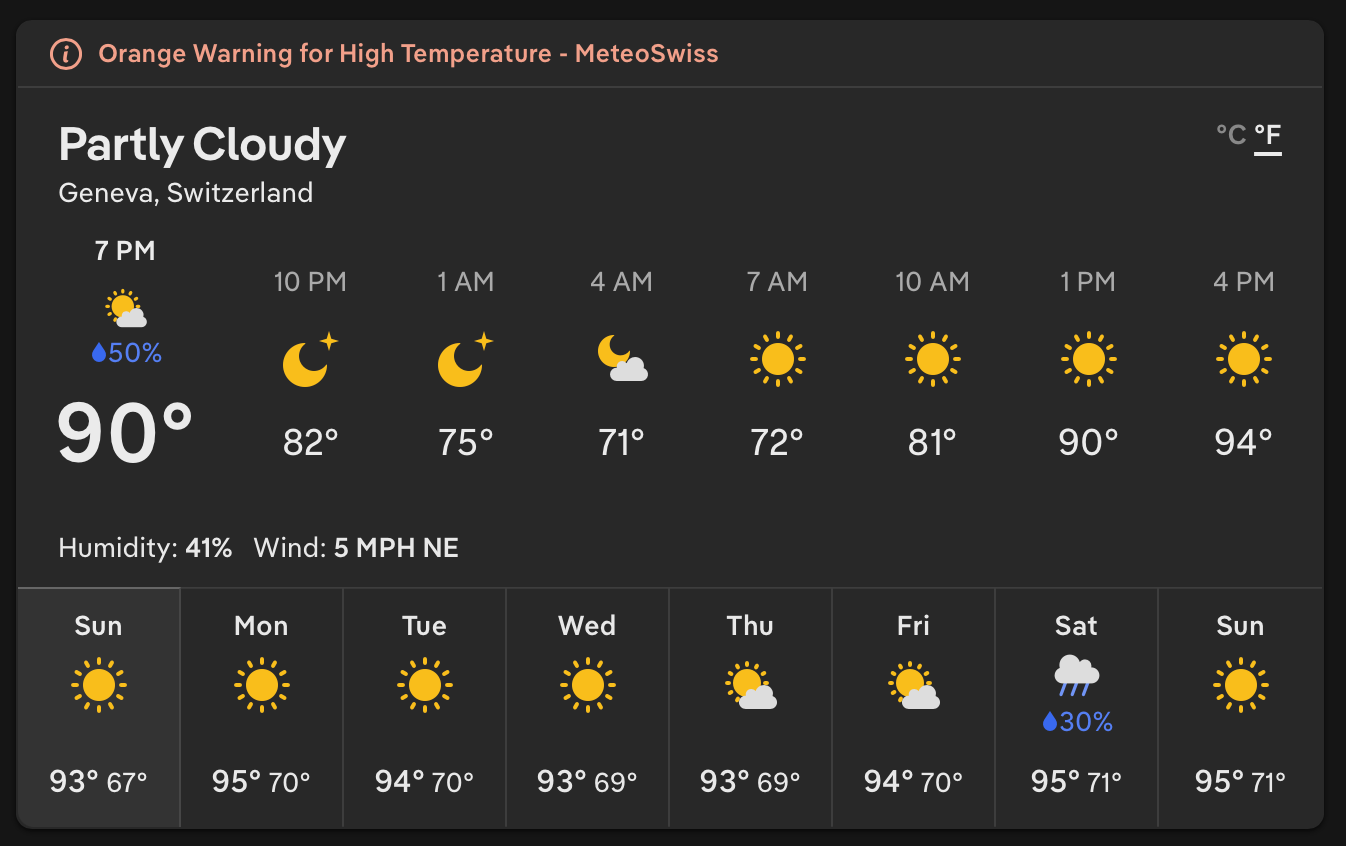
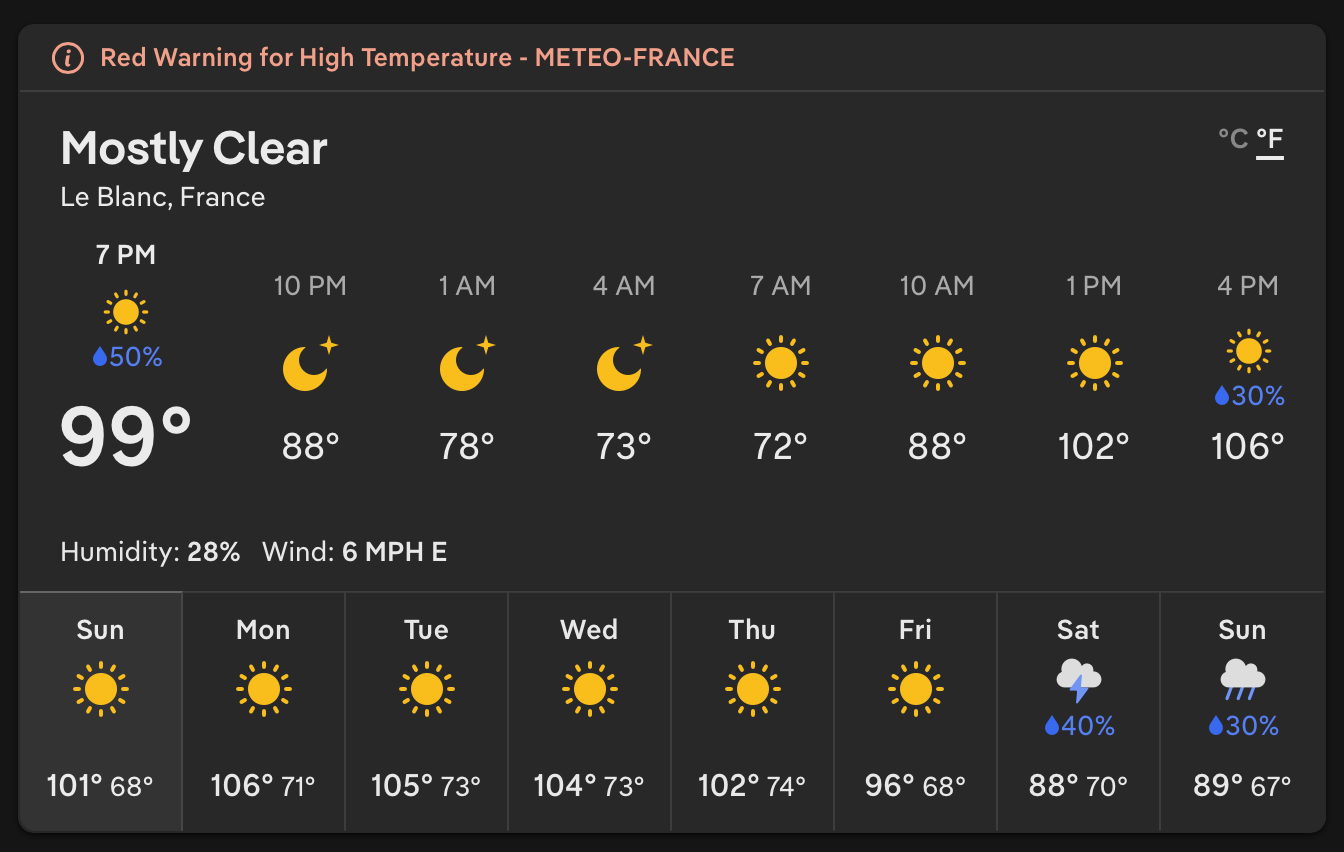
Others shared temperature forecast maps on social media showing the sizzling heat covering France, Spain, and elsewhere:




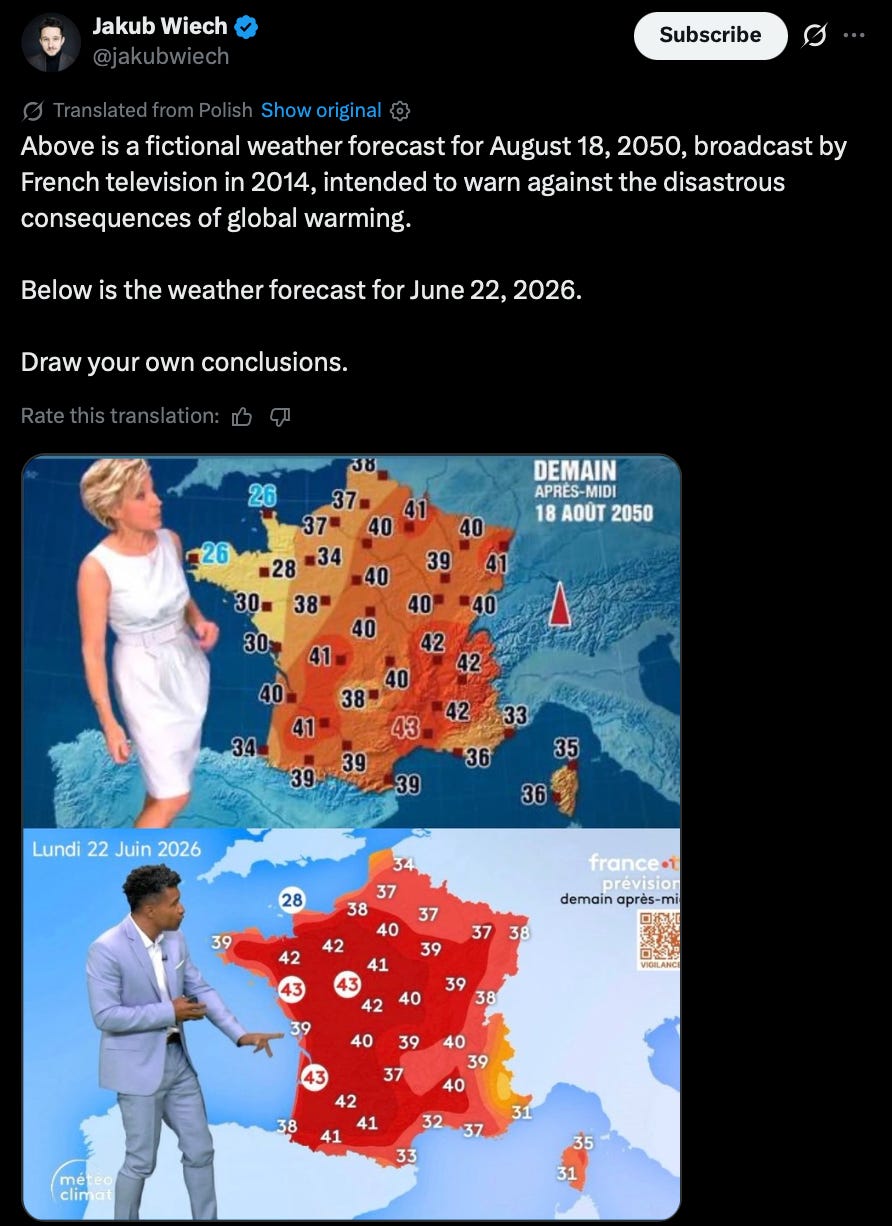
One person shared a fictional forecast from 2014 of what European temperatures will be in 2050, juxtaposed with an actual forecast for June of this year. Wild stuff!
The atmospheric heat is accompanied by an equally massive spike in marine temperatures, as this person points out:

All of this, by the way, is happening before the Super El Nińo kicks in! Next year is going to be horrific …

***
Interestingly, Europe is warming up twice as fast as the rest of the world (while “the Arctic is heating nearly four times faster than the global average rate and twice as fast as previously expected”). But if the AMOC and Gulf Stream collapse — which appears increasingly likely — Europe will fall into a “little ice age,” whereby temperatures will plummet to roughly the same levels as in Canada. (Note that Paris is slightly south of Winnipeg, Canada, while London is slightly north of Calgary.)
This will devastate European agriculture, with effects potentially greater than those inflicted by the sort of heatwaves it’s now experiencing.
It’s hard to overstate how infuriating this predicament is. I agree with scholars who argue that fossil fuel CEOs and political figures like Trump should be tried for crimes against humanity. If indeed 2 to 4 billion people die prematurely in the next few decades due to climate change, is there any punishment that could possibly fit the crime?
***
Incidentally — to tie things back to the first half of the article — I had a conversation with a TESCREAL colleague back in 2017 that went like this:
Climate change won’t pose an “existential risk” (an event that threatens the creation of cosmic utopia), he said, until later this century. But we will likely build ASI in the next decade or so. If the ASI is misaligned, it will kill everyone on Earth and annihilate the biosphere, thus rendering climate change irrelevant. However, if it’s aligned, it will use its god-like powers of mentation to devise a way of reversing the climate crisis, thus rendering climate change irrelevant. Hence, we shouldn’t worry about climate change, but instead focus on building an aligned ASI.
Many people in Silicon Valley seem to accept this view. Others appear to think that climate change is irrelevant because we’ll all be digital mind-clones living in virtual reality worlds soon, so solving climate change at any point doesn’t really matter (because, you know, who gives a damn about other species?).
Former Google CEO Eric Schmidt channeled the view of my old TESCREAL colleague when he said in 2024: “My own opinion is that we’re not going to hit the climate goals anyway because we are not organized to do it and yes the needs in this area [AI] will be a problem. But I’d rather bet on AI solving the problem than constraining it.”
A similar sentiment was recently satirized by an Instagram account named “bpd.news,” which made up this quote from Jeff Bezos:
“We have to look at the macro-picture of our planet’s future,” Bezos reportedly stated during a recent tech symposium. “Biological limits are real, but digital potential is infinite. If we starve our data infrastructure of cooling resources just to sustain baseline human comfort, we are actively delaying the birth of a super-intelligence that could solve all of our resource problems in the first place. Sometimes you have to prioritize the intelligence that will save us over the biology that slows us down.”
Although Bezos never said that, it’s a pretty accurate description of what the tech elites actually believe! I think that’s what the satirists were going for.
That’s it for today. I hope everyone is well. As always:
Thanks for reading and I’ll see you on the other side!
Fun fact of the day: Imagine a rope wrapped around the equator of Earth, which is roughly 40,000 kilometers in circumference. Now imagine lifting this rope off Earth’s surface at every point by exactly 1 meter. How much longer would the rope need to be for this to work? (Give it some thought!)
Now imagine a rope wrapped around a basketball. You do the same as above, lifting the rope exactly 1 meter above the surface of the ball. How much longer would the rope need to be — and how does this compare to the case of Earth?
You might think the rope would need to be at least several kilometers longer to lift it 1 meter above the earth. But the astounding fact is that it would only need to be 6.3 meters longer. That’s it!
Even more astounding is that the same answer applies to the second question: lifting the rope 1 meter above a basketball would require 6.3 extra meters of rope. In fact, this doesn’t change no matter how small or large the round object is: extending the rope 1 meter above an atom — or the UY Scuti hypergiant star — would require an additional 6.3 meters. You can check the math here. Now you know!
And it’s why people like Larry Page, Bryan Johnson, and Larry Ellison have invested so much in longevity research.
Btw, using my classificatory distinctions above — the four axes of disagreement — can you identify which type of pro-extinctionism Tomás accepts? He clearly thinks it’s very important that he himself gets to become posthuman. That implies that he also thinks at least some future posthumans should be evolutionary extensions of humanity. Furthermore, I’d guess that he accepts a digital eschatology according to which these posthumans, which we will become, should be digital in nature. This is because many transhumanists reason that humans are “broken” and “rotting” because of our biology, and hence the ultimate way of overcoming this problem is to completely replace our biological substrate with artificial hardware. As for the final question about values, Tomás doesn’t address this in his exchange with roon, so I don’t know what his views are. However, many people who want posthumanity to be an extension of us tend to hold that posthumans should also embody at least some of “our values.”
The more I learn of these movements and their worldview, the more I’m reminded of the Heavens Gate cult, with many little Marshall Applewhites urging on the great recycling. I wonder if any have the self awareness that they are in a quasi-religious cult?
Reading this and other pieces about some folks' giddy exuberance at the prospect of ceding the earth to the master ASI race reminds me of the madman, Renfield, in Dracula. How, crouched in his cell eating flies and spiders for life force he was ecstatic with the idea of being in psychic communion with his dark lord, who would soon arrive. If I remember correctly, I think you had asked in comments to a previous post what a more colloquial version of TESCREAL, which i like, might be. Perhaps an allusion to Renfield is appropriate? Something along the lines of Renfielders maybe?
Anyway, thank you for what you do, Emile! Your work is important.