

Everyone Is Cheating All the Time
Since the early 2000s, a major life goal of mine had been to land a professorship in philosophy. Academia has always been the community in which I felt most at home. However, after leaving a postdoctoral position last December, I struggle to imagine myself returning. There are many reasons for this, one of which is that AI is destroying the university system in realtime. As a college senior at Stanford, Theo Baker, writes in the New York Times:
Cheating has become omnipresent. I don’t know a single person who hasn’t used A.I. to get through some assignment in college, yet the school was at first slow to realize how widespread this would become. …
About halfway through freshman year, some coding classes started requiring students to sign a declaration — “I did not utilize ChatGPT” — to submit each assignment. During the first term these attestations began to appear, I watched a freshman I knew sign the declaration that he’d done his homework without A.I. as ChatGPT was still open in the next window — while on the deck of a yacht party financed by venture capitalists.
Although students are using AI to cheat their way through the university system, most seem to simultaneously hate AI because of its predicted impact on the job market. Just the other day, Microsoft AI CEO Mustafa Suleyman, who previously cofounded DeepMind, claimed that AI will automate “all white-collar work” within just 18 months.


Given such prognostications, there’s a certain logic to students choosing to cheat: if AI will leave them jobless, then why not? What’s the point of actually learning if the knowledge one acquires is worthless post-graduation? One could, of course, argue that knowledge is valuable in itself, independent of its usefulness. But we live in a capitalist system with few social safety nets (at least in the US), so an instrumentalist approach to education makes sense within this system. (Hence, the entire system needs to be reformed!) I thus sympathize with students who cheat, even though I don’t approve. In fact, surveys show that 60% of teachers are now using AI to grade papers, meaning that there’s no human in the loop at all. Students aren’t doing anything different from the people who teach them.


Students Boo AI
The disdain that many young people feel about AI being shoved down their throats was on full display during several recent graduation speeches. At the University of Arizona, the billionaire and former Google CEO, Eric Schmidt, told a large audience of students that AI “will touch every profession, every classroom, every hospital, every laboratory, every person and every relationship you have.” Amid jeers and boos, he added: “I know what many of you are feeling about that. I can hear you. There is a fear,” though he offered no optimistic message about how to alleviate the fear. Watch the deplorable clip here:
(Schmitt, by the way, is the guy who said that since we aren’t going to reach our climate goals anyway, we should plow ahead with AI in hopes of building a superintelligence that will magically solve the climate crisis. As Mashable put it, he “argued that current climate goals should be abandoned in favor of a no-bars-held approach to AI investment.”)
Over at Middle Tennessee State University, the CEO of Big Machine Records, Scott Borchetta, brought up AI and was heckled. In response, the asshole replied: “Deal with it. … You can hear me now, or you can pay me later,” with a smirk on his face.
Meanwhile, another university “used AI to announce graduates’ names and missed hundreds of names.” Jeers and boos are, once again, loudly heard in the background. Whoops.
AI Slop Is Polluting the Academic Literature
As noted earlier, it’s not just students who are using AI. A team of researchers recently combed over papers and preprints on websites like Social Science Research Network (SSRN), arXiv, bioRxiv, and PubMed Central. They found a whopping 146,932 fake citations, the result of AI hallucinations. This is appalling: academics are relying on AI to assemble their bibliographies, and even help research and write their papers.


To combat the tsunami of AI slop now polluting the academic literature, arXiv recently announced that “if a submission contained incontrovertible evidence that the authors did not check the results of LLM generation, this means we can’t trust anything in the paper.” Consequently, the paper will be removed and the authors banned for an entire year. All subsequent submissions will need to “be accepted at a reputable peer-reviewed venue” before being uploaded to arXiv. Examples of such evidence, the announcement adds, are hallucinated references and “meta-comments from the LLM (‘here is a 200 word summary; would you like me to make any changes?’; ‘the data in this table is illustrative, fill it in with the real numbers from your experiments’).”
Some academics apparently aren’t happy about this, which is astonishing:

I’ve said ad nauseam that AI is reliably unreliable. Do not ever trust it for anything factual; for anything that requires accuracy. AI lies with the same ease of sociopaths like Sam Altman (lol). In fact, a recent audit of doctors in Ontario, Canada,
found that AI agents tasked with turning doctor/patient conversations into structured notes routinely hallucinated false treatments, replaced drug names with entirely different drugs, and missed crucial information.
Imagine getting a prescription from your doctor for Adderall, but AI misinterprets it as Inderal, a beta-blocker that treats hypertension, tumors, and angina — or vice versa. The rapid integration of AI into the infrastructure of our society and lives is extremely worrisome given its inability to spit out accurate information in a reliable way. The further along this integration process goes, the more difficult it will be to reverse course. There might be a point in the near future (or recent past) at which it’s too late.
The AI Companies are Spying on You
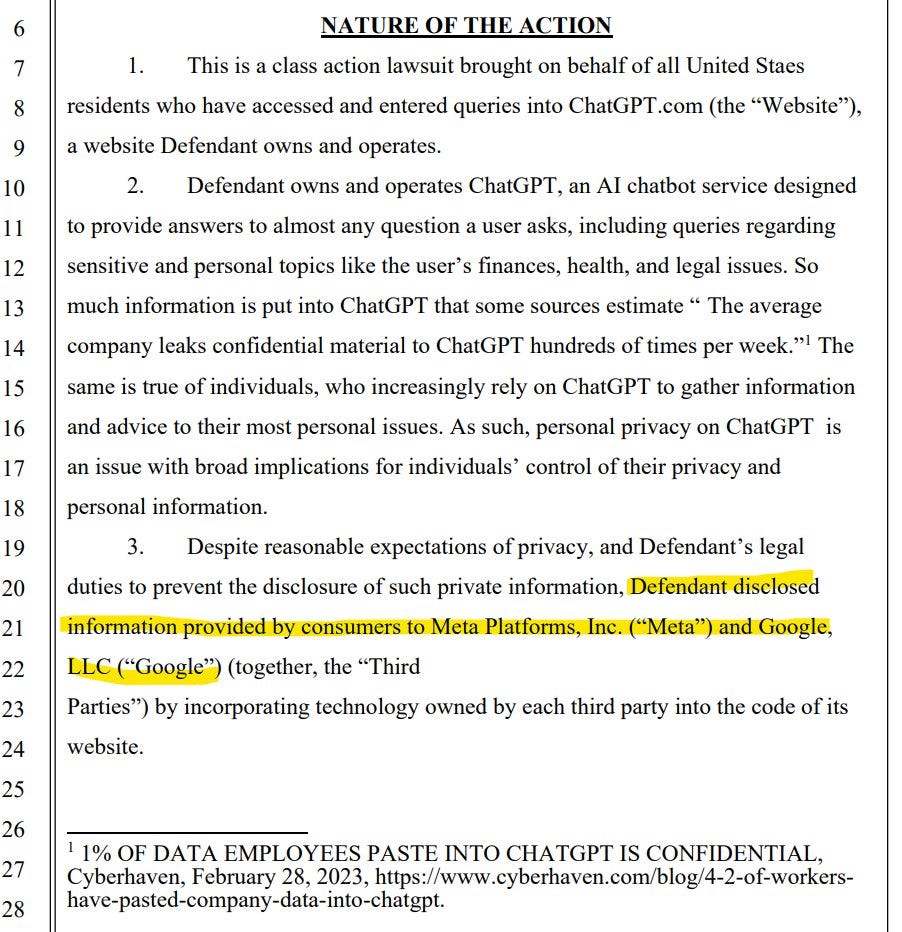
Yet another privacy concern relating to AI has been raised recently by a class action lawsuit brought against OpenAI. The court filing states that ChatGPT shares user IDs, email addresses, and even the topics of your conversations with Meta and Google. You might think your interactions with ChatGPT are private, but this is apparently not the case.
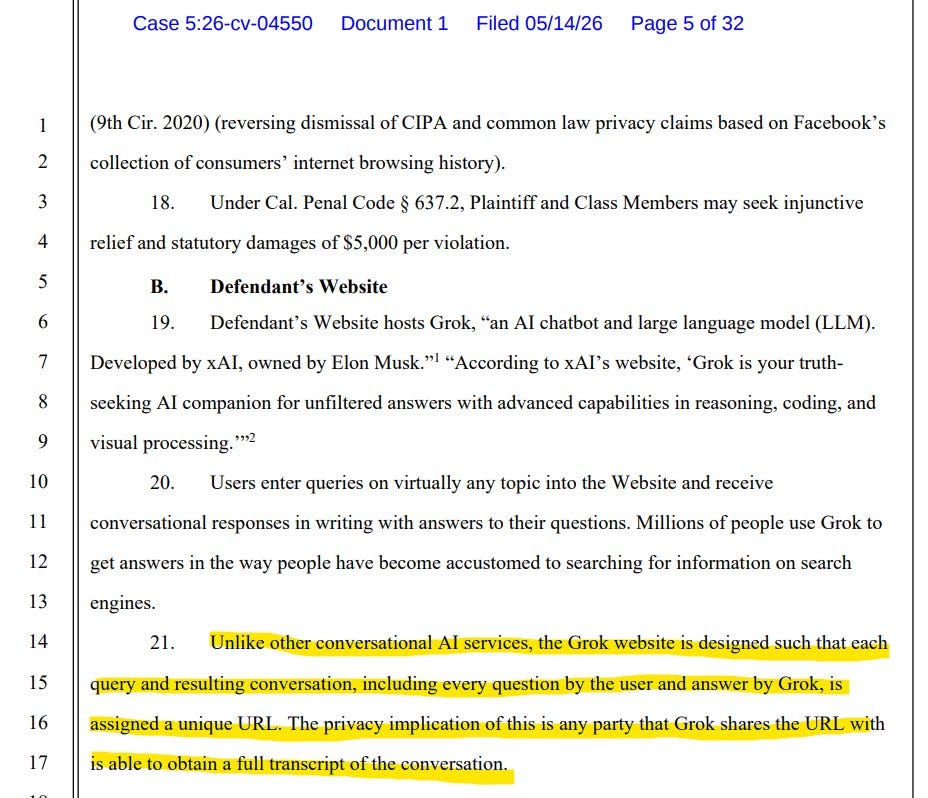
Grok “also shares your chat information, but even more so than other AI tools,” according to yet another class action lawsuit:
This increasingly looks quite dystopian, and as mentioned above we may be near, or have already crossed, a Rubicon beyond which it will become almost impossible to dislodge AI from the infrastructure of society. Fortunately, there appears to be a growing backlash against AI, though I’ll save that for another post.
Sundry News You Might Have Missed
Did you hear that we’re likely to experience a Super El Niño later this year? El Niño occurs when Pacific Ocean temperatures along the equator exceed 0.5 degrees C above historical averages. A Super El Niño happens when temperatures jump to 2 C of warming or more. The consequences for global weather patterns can be quite severe, and historically the year after a Super El Niño event has been hotter than the year in which it occurs. That’s led many scientists to think that 2027 could easily become the hottest on record. Buckle up, friends! As CNN writes:
The coming “Super” El Niño is poised to affect the lives of hundreds of millions of people worldwide as it strengthens through the year into the winter season. It may also alter ecosystems for decades to come, judging from the repercussions of past intense El Niños.
Musk lost his lawsuit against OpenAI. Several people have asked me what I thought about this. First, it’s clear that Musk had a point: OpenAI started off as a non-profit, took a bunch of money, then became a for-profit. Consequently, Musk basically funded a startup, not a non-profit. At least that’s my understanding of the situation. The problem is that Musk filed the lawsuit too late — past the statute of limitations. (There were questions about how exactly this statute should apply, which is why it was allowed to proceed in the first place; see below.)
 Max Zeff@ZeffMaxI'm seeing lots of confusion about why the statute of limitations issue came to a trial at all. Musk and OpenAI disagreed about when Musk could have reasonably become convinced that OpenAI was "stealing a charity," as he alleges. Because this case was filed in 2024, Musk had to
 Max Zeff @ZeffMaxJury unanimously rules that Musk's claims are dismissed on the timeliness issue... He filed his lawsuit too late. Court affirms it will uphold the jury's decision. It's over. Musk loses his lawsuit against OpenAI8:44 PM · May 18, 2026 · 199K Views35 Replies · 72 Reposts · 779 Likes
Second, my feelings about this outcome are virtually identical to what I’d feel if OpenAI had lost: a complex mix of frustration and schadenfreude. I like the thought of Musk — one of the worst people on Earth — being really pissed off that he lost, but it’s a real shame that OpenAI got away with basically stealing a bunch of money. On the other hand, if Musk had won, I’d find the thought of his joyful glee upsetting, but I’d have reveled in Altman and Brockman having to step down. A personal benefit of the ruling is that I won’t have to make major updates to my forthcoming book!
You might not be aware of the extent to which AI-controlled drones are being used in the Russia-Ukraine war. I’ve watched a few videos of drone strikes, and I have to say that they are absolutely f*cking terrifying. Truly the stuff of nightmares. Here’s an example, but please be aware that this video is extremely disturbing — on a purely human level, I can’t imagine the fear these soldiers experience knowing that there’s literally no escaping the drone once it finds you, and a terrible death is imminent.
This is a ghoulish glimpse of the future of war — and perhaps acts of terrorism, assassinations, etc. Is it only a matter of time before criminals use this technology to murder people? Can you imagine finding a drone circling your house, waiting for you to crack open a window so it can fly in and explode? What happens when these drones are fully autonomous, controlled entirely by AI? As the BBC writes:
Ukrainian troops already use AI-based software so that drones lock on a target and then fly autonomously for the last few hundred metres until the mission is over. …
Ultimately these systems are expected to evolve into fully autonomous weapons that can find and destroy targets on their own.
My god. I don’t envy young people.


On that cheery note! …
Thanks for reading and I’ll see you on the other side!
It becomes more and more clear that algorithmized work, learning, surveillance, consumption, and warfare are a dead end on many levels. Deep meaning spontaneously emerges when we allow ourselves to look into the eyes and feel the pain and agony of our fellow human beings, be they a terrified young soldier about to lose his life in a war (on whatever "side" he may be on), a worker about to lose their job, or a fresh graduate worried and distraught about their future. Compassion and kindness always and reliably lead the way.
At Monash University in Melbourne Australia, students and academics are being told we must use AI. Its not a choice and we’re cannot debate it. Its a fait accompli. The lunacy is real, and its already taken over.