

Given enormous interest in the topic of human extinction right now, driven largely by anxieties of an AGI apocalypse, I thought it might be worth sharing pieces of a theoretical framework that I’ve developed over the past few years. This framework aims to offer conceptual clarity on the ethical aspects of our extinction, and is based on several academic papers of mine published over the past year ( here, here, and here), which themselves extend and elaborate ideas first presented in my 2024 book Human Extinction: A History of the Science and Ethics of Annihilation.
(Note that a free copy of my book is available on LibGen. I wouldn’t normally advertise this, but Routledge sold my book to Microsoft to train AI systems without my consent and without any compensation, so I feel no sense of loyalty to them.)
Right off the bat, we should notice that there are two distinct debates about human extinction happening in parallel. The first concerns largely empirical questions about the possibility, probability, etiology, and timing of our extinction. Could AGI kill us all? What about a nuclear war, or mirror bacteria? How probable are such things? Are we in grave danger right now, or will the threat peak in several decades? Is our extinction inevitable in the long run? And so on.
The second concerns the ethical and evaluative implications of our extinction: Why exactly would no longer existing be tragic? Would extinction be morally wrong to bring about if everyone voluntarily chose not to have children? Do we have an obligation to ensure that there are future generations? Do we have obligations to past people to keep the human project going? Would our extinction render all the great achievements in science, the arts, and the domain of morality meaningless? Or might our extinction be desirable, as it would mean an end to human suffering, factory farming, and anthropogenic climate change? If so, how should we bring about this outcome?
We will focus entirely on the second issue, though it’s important to note that such ethical questions are partly motivated by the first: if human extinction really could happen in the near future, then surely it behooves us to take a closer look at why exactly this would be bad and wrong to bring about — or good and right.
Such questions might seem to have obvious answers at first. But the ethics of human extinction, as I’ve discovered over the past few years, is a deceptively complex topic, and after reflecting on the points made below you might actually find your opinion shifting. At the very least, this theoretical framework will — I hope! — enable you to get a much crisper understanding of what your own view actually is, as well as to properly interpret the views of others in the ongoing discussion.
Without further ado …
Going Extinct Versus Being Extinct
The most basic distinction that we need to make is between:
Going Extinct: The process or event of dying out, and
Being Extinct: The resulting state of no longer existing.
Pulling these apart is absolutely crucial for making sense of the various positions that people hold with respect to our extinction. My 2024 book Human Extinction was the first to explicitly articulate this distinction, which is mostly due, I think, to the fact that human extinction ethics has been largely neglected by philosophers until just the past few years!
Consider a real conversation I had with a guy back in 2019. I’ll call him “John.” We met in a North Carolinian bar while ordering drinks, and got to talking. John asked me what I do for work, and I explained that I study global catastrophic risks and human extinction. That’s either a conversation starter — “Wow! Are we all gonna die soon?” — or an abrupt conversation ender — “Oh dear, look at the time! Buh-bye!” For John, it was the former.
Ten minutes in, I asked him whether he thought human extinction would be good or bad. He replied without hesitation: “It would be very good! Just look at how we’ve destroyed nature. Think of climate change, factory farming, and all the people suffering right now. If humanity were to kick the bucket, all of these bad things would disappear.”
I then pointed out that by far the most likely way we’d die out would be through a global catastrophe that involuntarily catapults us into the eternal grave. This could be the result of natural phenomena, such as an asteroid impact, or of human action — a madman starting a nuclear war, or a lone wolf with access to synthetic biology. Either way, dying out would inflict unfathomable amounts of harm on everyone living at the time.
“There are scenarios,” I added, “in which we die out voluntarily and without billions of people dying prematurely. People might choose not to have children, causing the human population to dwindle over time. But how likely are such ‘peaceful and voluntary’ scenarios? Extremely unlikely — if we die out, it will be a catastrophe unlike anything experienced in all of human history!”
John reflected on all the people who would perish — sons, daughters, parents, friends, etc. — and said: “You’re right. Dying out would be horrific. I definitely don’t want that to happen!”
What’s going on here? Did John hold an incoherent view? Was he contradicting himself? Did his view actually change?
The key to making sense of this is the distinction between Going Extinct and Being Extinct. Sometimes, when people talk about human extinction, they’re actually talking about Being Extinct. Other times, they use “human extinction” as shorthand for Going Extinct. John initially answered my question by focusing specifically on Being Extinct. I then directed his attention to Going Extinct, which resulted in him agreeing that our extinction — specifically this aspect of it — would be very bad.
But there’s nothing incoherent about claiming that Being Extinct might be good and that Going Extinct would probably be horrendous, and hence that we ought to avoid Going Extinct if it were to cause great amounts of suffering and harm. I don’t think John held an incoherent view, and if I had been as knowledgeable then as I am now about the topic, I would have pointed this out to him.
Traditional Pro-Extinctionism
In fact, many traditional pro-extinctionists have championed precisely this position. Consider the South African philosopher David Benatar. He thinks that Being Extinct would be better than Being Extant (i.e., continuing to exist — my attempt at clever terminology). But he also says that most ways of Going Extinct would be very bad or wrong to bring about. Omnicide, or “the murder of everyone,” would be profoundly wrong for all the reasons that murdering someone is wrong. Benatar strongly opposes omnicide, like most other pro-extinctionists.1
On Benatar’s view, the only acceptable path from Being Extant (existing) to Being Extinct is voluntary antinatalism: people refusing to engage in what he condescendingly calls “baby-making.” Otherwise, our extinction would be undesirable, even if the outcome were better. I think John is best classified as a pro-extinctionist of this sort.
In addition to Benatar, examples of pro-extinctionists include Eduard von Hartmann, Philip Mainländer, Peter Wessel Zapffe, and contemporary groups like Efilists, the Gaia Liberation Front, and the Voluntary Human Extinction Movement. Somewhat curiously, most philosophers who discussed human extinction prior to the 21st century were either traditional pro-extinctionists or most sympathetic with pro-extinctionism. See Part II of my 2024 book for details!
Equivalence Views
Another group of philosophers disagree with this assessment. I call them “equivalence theorists” and the position they accept “equivalence views.” These equivalence theorists claim that Being Extinct wouldn’t be better or good, but that it’s neither good nor bad, better nor worse. Why? One argument is that if there’s no one around to bemoan the nonexistence of humanity — and there wouldn’t be — then who exactly would be harmed? If no one is harmed by Being Extinct, then how can Being Extinct constitute a source of moral badness or wrongness?
Equivalence theorists thus argue that the badness or wrongness of our extinction comes down entirely to the details of Going Extinct. If there’s something bad or wrong about Going Extinct, then there’s something bad or wrong about our extinction. If there’s nothing bad or wrong about Going Extinct, then there’s nothing bad or wrong about our extinction.
On this view, human extinction doesn’t pose any unique moral problems. Everything you might say about our extinction can be said without reference to extinction itself. If a catastrophe wipes out humanity, then our extinction would be bad because catastrophes are bad, full stop. All the term “an extinction-causing catastrophe” conveys is that it results in the maximum number of casualties. That’s it. An extinction-causing catastrophe may be the worst type of catastrophe, but not because it results in our extinction.
Equivalence views thus see Being Extinct as morally irrelevant, which is precisely why our extinction poses no unique moral conundrums. This is why I call this the “equivalence view”: the badness or wrongness of human extinction is equivalent to the badness or wrongness of Going Extinct.
An implication is that equivalence theorists would see nothing bad or wrong about our extinction if it were, e.g., voluntary. If everyone around the world decides to stop having children, resulting in our collective disappearance, this would be perfectly fine. Again: all that matters are the details of Going Extinct.
Examples of equivalence views include Scanlonian contractualism, as defended by Elizabeth Finneron-Burns, as well as person-affecting utilitarianism of the sort proposed by Jan Narveson. In general, person-affecting ethical theories will entail the equivalence view. See my 2024 book for a detailed look at a wide range of ethical theories that all converge upon this position.
Further-Loss Views
This contrasts with a third position that one could hold, which I call “further-loss views.” Advocates of these views claim that assessing our extinction is a two-step process: first, one examines the details of Going Extinct. If there are aspects of Going Extinct that are bad or wrong, then this contributes to the overall badness/wrongness of our extinction. The second step is to examine the various “further losses” or “opportunity costs” associated with Being Extinct. This might include all the future generations that Being Extinct would prevent from existing, and all the happiness and pleasure they might have experienced. It could include things like future scientific breakthroughs, works of art, and advancements in moral progress toward a fully just society.
Since the future could be very big and last a long time (our descendants could theoretically exist for another 10^100 years, when the heat death will occur), many further-loss theorists would say that Being Extinct is by far the greatest source of extinction’s badness. Even if Going Extinct were to inflict truly horrendous suffering on those living at the time, the opportunity costs of no longer being would be far greater in moral importance.
Hence, Nick Beckstead, Matthew Wage, and Peter Singer write this:
One very bad thing about human extinction would be that billions of people would likely die painful deaths. But in our view, this is, by far, not the worst thing about human extinction. The worst thing about human extinction is that there would be no future generations.
The further-loss position implies that human extinction does pose a unique moral problem, precisely because Being Extinct would irreversibly foreclose the realization of all future value or goods. Further-loss views also imply that our extinction would still constitute an enormous tragedy even if it were the result of everyone voluntarily choosing not to have children. Whether Going Extinct happens because people go childless or because of a nuclear war, the outcome is the same: we forgo all the great things that lie in our future, with subsequent generations never getting to exist.
Examples of further-loss views include totalist utilitarianism, longtermism, and transhumanism, as well as Hans Jonas’ theory according to which the loss of humanity (or posthumanity) would be catastrophically bad because it would mean the loss of the “moral universe.” Mary Shelley also seems to have endorsed a further-loss view, as discussed later on. Once again, see my 2024 book for details.
Some Thought Experiments!
A couple of thought experiments can help clarify the differences between these three positions. The first is what I call the “two-worlds thought experiment.”
In World A, 11 billion people exist, while in World B, 10 billion exist. Now imagine that a ghoulish psychopath named “Joe” with a death wish for humanity kills exactly 10 billion people in each world. The question is: does Joe do something extra morally wrong in World B compared to World A? Ten billion deaths in World B would result in human extinction, whereas in World A it would leave 1 billion behind to, let’s say, carry on civilization and repopulate the planet. Does this factual difference make any moral difference?
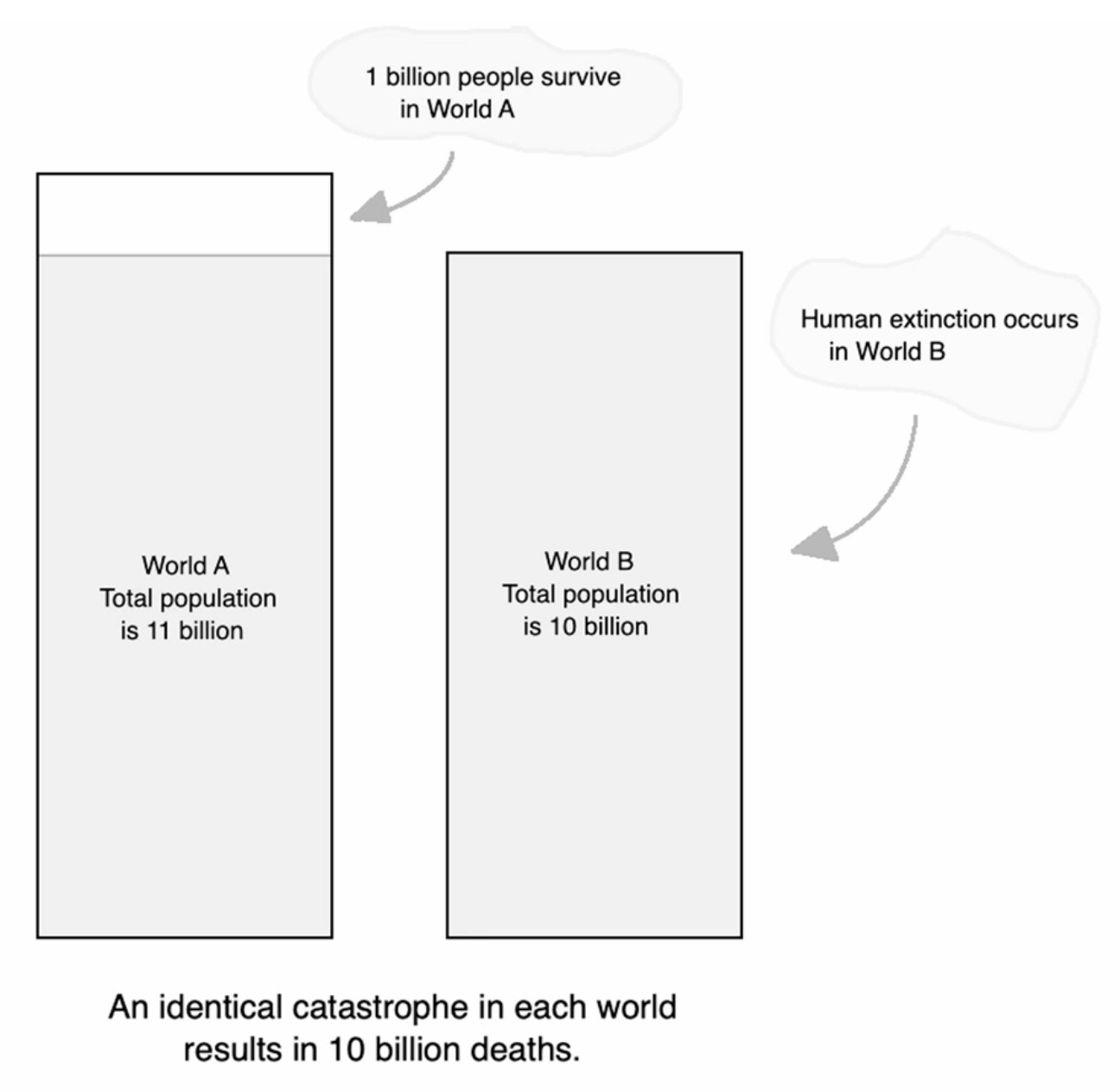
Equivalence theorists would say that there’s no moral difference between these two scenarios. Since Being Extinct is morally irrelevant (again, who’s harmed by humanity no longer existing?), the fact that World B’s catastrophe results in Being Extinct is irrelevant. The badness/wrongness of these scenarios is equivalent.
Further-loss theorists would say that the catastrophe of World B is much worse than that of World A, and hence that Joe does something far more immoral in World B than World A. At least in World A there’s a chance of realizing future value and goods.
Most traditional pro-extinctionists would say that both scenarios are very bad. But they would also say that the World B scenario is better, since it would prevent future suffering, anthropogenic environmental destruction, factory farming, etc. Whereas many further-loss theorists emphasize that the amount of positive value in the future could be enormous — quite literally astronomical — some traditional pro-extinctionists flip this on its head and argue that the amount of future suffering could be unfathomably large. That’s what makes World B better than World A — at least there’s a (bright) silver lining to the catastrophe, namely, no more human-caused and human-experienced harms.
Now consider another thought experiment, which specifically contrasts equivalence and further-loss views. Imagine a disaster that kills the entire human population over the course of 1 year:
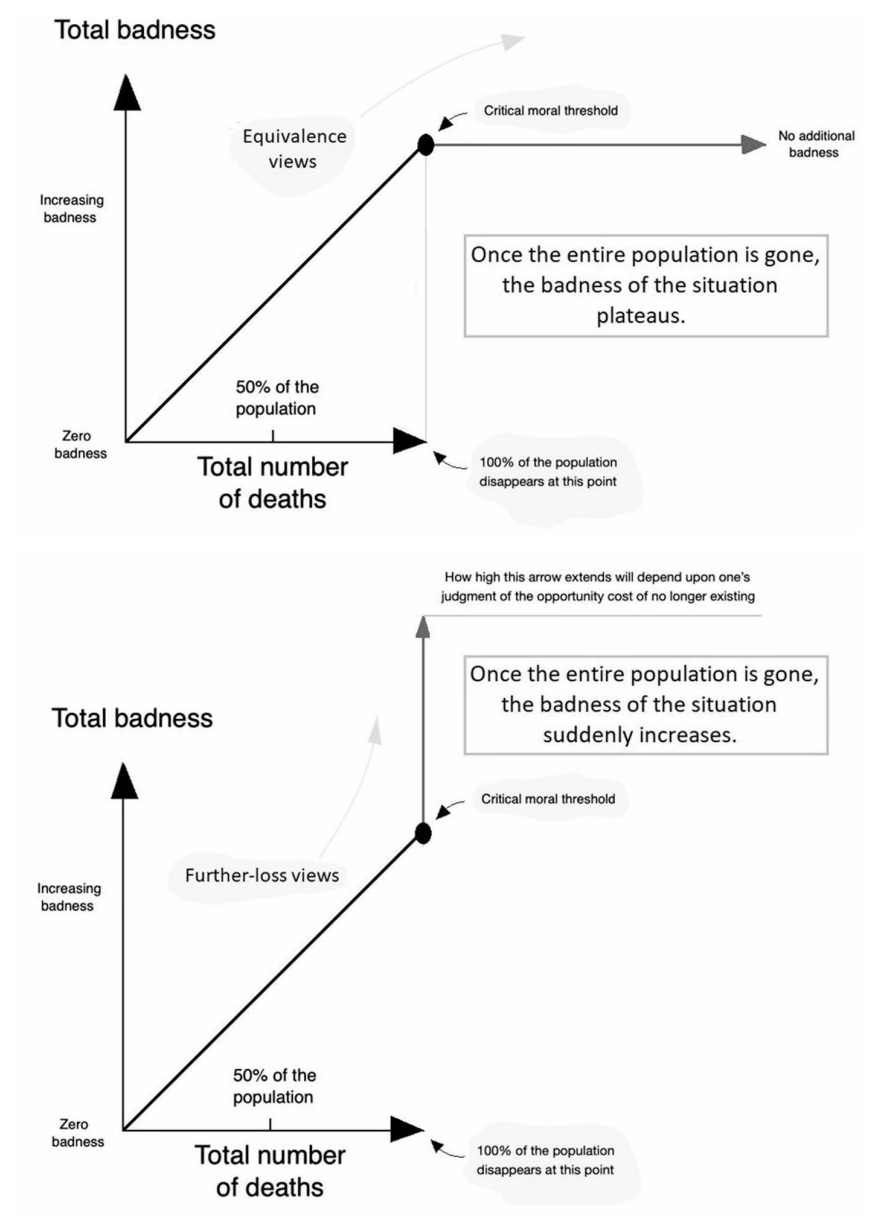
Equivalence theorists and further-loss theorists can agree that as the total number of deaths rises, the badness of the situation increases in proportion. However, they dramatically part ways at the precise moment that the entire human population dies out.
For equivalence theorists, the badness of the situation suddenly plateaus. Why? Because that’s the moment that Going Extinct transitions into Being Extinct. And since Being Extinct harms no one, there’s no additional badness. Further-loss theorists would say that, at this “crucial moral threshold,” the badness of the situation suddenly skyrockets. Why? Because as soon as Going Extinct becomes Being Extinct, all those future goods have been lost forever.
This is precisely what Derek Parfit, a further-loss theorist, was getting at with his own thought experiment, mentioned in the final pages of Reasons and Persons. He writes:
I believe that if we destroy mankind, as we now can, this outcome will be much worse than most people think. Compare three outcomes:
(1) Peace.
(2) A nuclear war that kills 99% of the world’s existing population.
(3) A nuclear war that kills 100%.
(2) would be worse than (1), and (3) would be worse than (2). Which is the greater of these two differences? Most people believe that the greater difference is between (1) and (2). I believe that the difference between (2) and (3) is very much greater.
Equivalence theorists, in contrast, would affirm that the greater difference is between (1) and (2).
Ambiguous Terms: “Human”
So far, we’ve been discussing the ethics of human extinction as if the meaning of that term is straightforward and obvious. It turns out that’s not the case. In fact, “human extinction” can be, and has been, defined in many ways.
Importantly, the way one defines the term can determine whether specific positions count as further-loss or pro-extinctionist views (!). Perhaps you can see why this matters: further-loss views strongly oppose human extinction, while pro-extinctionist views advocate it. If a position presents itself as, or is seen to be, a further-loss view but is in fact pro-extinctionist, that matters!
We begin with the term “human” or “humanity.” A Narrow Definition of this term identifies it with our biological species, Homo sapiens. This is the common-sense, intuitive definition that I believe most people employ when talking about our extinction. In contrast, many futurists, including those in the TESCREAL movement, either explicitly or implicitly adopt a Broad Definition that equates “humanity” with both our species and whatever “posthuman” successors we might have.
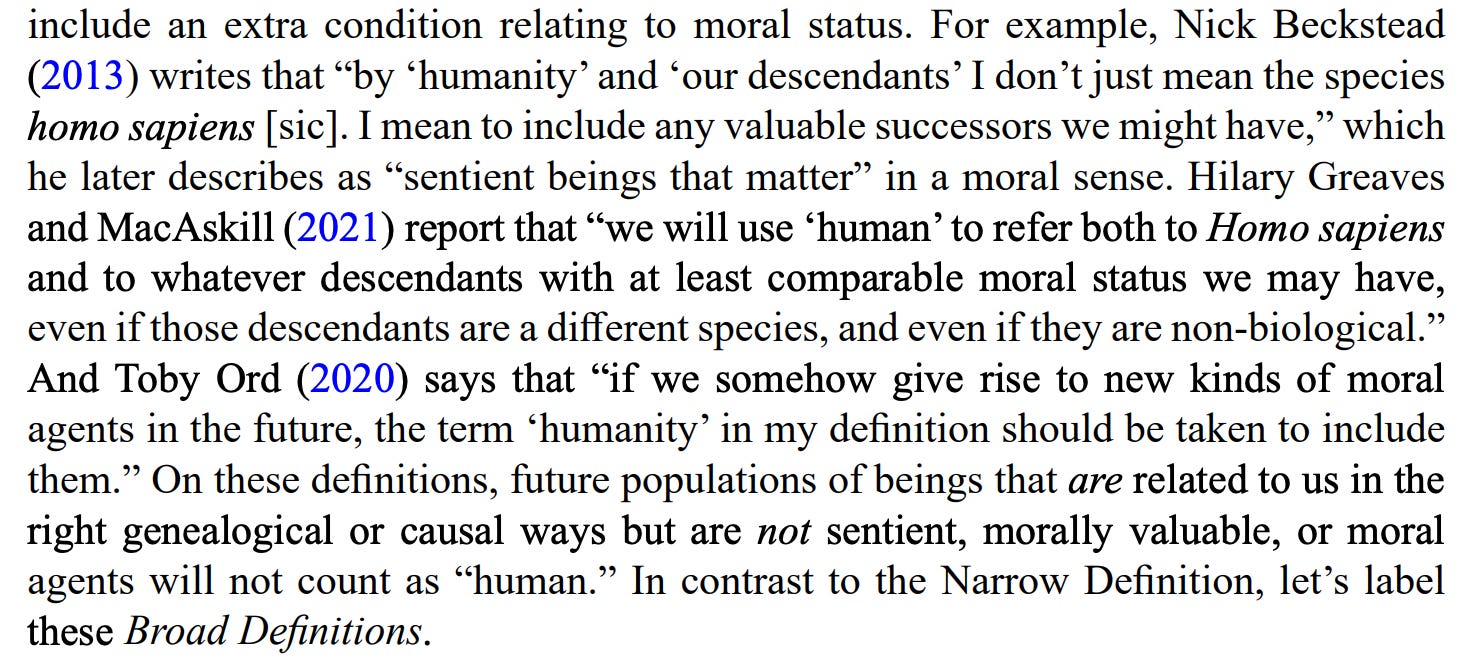
If you think this phraseology looks oxymoronic, you’re right! According to the Broad Definition, posthumans would count as human no less than current people do — so long as those posthumans have certain properties like consciousness and a comparable moral status.
In sum:
Narrow Definition: “Humanity” refers to our biological species.
Broad Definition: “Humanity” refers to our biological species and whatever descendants we might have, even if they are nonbiological in nature.
The Broad Definition leads to some startling conclusions. For example, it implies that Homo sapiens could die out next year without human extinction having happened. As long as our disappearance coincides with the rise of a new posthuman species to take our place, then human extinction will not have occurred — because those posthumans would count as “human”! Hence, “humanity” would persist.
To illustrate, consider the ethical theory of totalist utilitarianism (sometimes called “total utilitarianism”). This states that our sole moral obligation in the world is to maximize the total amount of “value” that exists across space and time. Hedonistic utilitarians take “value” to be pleasurable experiences; for our purposes, let’s adopt this hedonistic account of “value.”
The question then arises as to whether our species is necessary for there to be pleasurable experiences in the future, and the answer is: “No, because posthumans could also experience pleasure.” In fact, posthumans might be able to experience more and more intense pleasure than current humans, which suggests that posthumanity should replace humanity, according to utilitarianism.
On this view, the disappearance of our species without us having left behind posthumans to supplant us would constitute a catastrophe of literally cosmic proportions. In this sense, given the Broad Definition, totalist utilitarianism is a further-loss theory that very strongly opposes “human extinction.” But if one accepts the Narrow Definition, whereby “humanity” refers to our species, utilitarianism is actually a pro-extinctionist view, since it implies that our species should be replaced by “superior” posthumans.
The ambiguity of “human” can thus have major implications for debates about human extinction. Imagine two people: one is a totalist utilitarian (call him “Will”) and the other is me, as I think totalist utilitarianism is a terrible moral theory that ought to be cast into the fire and burned to a crisp. I personally want our species to survive into the future. I don’t want Homo sapiens to disappear. But Will is okay with Homo sapiens dying out, so long as we’re able to pass the existential baton on to some posthuman successor.
If someone were to ask both of us, “Should we avoid human extinction?,” Will and I would give the exact same answer: “Yes.” But scratch the surface and you’d find radically different interpretations of what this means! Indeed, I see Will as embracing a deeply problematic pro-extinctionist view, despite Will claiming that he strongly opposes human extinction. Our differing opinions come down to the ways we define “humanity” — Will understands it according to the idiosyncratic, uncommon Broad Definition, while I preferentially use the Narrow Definition.
It might at first look like we agree, but in reality our sides are diametrically and even violently opposed.
Ambiguous Terms: “Extinction”
The word “extinction” is also ambiguous, as it could denote a range of distinct scenarios. In my 2024 book, I count at least six types of human extinction scenarios, depending on how one defines “human.” The two most relevant to our discussion are terminal and final extinction, which specifically apply to the Narrow Definition (not the Broad Definition2). Given the Narrow Definition:
Terminal extinction: our species, Homo sapiens, ceases to exist entirely and forever.
Final extinction: our species ceases to exist entirely and forever without leaving behind any successors.
As you can see, final extinction entails terminal extinction, but not vice versa: our species could kick the bucket while also leaving behind successors to take our place.
The implications here mirror those drawn above: for utilitarians like Will, all that matters is avoiding final extinction (assuming the Narrow Definition, which people like Will usually don’t use because they tend to prefer the Broad Definition). Terminal extinction either doesn’t matter or would be positively desirable once our replacements arrive.
To be more specific, avoiding terminal extinction does matter right now, but only because we’re not yet ready to hand the baton off to our successors, as no such successors yet exist. If we were to undergo terminal extinction next week, it would contingently entail final extinction. But once posthumanity arrives, the disappearance of our species would no longer result in final extinction. Hence, avoiding terminal extinction is important only insofar as it would bring about final extinction.
In contrast to Will, I care deeply about avoiding terminal extinction. I value our species; I love our species, flawed and cruel as it can be. (In fairness, there’s no guarantee that posthumans wouldn’t be worse than us.) I personally don’t give a damn about posthumanity, especially not the sort of posthumanity that contemporary TESCREALists imagine taking over the world. Hence, I don’t care about avoiding final extinction — about ensuring that we leave behind a radically different successor species of some kind. Will and I both oppose extinction, but the types of extinction we oppose are very different.
The ambiguity of the terms “human” and “extinction” have devastated contemporary discussions about human extinction. Among the loudest voices calling for us to avoid “human extinction” are the TESCREALists. But most TESCREALists are okay with our species dying out in the near future through replacement with “superior” posthumans — e.g., human-machine cyborgs or wholly artificial intelligences (like AGI).
One might thus get the impression that TESCREALists are on the side of those fighting for the survival of our species — me and you, I presume. Yet they are not on our side. They are the enemies of our species, to put it bluntly! They want an end to the human era and the inauguration of a new posthuman era.
That’s why it’s so important to disambiguate these terms. Two people can both shout “We must avoid our extinction!” and yet hold completely different views about whether our species should survive.
The First Thing You Should Do When People Talk About Human Extinction
Where does this leave us? Let’s recap: the term “human extinction” is polysemous: it can mean many different things since both “human” and “extinction” are ambiguous. Complicating the issue, some people use “human extinction” as shorthand for Going Extinct, while others use it to mean Being Extinct.
(The distinction, by the way, between Going and Being Extinct cuts across the different definitions of “human extinction” — i.e., there’s Going terminally Extinct, Being terminally Extinct, Going finally extinct, and Being finally extinct. Hence, someone might use “human extinction” as shorthand for Being Extinct in the sense of final extinction, while someone else might use it as shorthand for Going Extinct in the sense of terminal extinction. Etc.)
When someone talks about the badness or goodness, rightness or wrongness of human extinction, they might be defining those terms differently than you, and they might be focusing specifically on Going Extinct or Being Extinct. In the case of John, he immediately thought of Being Extinct in the sense of final extinction, whereby our species dies out and leaves nothing behind. This is what he thought was good. I then directed his attention to a different aspect of extinction — Going Extinct — which he agreed we should avoid because of how much suffering it would likely cause.
So, whenever you hear someone talking about human extinction, you should immediately ask:
How are they defining the words “human” and “extinction”? What is “human extinction” to them? And are they focusing in on Going Extinct or Being Extinct? Or are they considering both at the same time as part of a more comprehensive overall assessment?
When TESCREALists say that human extinction would be extremely bad or wrong to bring about, they’re typically using “human” on the Broad Definition. However, looking carefully at their statements and writings, one often finds them slipping between the Broad and Narrow Definitions, usually without even realizing it (gah!). When they do use the Narrow Definition, what they typically mean by “extinction” is final rather than terminal extinction. And when they say that the final extinction of our species would constitute a cosmic tragedy, they’re specifically highlighting Being rather than Going Extinct, since they believe that by far the worst part about our extinction would be the loss of all future value.
In contrast, if you were to ask me about human extinction, I’d say that it would be very bad or wrong to bring about. But for me, “human” almost always refers to our species and “extinction” specifically refers to terminal extinction. Furthermore, since I’m sympathetic with equivalence views, my underlying reason for opposing the terminal extinction of our species is that Going Extinct would almost certainly inflict enormous harms on those living at the time. On my view, then, the focal point is Going rather than Being Extinct.
Recent Bad Scholarship on Human Extinction
A great example of how failing to make these distinctions can undermine scholarship comes from a just-published article in Nature titled “Lay Beliefs About the Badness, Likelihood, and Importance of Human Extinction.” I was actually a reviewer of this paper and recommended “reject” because the authors fail to define their terms — an elementary mistake that renders their results completely meaningless. Unfortunately, they chose not to heed my concerns or act on my recommendations, and Nature published the article anyway. (What was the point of asking me to spend many hours reviewing the paper — unpaid intellectual labor — if my review didn’t matter? A warning for those asked to review articles for Nature — it’s a waste of time.)
Consider the opening sentence of the article’s abstract: “Human extinction would mean the end of humanity’s achievements, culture, and future potential.”
No, it wouldn’t! But read on.
If humanity were to create or become a “value-aligned” posthuman species that supplants Homo sapiens, our civilization could continue. The projects of science, the arts, and moral progress could persist. Indeed, posthumanity could potentially elevate these endeavors to even greater heights of achievement — heights that our species could never reach.
That’s part of the appeal, among longtermists and other TESCREAL believers, of superintelligent, god-like posthumans who share our “values.” It’s why the TESCREAList Toby Ord writes that “forever preserving humanity as it is now may … squander our legacy, relinquishing a greater part of our potential” and that “rising to our full potential for flourishing would likely involve us being transformed into something beyond the humanity of today.”
If the continued survival of our biological species is not necessary for the continuation of “humanity’s achievements, culture, and future potential,” then “human extinction” would not entail the end of these things — that is, if one adopts the Narrow Definition and assumes that “extinction” means “terminal extinction.” To the contrary, the terminal extinction of our species could actually enable even greater achievements if extinction comes about through replacement with superior posthumans. Again, that’s part of the promise of posthumanity — fulfilling our “long-term potential” in the universe.
Hence, the authors must not mean “the terminal extinction of our species (Narrow Definition).” Their opening sentence only makes sense if (a) they’re adopting the Broad Definition, or (b) they’re using the Narrow Definition while defining “extinction” as final extinction.
Yet most people, including myself, will naturally, intuitively, or preferentially adopt the Narrow Definition and think of “extinction” in terms of terminal extinction. The authors — who have direct connections with longtermist organizations like the Global Priorities Institute — seem oblivious to this crucial fact, which hopelessly confounds their empirical results.
Imagine them explaining to their test subjects that the way longtermists like Toby Ord, Will MacAskill, Hilary Greaves, Nick Beckstead, Nick Bostrom, etc. define “humanity” explicitly entails that our species could go extinct next year without “human extinction” having happened. Those test subjects would likely be surprised and probably appalled.
If the authors were to explain that longtermists like Ord want to “avoid human extinction” by transforming humanity into a new species of posthumans, they would likely express a degree of consternation, and perhaps suddenly realize that what the authors’ mean by “human extinction” might not be what they mean by the term.
I read this paper in Nature with great frustration, because the errors made are so easily avoidable and yet so devastating. At one point, the authors write about the need to avoid “public misconceptions that need to be addressed,” while simultaneously contributing to public — and academic — misconceptions of human extinction. The most significant contribution of the paper, unfortunately, is to further confound and obfuscate the topic, which I consider to be of great importance right now. What a shame!
The authors also get the history of thinking about human extinction wrong. This is because they rely on Thomas Moynihan’s article “Existential risk and human extinction: An intellectual history,” which is chock-full of historically inaccurate claims.
(Moynihan’s book X-Risk: How Humanity Discovered Its Own Extinction is even worse, as it claims that Hiroshima and Nagasaki were bombed in 1943, Rachel Carson’s Silent Spring sounded the alarm about catastrophic climate change, Marquis de Sade and Arthur Schopenhauer advocated omnicide, and that our contemporary notion of human extinction dates to the Enlightenment rather than the 19th century. All of these claims are factually incorrect.3 See this article for further details about how nearly every page of the book contains factual errors. If people want a reliable and accurate account of the history of the idea of human extinction, see my 2024 book.)
For example, the authors write:
Setting aside longstanding religious traditions of apocalyptic thought — many of which describe catastrophic but temporary upheavals rather than the permanent end of humankind — the secular notion of human extinction is surprisingly recent. Only in the Enlightenment, with the development of fields such as geoscience, demography, and probabilism, thinkers started recognizing and assessing the possibility that the human species could end and whether that would be desirable or not.
This is misleading at best. There were some during the Enlightenment, such as Diderot, who talked about human extinction. But the type of human extinction they were referring to was no different than the type of human extinction discussed by Presocratic philosophers like Xenophanes and Empedocles, as well as the ancient atomists and Stoics! (See footnote 4 below.) For Diderot, we might disappear in the future, but we will necessarily re-emerge. This is because he accepted a kind of “temporalized” version of the Great Chain of Being.
I call this conception of extinction “demographic extinction,” in contrast to terminal and final extinction. Demographic extinction says nothing about our disappearance being permanent, and this conception of extinction dates back to ancient Greece. It wasn’t until the 1800s that, for the first time in the Western tradition, people started to talk about terminal and final extinction.4 Gah!
Furthermore, there was virtually no serious discussion of whether demographic (or any other kind of) extinction “would be desirable or not” during the Enlightenment. False! It wasn’t until the second half of the 19th century that people started to address the ethics of our extinction. Examples include Henry Sidgwick, Eduard von Hartmann, and Philipp Mainländer, all of whom I discuss in detail in Part II of my book. Gah!!
What a missed opportunity for the authors of this Nature paper to have contributed something worthwhile to the literature. I know literally nothing more about the public’s views about the ethics of human extinction after having read it, because the authors conspicuously fail to do the most basic thing required for good scholarship: define their terms.
Conclusion
I hope you found this tour through the maze of human extinction ethics to be in some way illuminating. Let me know if you have any additional questions! As always:
Thanks for reading and I’ll see you on the other side!
There are notable exceptions, though, such as the Gaia Liberation Front and the Efilists. Both advocate for someone or some group of people to unilaterally end the human project. They are pro-omnicide, a minority view among traditional pro-extinctionists.
They don’t apply to the Broad Definition because there’s no way for “humanity” to die out while also leaving behind successors. Why? Because those successors would also count as “human.” Hence, the distinction between terminal and final extinction collapses on the Broad Definition: the terminal extinction of humanity, on the Broad Definition, just is final extinction.
Moynihan also misunderstands talk from Immanuel Kant and others about the annihilation of our planet not being bad. In fact, these discussants accepted a “plurality of worlds” model according to which the annihilation of our species would constitute what biologists call extirpation rather than extinction, as humans would continue to exist elsewhere in the cosmos.
A very brief history of thinking about human extinction:
Our contemporary notion of human extinction is historically new. To be more precise, there was a version of this idea discussed by ancient Greek philosophers: Xenophanes, Empedocles, as well as the atomists and Stoics. On their accounts, though, our species will someday disappear entirely but not forever. After going “extinct,” we will inevitably reemerge at some later point.
Xenophanes, for example, argued that the universe cycles through different phases, one of which necessarily entails our disappearance. Nonetheless, we will always reappear in the next cycle — such is the fundamental nature of our cyclical cosmos. In this way, these ancient philosophers combined the idea of human extinction with the seemingly incompatible idea that we are also indestructible.
It wasn’t until the 1800s that a more robust notion of human extinction emerged for the first time in Western history, whereby humanity disappears entirely and forever. Lord Byron’s poem “Darkness” and Mary Shelley’s 1826 book The Last Man appeared to explore this new conception of extinction.
With the subsequent rise of what I call “deep-future thinking” — helped along by Darwin’s theory of evolution and novel scientific studies of the future of our planet, solar system, and the universe itself [1] — even more conceptions of our extinction sprung up. These were shaped by new speculations about what might come after us, and how these successors might carry on our civilization and/or the things that we value.
Although some notable figures entertained the idea of terminal/final extinction beginning in the 1800s, it wasn’t until the 1950s that many people began to discuss the possibility of our disappearance. As I discuss in a Los Angeles Review of Books article, this was due to the discovery (and creation) of a flurry of new kill mechanisms, i.e., ways of going extinct.
In 1954, scientists realized that global fallout from a thermonuclear war could potentially end the human species by peppering Earth’s surface with radioactive particles. (Interestingly, almost no one talked about nuclear annihilation between 1945 and 1954; after the 1954 Castle Bravo debacle, a large number of people suddenly took the idea seriously.)
The early 1980s then witnessed the nuclear winter hypothesis being proposed by Carl Sagan and others, and by 1991 the scientific community agreed for the first time that asteroids, comets, and volcanic supereruptions could trigger global-scale catastrophes. (From 1830/1850 until the early 1990s, the Earth sciences was dominated by a paradigm called “uniformitarianism.” This denies that natural catastrophes can ever be global in scale, and that mass extinction events are artifacts of an incomplete fossil record.)
By the early 2000s, another consensus emerged: that climate change is real and anthropogenic, with potentially devastating consequences for humanity. Since the release of ChatGPT in late 2022, anxieties about a “misaligned” superintelligence annihilating humanity have exploded, largely eclipsing other existential threats.
Never before in human history has the idea of human extinction been more discussed, debated, and fretted over than right now. This is an extraordinary fact. People of course expected the world’s end for millennia — going back at least to Zoroastrianism, which may have codified the first linear conception of time as having definitive starting and ending points. (Most prior eschatological narratives were circular — think: the Ouroboros, or Buddhism’s notion of endless cosmic cycles, not that dissimilar to Xenophanes’ cosmic model.)
Within what we could call the Zoroastrian-Abrahamic eschatological tradition, the end of the world marks a wondrous new beginning: eternal life for believers in heaven. What lies on the other side of the apocalypse is paradise. Not so for human extinction on a naturalistic conception. You might think of this, very roughly, as the difference between termination and transformation.
[1] I am referring here to the discovery of the second law of thermodynamics in the early 1850s, which immediately led physicists to speculate about the long-term future (and livability) of our planet. In 1969, the field of physical eschatology was founded by Martin Rees. It offered a more rigorous account of the future of not just our planet and solar system, but the universe as a whole. The most popular view at the moment is that the universe will eventually sink into a state of thermodynamic equilibrium — the dreaded “heat death.”’
The lack of definitions and polysemous terms makes me think about how we use terms like "artificial intelligence." In general, I think a lot of arguments are unproductive when the definitions of what we're arguing over aren't the same.
Caring about "terminal extinction" seem to be contradictory with having an equivalence view. How is one supposed to graph the badness of the situation in proportion of the fraction of humanity that voluntarily exercise their morphological freedom to become 'posthumans'?