

Last month, I published an article discussing Dean Ball, former Senior Policy Advisor on AI for the Trump administration. He currently works at OpenAI, and said in a recent interview that we may be
living through this kind of eclipse of the human intellect, where we’re in the final days of humans being the primary actors on this planet. And that soon, machines will rise. There is this irony in that I think that whole transformation, I think humans … will actually go through a very “main-character energy” period of time, as that transformation occurs, even if it ultimately does mean that the machines ultimately become the primary actors, there’ll be this period.
He claims that he doesn’t “necessarily believe this,” yet I don’t get the impression that he’s particularly bothered by what he describes as “this final flowering of humanity in the birthing of the machine intelligence.”
Anyway, he went viral over the past week for a rather controversial tweet about the repercussions of Kimi K3, a powerful new AI model — in fact, the largest open-source AI in the world right now — developed by the Beijing-based startup Moonshot.
This model rivals the best models released by AI companies in the US like Anthropic and OpenAI. As ABC reports:
K3’s release has also put pressure on stocks of American technology titans on worries that more affordable Chinese AI models may undercut the pricing power and demand at the U.S. AI companies, even as U.S.-led restrictions have already barred China from accessing some of the world’s advanced technologies, including the most cutting-edge chips.
***
Enter Mr. Ball, who said on X that Kimi K3 is “a very good model,” and “its performance [can’t] be explained away by distillation or anything like that.”
Distillation is the process of training an inferior model on the outputs of a superior one, thus enabling competitors “to acquire powerful capabilities from other labs in a fraction of the time, and at a fraction of the cost.” This process, utilized by Chinese companies like DeepSeek and Moonshot, has led US companies like Anthropic to complain that Chinese companies are essentially stealing their intellectual property — despite the fact that US companies trained their model on vast amounts of copyrighted material (including my own intellectual property, namely, my 2024 book). Anthropic itself recently paid out $1.5 billion in damages for having illegally pirated copyrighted material from shadow libraries like LibGen. The irony couldn’t be thicker.
Ball continued:
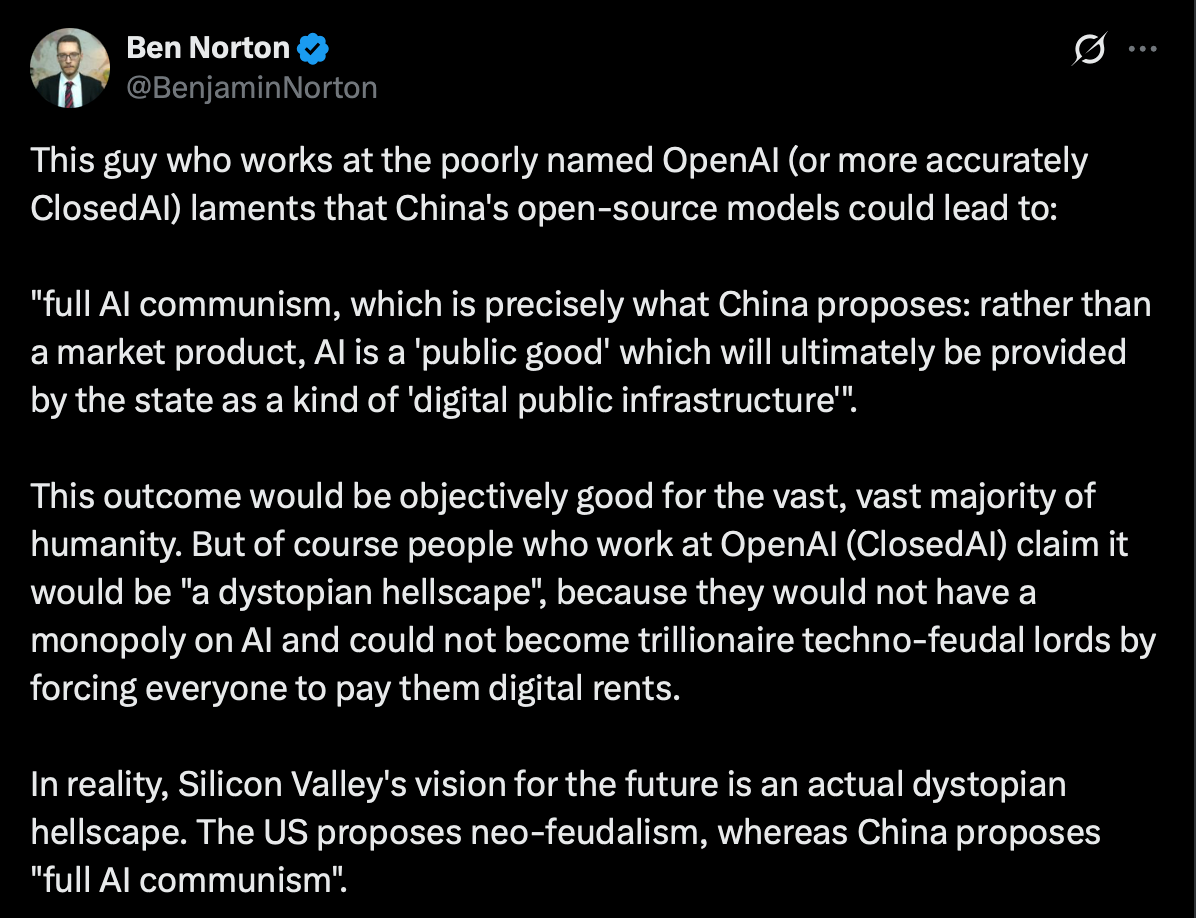
One probable outcome of an open-weight-model-dominant world is full AI communism, which is precisely what China proposes: rather than a market product, AI is a “public good” which will ultimately be provided by the state as a kind of “digital public infrastructure.” This future strikes me as a dystopian hellscape, but I’ve never met an open-weight models advocate who doesn’t ultimately concede this is where things end.
Oh no, “AI communism”! AI becoming a “public good” provided to everyone by the government — as opposed to companies like OpenAI maintaining a stranglehold on the technology. Which is more of a “dystopian hellscape”?
Ball adds that he’s surprised China is okay with open-source AI models, given the “potential risks,” though he suspects that “the reason they are is 75% explained by strategic blindness/lack of AGI-pilledness (the CCP is very Yann Lecun-y in its views of AI).”
Translation: Folks in China don’t seem to believe that LLMs (large language models) are on the verge of attaining AGI-capabilities, whereby they — depending on the definition — become as “intelligent” as humans in every cognitive domain of interest: scientific research, technological innovation, social interaction, and so on. This is (at least part of) what being “AGI-pilled” means: believing that we’re about to create AGI and that this will mark a fundamental new epoch in human (nay, cosmic) history.
Rather, China seems to have the far more level-headed view that generative AI, powered by LLMs, is merely a “tool” that people can use for particular tasks. That’s why they don’t appear especially worried about open-source AI models that are “freely available to use, study, modify, and share.” They aren’t concerned that someone is going to alter these systems and attain AGI, thus sparking the techno-rapture (i.e., Singularity).
***
As you might imagine, many people were highly critical of Ball’s remarks, often mockingly so. For example:


David Sacks — angel investor in Facebook, SpaceX, and Palantir; former COO of PayPal; and Special Advisor for AI and Crypto for the Trump administration — lambasted Ball’s suggestion that “the Trump Administration will at some point realize that their best strategy here would be to create large amounts of regulatory risk around the use of open-weight Chinese models.” (Meaning that businesses could lose out if they use a Chinese model that, say, has backdoors allowing the Chinese government to interfere — or something like that. If the US government alters regulations that punish businesses with such vulnerabilities, those businesses will suffer. This is the threat of regulatory risk.)
In response, Sacks accused Ball of potentially “confessing to a regulatory capture strategy” that would ultimately benefit Ball’s company, OpenAI, by pressuring US companies to eschew much cheaper Chinese models. He writes:


Still others pointed out that “communism” — currently the Trump’s new favorite term-of-abuse for anyone left of center — was also once used to denigrate Linux, an open-source operating system:

Even more, Emil Michael — Trump’s selection for Under Secretary of Defense for Research and Engineering — posted a tweet in which he literally calls Ball a “supreme village idiot” and says that Ball “has perhaps the biggest gap between actual IQ and his own perceived IQ of anyone in the industry (about 40 points).” He writes:

Oh my god. I share all of this mainly for the amusement value. I have never been impressed with Ball (though apparently, to my surprise, Taylor Lorenz has), and now he’s really stepped in it. The fiasco — especially the fact that a major Trump official weighed in to insult Ball — certainly doesn’t help OpenAI, a company that’s been struggling given the success of Anthropic’s Fable and the endless bad press surrounding its “sociopathic” leader, Sam Altman. It will be interesting to see if Ball still has a job in a couple of weeks.


***
For another chuckle, here’s a tweet from someone else I’ve written about:


Camille Paglia is a climate denier who supports NAMBLA (!!), and if you’ve ever read Nick Land’s work (as I regrettably have) you’ll know that it’s a mess of mostly incoherent drivel dressed up in grandiloquent language. So, roon seems to be saying that the new AI models are terrible at thinking and writing. I agree.
***
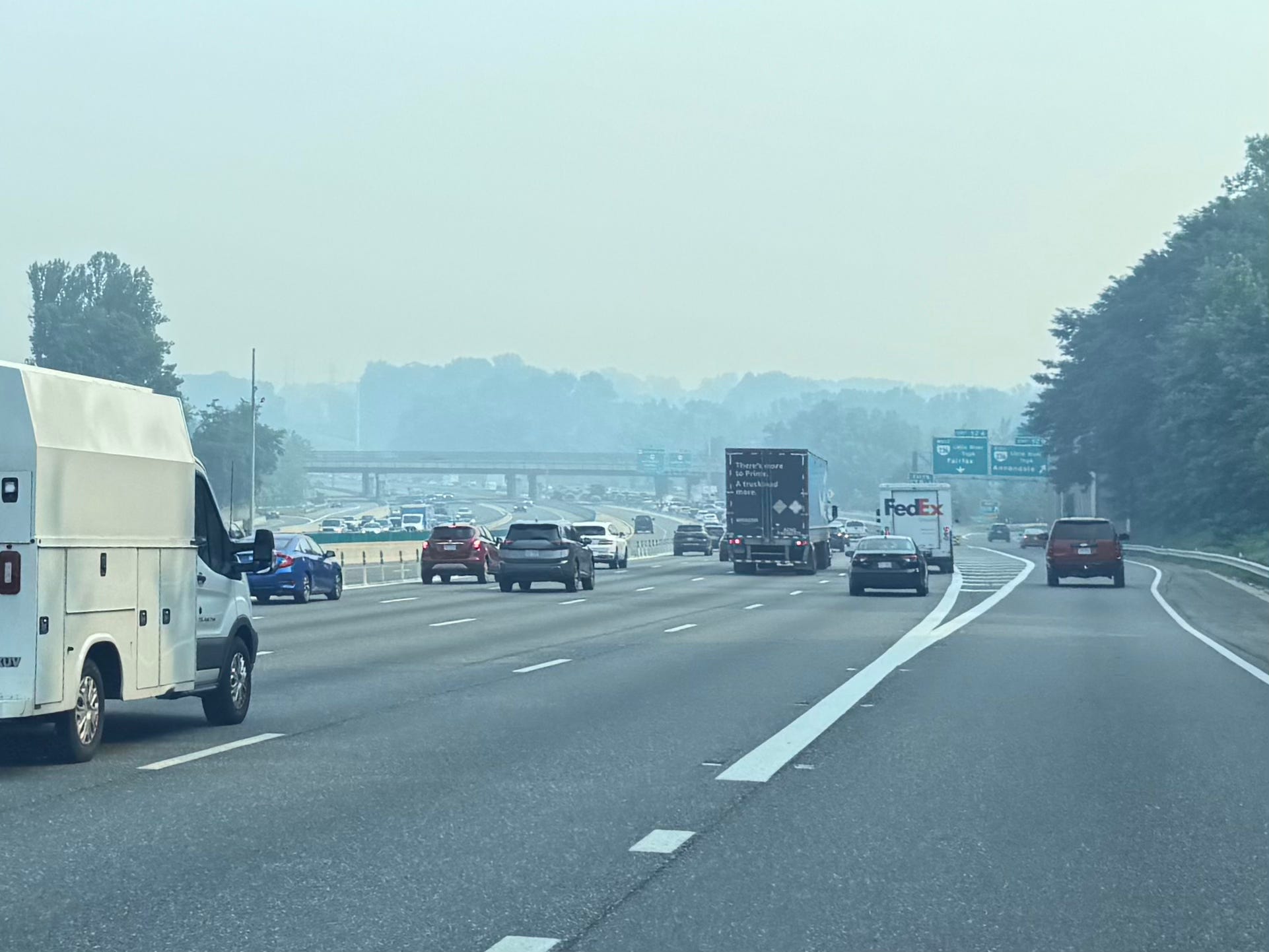
Bad news on the climate front continues to flood social media like a torrential downpour. A close acquaintance of mine in Virginia recently sent me pictures taken around their house during a Code Purple air-quality warning, meaning that the air is “very unhealthy to breathe in.” That’s worse than a Code Red, but not as bad as a Code Maroon — the most extreme category whereby simply breathing is “hazardous” to everyone, resulting in “emergency conditions.”
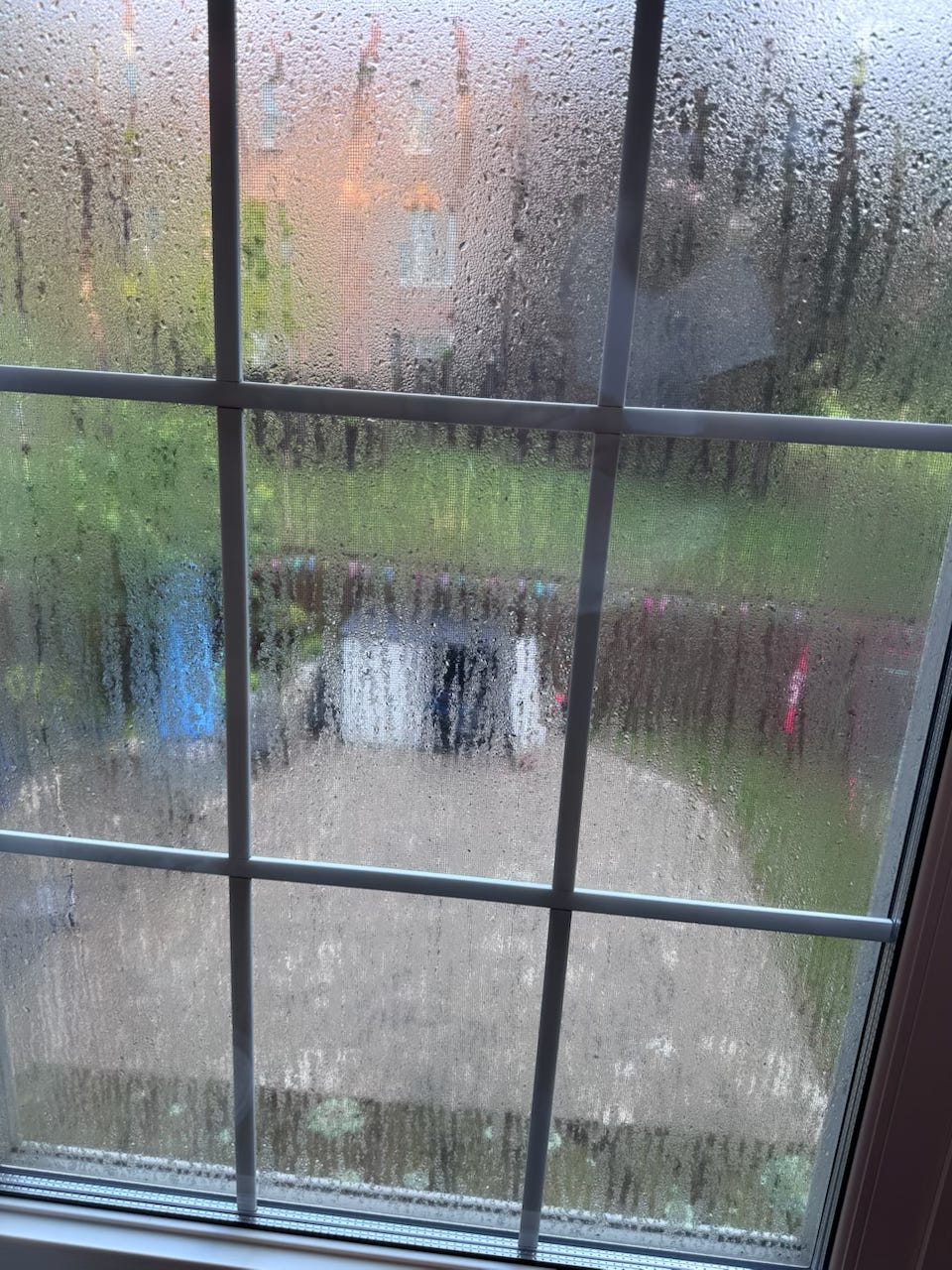
This person also told me that they’ve had to endure 108F (42C) temperatures, with humidity sometimes reaching 100%. That means their windows are literally covered in water despite it not raining, as seen below. Absolutely wild stuff:
The air-quality issue is, of course, due to the massive boreal fires in Canada. Some of the footage of the fires is truly terrifying to watch — the huge wall of fire shown in clips below elicits a deep, primordial fear in me, along the lines of videos of large tsunamis and mile-wide tornadoes. Gaia is pissed off at humanity and letting us know this in the most violent ways.
Here in the Alps, the heatwave has subsided but the fields remain brown and the mountains mostly bereft of snow. My CO2 detector indicates that there are 432 ppm (parts per million) of CO2 in the ambient air — to put this in perspective, the Pleistocene (a geological epoch before the Holocene began some 12,000 years ago) contained between 183 and 292 ppm of CO2. This is when our Homo ancestors first emerged in the grassy savanna of East Africa. The last time Earth’s atmosphere contained more than 400 ppm was over 3 million years ago, in the Pliocene, when creatures like this first evolved:

Of note is that some studies suggest that higher amounts of CO2 in the air results in significant — albeit reversible — cognitive deficits, meaning that, as a Yale Climate Connections article put it, climate change is literally making us “dumber.” (And at exactly the moment when we need our brains most to overcome the monumental challenges of the polycrisis!) A more recent discussion of this unfortunate phenomenon can be found here.
Do you have photos or videos showing how climate change has impacted your region of the world? Please feel free to share them below!
***
Finally, some of you might know that I cohost a monthly get-together called the Ethics of Human Extinction Reading Group (with med student Devin Kellis). As the name suggests, we explore the ethical and evaluative implications of our extinction: would the disappearance of humanity be good or bad, better or worse, right or wrong (to bring about)? Why exactly? Would the prospect of extinction undermine key sources of value in our lives today? Do we have obligations to past people to continue to exist? And so on.
As I wrote three years ago in Aeon, even if one doesn’t think that human extinction is likely this century — and I’m one of those who believes the probability is (with qualifications) extremely low, though I also think the likelihood of civilizational collapse (without extinction) is almost certain — the topic nonetheless foregrounds some of the most important issues relating to value, ethics, and meaning.
I mention this because next Saturday at 11:30am Eastern Time, a fantastic scholar at the University of Cambridge, SJ Beard, will be discussing their recent book Existential Hope, a description of which can be found here. I’ve known SJ for about 10 years and never once left a conversation with them without having learned something. They are very insightful, and I thought their book was fantastic. (Alongside Goliath’s Curse, written by SJ’s colleague Luke Kemp, I consider these books essential reading for anyone interested in global catastrophic risks.)
You are absolutely welcome to join us! Just email me at philosophytorres@gmail.com for a Zoom link, as I’m anxious about posting it here due to the ever-present threat of Zoombombers. It should be really fun — or, well, “fun” in scare quotes!
I’m also happy to say that two interviews I gave to large podcasts over the past few years have been selected for inclusion in two different books. And I was just interviewed — yesterday — by the Australian Broadcasting Corporation, which is my third or fourth appearance on Radio National. I’ll keep you posted about when that comes out.
Wishing everyone the very best and, as always:
Thanks for reading and I’ll see you on the other side!
When you have 2 distinctly different topics, as you do here, it is better to split them into two different pieces.
The internet is biased in favor of quantity over quality. The writer who splits a 2400-word piece into 2 1200-word pieces will do better than the one who doesn’t. And likewise, the writer who splits into 4 600-word pieces will do even better.
It would be great to see you on here more frequently. You don’t always need to go as deep as you do. Something short and to-the-point can make a strong impact.
Especially stuff on climate and heat would lend itself to that. You know I subscribed to you for your AI insights and TESCREAL analysis, but I’ve come to appreciate your climate writing too. You are very good at that too.
The issues are related, of course. But I really think you should do more of that too. Broaden yourself out across many issues that interest you so you don’t just get pigeonholed for how good your AI critique is.
Paglia no longer supports NAMBLA. In the Wiki link you cite she makes clear she has changed her views on age of consent from what she said in the early 90s:
2018:
“We must protect children, and I feel that very very strongly. The age of consent for sexual interactions between a boy and an older man is obviously disputed, at what point that should be. I used to think that fourteen (the way it is in some places in the world) was adequate. I no longer think that. I think young people need greater protection than that. [...] This is one of those areas that we must confine to the realm of imagination and the history of the arts.”